The infamous particles – doch, noch, schon, eben and plenty more of these short little words that Germans throw in all the time but that are hard to translate.
Summary
"ja" is the German word for "yes". But it's used for a lot more than that. Today, we'll find out how native speakers use "ja" and what they express with it.
Vocabulary
ja

Summary
Germans use "halt" a lot as a sort of "verbal shrug". But it's also increasingly popular as a premature "excuse" for what they're saying - read more today.

Summary
Most of you know that 'etwas' means 'something'. But German also has 'etwa' ohne 's' and it's actually kind of common. Today, we'll learn what it means.
Vocabulary
etwa, in etwa, etwaig

Summary
We'll explore how "eben" and "gerade" are used in context of time and as these weird particles that seem to appear anywhere. Featuring: a really scary cat.
Vocabulary
eben, gerade, eben gerade, gerade eben
Summary
"eben" and "gerade" are brothers in spirit. One is about "flat", the other about "straight" and Germans use both of them in the context of time. But why? And how?

Summary
Dictionaries say "eigentlich" is "actually". But they're not a great match because "eigentlich" has a completely different vibe and most learners use it wrong.
Vocabulary
eigentlich, uneigentlich

Summary
"nämlich" looks like namely, but that's not really a fit. "nämlich" is actually hard to translate but easy to understand. And today, we'll do just that.
Vocabulary
nämlich, namely
Summary
"allerdings" can express agreement. And it can express a contrast. How does that make sense? Well, that's what we'll learn in this episode.

Summary
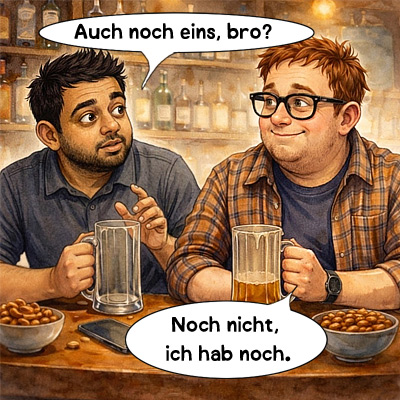
"noch" can mean "still", "yet", "else" and a few other things. But why? Today, we'll find out and see how to use phrases like "noch mal" or "noch nicht".
Vocabulary
noch, jetzt, noch nie, noch mal, noch eins, immer noch, nur noch, was noch
Summary
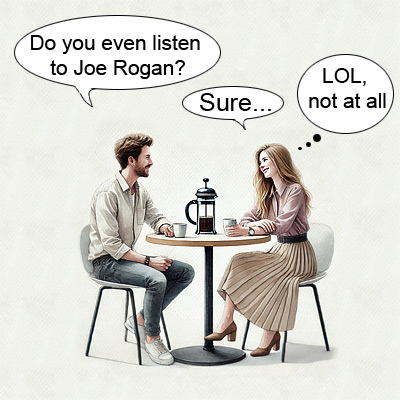
"überhaupt" is the main German option for "at all" and it works in questions, statements and with negations. Today, we'll learn why, and how to use it properly.
Summary
"sogar" means "even". But why? Today, we'll learn about the meaning of "gar" and "sogar" and we'll see what those have to do with pasta :)
Vocabulary
gar, sogar, gar nichts, garen

Summary
A thorough look at the German "so", its various idiomatic uses in everyday German and the differences to English "so". With lots of audio examples.
Vocabulary
so, also, so so, so lala, geht so, sowieso, achso

Summary
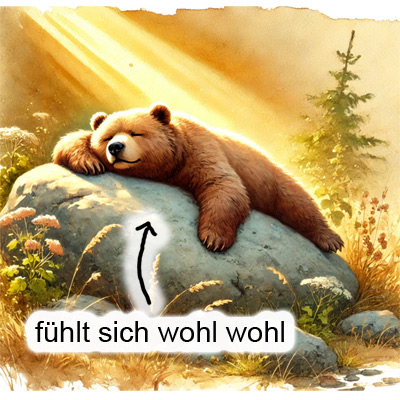
The German "wohl" can mean "well". But it has some other uses in daily life that are absolutely not intuitive. Today, we'll find out more.
Vocabulary
wohl, wohlhabend, obwohl, wohl wahr, sehr wohl, wohl kaum, wer wohl, zum Wohl
Summary
A fun look at the meaning of "sonst". We'll see how to use it in conversation and explore related words like "ansonsten", "sonstige" or "umsonst".
Vocabulary
sonst, ansonsten, sonstige, umsonst, sonstewo

Summary
One meaning of "mal" is "once", but in daily life, Germans use it more like a spice that makes their sentence more casual. Today, we'll explore all about that.
Vocabulary
mal, noch mal, nicht mal, erstmal, gerade mal, schon mal
Summary
The first part of our look at the meaning of "mal". Here, we focus on where "mal" comes from and on its more "conventional" meanings.

Summary
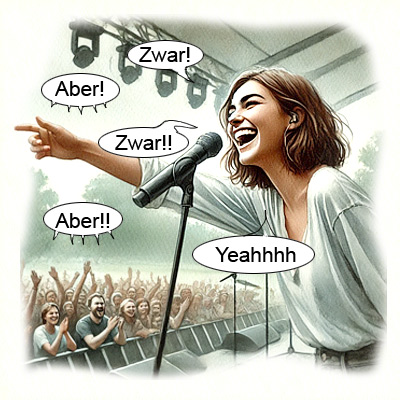
"zwar" hard to translate but its essence is not hard to understand: it sets up a "but". Today, we'll learn how to use it and also check out "und zwar".
Summary
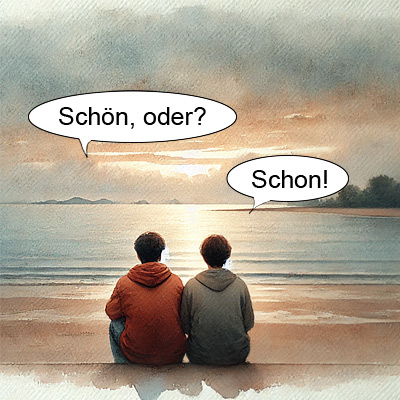
"schon" is the German translation for "already" but it's actually broader than that. And it's also a particle that's kind of the direct opposite of "nicht".
Vocabulary
schon, schon wieder, schon mal
Summary
"halt" comes from "halten", but in daily life, Germans use it as a coloring particle to express "a verbal shrug". Or a shield against criticism.

Summary
A fun look at the meaning of 'denn', the difference between 'denn' and 'weil' and the real reason why Germans love adding 'denn' to questions.

Summary
"doch" has three core functions - reverting a "no", toning down commands and most importantly: seeking affirmation. That's the one most of you are looking for.


