**LEO Dictionary is currently down, so it's not just you. They're also insolvent, so .. uh... try my dictionary, I guess. **
← Vocabulary

False Friends

In this series, we explore common and not so common false friends between German and English. We’ll learn what they mean, how to properly translate them and we’ll explore WHY the words look the same but don’t mean the same.
Your progress in this section:

Join to start tracking.

Login Sign Up
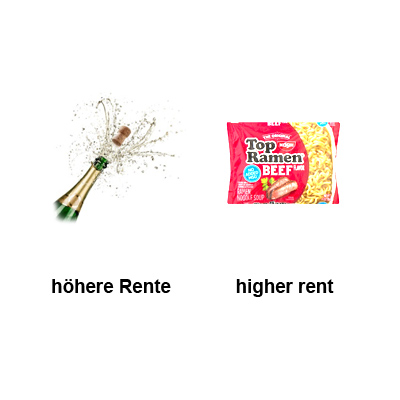
rent vs die Rente - False Friends Explained

"rent" and "die Rente" - both are related and both are about money. But they're not the same. Today, we'll find out why, and how to translate each of them.

die Rente, Rentner, Waisenrente, Labradorente, die Miete, mieten, vermieten, Mieter, Untermieter

Read article →
Bekommen vs Become - False Friends Explained

German bekommen and English to become look the samee but they don't mean the same at all. Today, we'll find out why and how surprisingly close they actually are.

bekommen

Read article →
"Fabrik vs. fabric" - False Friends Explained -

A fun look at why fabric and die Fabrik are false friends and how to translate them. We'll also talk about der Stoff, and learn some word history.

die Fabrik, der Stoff, Sauerstoff, Wasserstoff, Rohstoff, Ballaststoff

Read article →
Word of the Day - "arm"

"arm" in English is a body part and a weapon. "Arm" in German is a body part and poor. Today, we'll find out all about these weird double meanings

der Arm, umarmen, langärmlig, arm, ärmlich, die Armut, verarmen, die Waffe, bewaffnet

Read article →
German 'bald' vs English 'bald' - False Friends Explained

English "bald" is about no hair, German "bald" means "soon". What could possibly be the connection there? Or is there one at all? Today, we'll find out.

bald, kahl, glatt, die Glatze

Read article →
'spenden' vs 'to spend' - False Friends Explained

German 'spenden' and English 'to spend' are classic false friends. Today, we'll learn what 'spenden' means, and how to say 'to spend' in various context.

spenden, die Spende, spendieren, die Speise, die Spesen, ausgeben, verbringen

Read article →
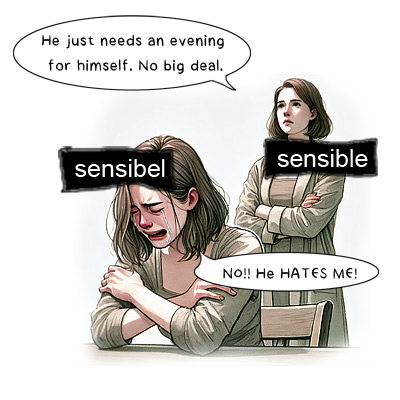
"sensibel vs sensible" - False Friends Explained

The English "sensible" and the German "sensibel" look REALLY similar - but they don't mean the same thing. Today, we'll find out why and how to translate them.

sensibel, vernünftig, empfindlich, Empfindlichkeit, merklich, fühlbar, spürbar

Read article →
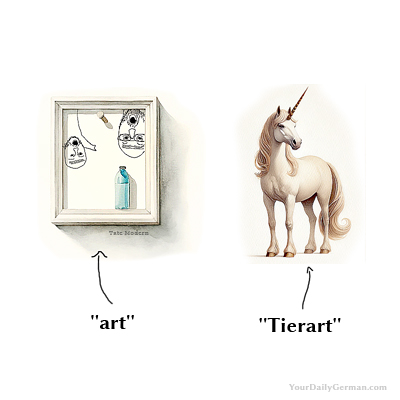
English 'art' vs German 'Art' - False Friends Explained

A fun look at the meaning of the German words "die Art" and "die Kunst" and why only the second one actually means art.

die Art, die Tonart, die Tierart, artgerecht, artig, eigenartig, die Kunst, künstlich, der Künstler

Read article →
Craft vs Kraft - False Friends Explained

We'll take a look at the false friends "craft" and "Kraft" and how they got so confusing. And we'll explore the family of "Kraft" a bit and learn cool new words.

die Kraft, kräftig, die Stärke, die Schwerkraft, KFZ

Read article →
False Friends Explained - "irritieren vs. irritate"

'irritate' and 'irritieren' do NOT mean the same and mixing them up can actually be really awkward. Today, we'll find out what they each mean.

Read article →
German-English False Friends - Two Examples

We'll talk about the pair 'eventuell - eventually' and the pair 'prägnant - pregnant' and see what happened and how to actually translate them.

eventuell, prägnant, vielleicht, schwanger, die Schwangerschaft, die Prägnanz

Read article →
Subscribe for free


My German Learning Newsletter

Once a week (or so).

We don’t spam! Read our privacy policy for more info.