Hello German Learners,
And welcome back to the series on German particles. Today, with a thorough look at the meaning and use of
schon
The “normal” translation of schon is already, but it’s actually not a perfect match and many German native speakers use already wrongly.
But more importantly, schon is one of those infamous particles that Germans pepper their speech with. You know, like doch and eben and mal.
As usual with particles, many sources you can find online will list a whole bunch of potential meanings for schon, or they’ll just say it “adds emphasis”.
Neither approaches is true.
The particle schon does have a somewhat clear core function.
Today, we’ll explore all about that and we’ll also talk about schon as already and how it goes beyond that. Of course, as usual, with loads of examples and the occasion stupid joke.
So if you’re ready, let’s fart right in. I mean dive…
And we’ll start with a quick look at where schon actually comes from.
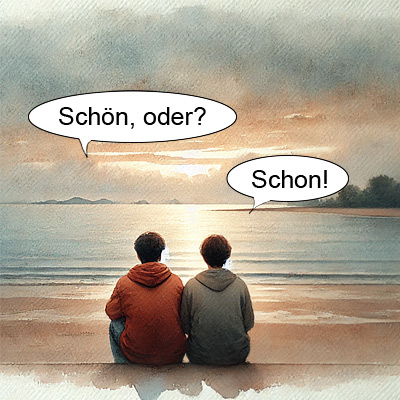
The origin of “schon” and “schön”
Many of you probably noticed that there is another word that looks quite similar to schon.
I’m of course talking about schön, which means nice, beautiful or pretty.
And indeed the two words are related.
Schon and schön go back to the disgustingly ancient Indo-European root *(s)keu-. The core idea of this root was something like observing attentively, perceiving. English offspring of that root are for instance caution, kudos and to show and I think we can sort of see the core theme of observing in all of them.
And it’s also in the word schön. Basically, schön (beautiful) is one sort of quality that “makes you look”.
What about schon though?
Well, the original idea of schon was also simply nice, beautiful(ly), so it was kind of a synonym for schön. But over time, schon slowly shifted toward a sense of satisfying(ly) and from there it took a turn toward the idea of completely.
And from there, it’s just a small step to the idea of already.
Now you might be like “Wait, I’m confused. How is it just a small step from completely to already?”
Well, just take a look at the word already. It’s literally a compressed version of “all (is) ready”. Or in other words complete.
In a way, the difference between already and all ready is only that already shifted focus to time instead of completion.
“Pizza is ready.”
“Oh, already?! Nice.”
“Pizza ist fertig?”
“Oh, schon? Schön!”
The German schon basically evolved from expressing satisfaction about completion toward the aspect of “time”, the same way that already move from completion to “time”.
If you’re now like “Hmm, not sure what to do with this info.” no worries. Feel free to forget it immediately.
I just like to include it because understanding why something means what it it means can help remember the meaning. But it’s okay if it doesn’t.
Either way, it’s time to look at schon in practice.
“schon” as “already” and beyond
Let’s look at some examples.
- Ich habe schon gegessen.
- I already ate.
- Ich wollte gestern Abend noch einkaufen gehen, aber der Supermarkt war schon zu.
- I wanted to do groceries last night, but the supermarket was already closed.
- Practice pronunciation – click once to start recording and again to stop
- Marie’s son is only 10 months old and can already talk.
- Maries Sohn ist erst 10 Monate alt und kann schon sprechen.
- Practice pronunciation – click once to start recording and again to stop
- When the waitress came, I had been waiting already for almost an hour.
- Als die Kellnerin kam, hatte ich schon fast eine Stunde gewartet.
- Practice pronunciation – click once to start recording and again to stop
- “Are you already leaving?”
“Yes, it is already midnight and I have to get up early tomorrow.” - “Gehst du schon?”
“Ja, es ist schon Mitternacht und ich muss morgen früh raus.
Now, so far this is pretty straight forward, but there are a couple of pretty important differences between schon and already.
The first one is when there’s a negative involved. The most common way to say that in English is not yet, but on some occasions not already might work as well. In German, nicht schon NEVER works and schon nicht rarely does.
The proper phrasings is noch nicht.
- If you haven’t already seen the movie, go see it!
- Wenn ihr den Film noch nicht gesehen habt, dann guckt ihn euch an!
- Practice pronunciation – click once to start recording and again to stop
The second difference is that schon is a little bit more broad than already.
Here’s an example…
- Ich habe vergessen, meinem Chef zu sagen, dass das Meeting morgen schon um 5 anfängt.
- I forgot to tell my boss that the meaning will start
alreadyearlier than expected – at 5. - Practice pronunciation – click once to start recording and again to stop
Schon works perfectly fine in this example, but already does not. A common mistake of Germans who speak English, by the way.
The thing is that already kind of needs something there that is actually (being) accomplished…. something that can be “all ready”.
Schon on the other hand (just like its counterparts in French or Polish for that matter) has a much broader, vague sense of accomplishment. Let’s take a short example:
- Ich gehe morgen schon um 12 nach Hause.
- Practice pronunciation – click once to start recording and again to stop
Here, schon indicates that 12 is considered somewhat early either by me, the listener or the general public. Here are possible contexts for the sentence:
- My plan was originally to come at 3 so 12 is kinda early compared to that.
- My company thinks 5 is a good time to go home so 12 is kinda early.
- There is a party tomorrow that starts at 11 so… 12 would be kind of early to leave by party attendance standards.
So schon basically expresses “wow, that is kinda early“ and it totally depends on the context and personal opinions when this is applicable.
In fact, this is kind of the core of schon. It expresses “Wow, that’s kinda [quite something].” in contexts where there’s a change over time. And as such it’s pretty much the exact opposite of erst, which exresses “wow, that’s not so much (yet)“.
Here are a few examples…
- Ich hab’ schon/erst 4 mal angerufen
- I have called 4 times already.
I have called as little as/only 4 times.
- Ich war um 2 schon/erst zuhause.
- I was at home at 2 already.
It was as late as 2/already 2 when I was home.
- Ich bin schon/erst 10.
- I am already 10 (years old).
I am only 10.
- Das Meeting is schon/erst um 11.
- The meeting is as early as 11.
- The meeting is not before/as late as 11.
What schon and erst do is basically look at the same statement from two different points of view. The put a fact into a certain perspective, if you want.
That said though… I think for daily life it is safe to just think of schon as already and just keep in mind that schon is a little broader.
Cool.
Now, before we move on to schon as a the weird confusing hard to translate filler, I want to mention two kind of fixed expressions that are going to be really useful: schon mal and schon wieder.
“schon mal” and “schon wieder”
Quiet headline! I just said that!
So, schon wieder actually translates to again. But not just the normal again that talks about repetition. It’s again with an attitude… you know… the all caps AGAIN :)
- Ich musste heute schon wieder Überstunden machen.
- I had to work extra hours today… AGAIN!
- Practice pronunciation – click once to start recording and again to stop
- “Papa, Ich muss mal.”
“Schon wieder???” - “Daddy, I need to pee.”
“AGAIN???” - Practice pronunciation – click once to start recording and again to stop
Wieder by itself is the neutral again. Schon adds this notion of “wow, that’s kinda early” that we mentioned earlier, while English does all with the voice.
Cool.
The other expression is schon mal and this expresses the idea of already in contexts of “once(or multiple time) before”. And it has a grander scope, it reaches back into the past more, if that makes sense.
Here they are back to back…
- Das hab’ ich schon mal gehört.
- I have heard that before.
- Practice pronunciation – click once to start recording and again to stop
- Das hab’ ich schon gehört.
- I’ve heard that already (so I know it and there is no need to hear it again).
- Practice pronunciation – click once to start recording and again to stop
Schon mal is actually also used in questions, and then the English translation changes a bit. The idea is the exact same though, so maybe that helps you get a better graps of schon mal.
- “Warst du schon mal in Paris?”
“Ja, war ich schon mal.” - “Have you ever been to Paris?”
“Yes, I’ve been there before/once/already” (I don’t know which one is best). - Practice pronunciation – click once to start recording and again to stop
- “Hast du schon mal eine Diät gemacht?”
“Ne noch nie.” - “Have you ever gone on a diet.”
“No, never.” - Practice pronunciation – click once to start recording and again to stop
Cool.
So now that we have the more standard schon covered, let’s get to the weird schons. The particle schons, the filler schons that Germans pepper their speech with. And we can distinguish between two use cases: commands and statements.
Let’s start with the commands.
The particle “schon” – Coloring Orders
And there’s good news for all native speakers of American English: schon used in imperative sentences (commands) is not going to be a new concept for you. Schon expresses impatience in those sentences and already is used to the exact same effect.
- Sag schon!
- Say it, already!
- Gib schon!
- Gimme that already!
- Practice pronunciation – click once to start recording and again to stop
I am not sure as to how strong adding already is in this context but schon can have different intensities and it really comes down to how you say it. You can say either example in a really nice, encouraging way or you can flat out bark it at someone.
This use of schon is not the most common one but there is one expression that is used a lot…
- Ach, komm schon…!
- Oh, come on…!
- Practice pronunciation – click once to start recording and again to stop
Komm schon is mostly used in a context of encouraging someone to do something.
- “Wollen wir ins Kino gehen?”
“Nee, keinen Bock.”
“Ach, komm schon!” - “Should we go see a movie?”
“Don’t wanna ”
“Oh, come on! - Practice pronunciation – click once to start recording and again to stop
It doesn’t really work if you want to doubt someone’s statement. Just to give you an example
- “Dieser Film ist toll”
“Ach hör auf, du weisst, dass er Scheiße ist.” - “This movie is great.”
“Oh come on, you know it’s not.” - Practice pronunciation – click once to start recording and again to stop
But anyway… so schon used in giving orders can be anything from encouraging to really pushy.
Now, let’s see what it does in statements.
The Particle “schon” – Its Core Meaning
The Duden, a German reference for word meaning and spelling, lists up to eight possible meanings for the schon as a particle. You can check them out here.
But you can also just ignore them, because I think we can boil down the core meaning of the particle schon to just one idea:
Dispersing Doubt
Now, we’ll go over various uses and see if we can find this core notion in there.
Sounds good? Then let’s start with the first examples.
- “Oh Gott, morgen ist Klausur. Ich bin sooooo nervös.”
“Du schaffst das schon.” - “Oh god, tomorrow is the quiz. I am soooo nervous.”
“Don’t worry, you’ll make it.” - Practice pronunciation – click once to start recording and again to stop
- “Wo ist denn Marie? Die wollte doch eigentlich um 7 da sein.”
“Ach die kommt schon noch.” - “Where is Marie? She wanted to be here at 7, I think.”
“Oh she is going to come, don’t worry.” - Practice pronunciation – click once to start recording and again to stop
- Du machst das schon.
- You’ll do fine/beautifully.
(nice tie in with the original sense of schon, by the way)
Here, schon adds kind of the same reassuring effect – it is essentially used to disperse doubt that the person might have. So far, the theory seems to work.
Let’s keep testing…
- “Das sieht komisch aus… schreibt man das so?
“Ja ja, das ist schon richtig so.” - “That looks odd… is it spelled like that?”
“Don’t worry it is fine that way.” - Practice pronunciation – click once to start recording and again to stop
- “Soll ich dir beim Tragen helfen?”
“Ne ne, geht schon.” - “Do you want me to help you carry that?”
“No no, don’t worry, it’s ok.“ - Practice pronunciation – click once to start recording and again to stop
- (Someone just fell with his bike)
“Hey alles ok, bist du verletzt?”
“Nee, geht schon.” - “Hey everything all right, are you hurt?”
“No, I’m ok.” - Practice pronunciation – click once to start recording and again to stop
Again, in all these examples, schon tries to actively disperse a doubt the other person has. We’ve seen “Don’t worry” a lot in the translations but there’s also a vibe of “Let it go.” or “It’s fine.”
- “Und wie is’ die Suppe”
“Naja, geht schon, is’ schon ganz lecker.” - “So, how’s the soup?”
“Meh, it‘s fine, it is tasty, all right.” - Practice pronunciation – click once to start recording and again to stop
Here, schon disperses the doubt that the soup has passed the okay-threshhold. Nothing more. It doesn’t imply greatness, just asserts “okayness” and leaves room for follow up nit pick.
So far, there seems to indeed by a common theme.
But what about examples like this, where the Duden for example says that the schon sounds skeptical and sets up a but.
- “Ich suche einen neuen Job.”
“Oh, hat dir der alte keinen Spaß gemacht?”
“Das schon, aber das Geld war zu wenig.” - “I am looking for a new job.”
“Oh, did you not like the other one.”
“No no I did like it ok, but the money wasn’t enough.” - Practice pronunciation – click once to start recording and again to stop
But if you look at it really closely, it doesn’t “set up” the but, it just leaves room for it. The schon reaffirms the first bit, the bit about the fun. Like… “oh, don’t worry it wasn’t the lack of fun that made me quit.”
Here’s a similar example…
- “Wollen wir was essen?”
“Auf keinen Fall.”
“Hast du etwa keinen Hunger?”
“Doch, schon, aber ich mache grade Diät.” - “Should we eat something?”
“No way.”
“But aren’t you hungry?”
“I am. But I am on a diet right now.” - Practice pronunciation – click once to start recording and again to stop
And again, schon disperses the doubt about one thing, while leaving room for a but.
Cool.
Now, there’s a couple more uses that I want to address real quick.
The first one is schon in rhetorical questions.
- Thomas? Was will der schon machen?
- Thomas? What is HE gonna do? as in: (Thomas? He can’t do anything.)
- Practice pronunciation – click once to start recording and again to stop
- Ich könnte sie ja anrufen, aber was bringt das schon?
- I could call her, but what would THAT accomplish? (as in: Nothing.)
- Practice pronunciation – click once to start recording and again to stop
- Wen interessiert das schon?
- Who cares?
- Practice pronunciation – click once to start recording and again to stop
- Wer hat schon so viel Zeit?
- Who on earth has time for that?
- Practice pronunciation – click once to start recording and again to stop
In questions like these, schon implies that the answer to the question is: nothing or no one. And so once again we have the dispersing doubt notion at work. In the first example it evaporates doubts that Thomas could do anything of consequence for me. In the second one it leaves no doubt that nothing will be achieved and so on.
The other “specific” type of statement are affirmative questions, so sentences that are statements by shape, but they’re actually meant as a question.
And schon can be used in these, as well.
- Du kommst SCHON morgen, oder? (schon gets emphasized here)
- You WILL come tomorrow, right?
- Practice pronunciation – click once to start recording and again to stop
- Du hast SCHON einen Führerschein, oder?
- You DO have a license, right?
- Practice pronunciation – click once to start recording and again to stop
As you can see, schon actually gets an emphasis here, and it’s basically a signal that you’re pretty sure of your statement. Like… it’s a bit like double checking, and would be really surprised if the answer was no. I just want affirmation of what I already consider to be a fact.
Now, some of you might be like “Wait, wasn’t affirmation seeking the core of doch?”
And that’s a great point actually, so let’s explore.
The difference between “doch” and “schon”
doch and schon are both in a way about reaffirming something.
But there is a difference in tone.
- Du hast doch einen Führerschein, oder?
- Du hast SCHON einen Führerschein, oder?
Schon sounds waaaaaay more convinced here. It almost affirms itself (because it has doubt dispersing powers) while doch is yearning for affirmation because it is just not sure. Let me try to capture that in English.
- You have a license, don’t you?
- Come on, don’t tell me don’t have a license.
That’s not the real translation, it’s just the vibe.
The schon version could be said by a police officer after upon your saying that you have no license to show. The cop assumes that you don’t have it WITH you.
So, schon is way more sure of itself than doch is in affirmative questions.
Cool.
Now, we’re almost done, but there is one last context in which schon is very common, that’s worth a mention. Here’s a couple of examples.
- Wenn du schon zu spät kommst, dann ruf wenigstens an.
- If you are going to be late, then at the very least call me.
- Practice pronunciation – click once to start recording and again to stop
- Wenn ich schon eine Liebeskomödie sehen muss, dann bitte eine richtig schmalzige.
- If I really have to watch a romantic comedy, then please make it a really schmaltzy one.
- Practice pronunciation – click once to start recording and again to stop
What exactly does the schon do here?
It accepts or concedes that there is no way around what is said before and at the same time it sets up a condition of yours.
- Wenn ich das schon machen muss, dann will ich aber auf jeden Fall das und das.
- If I really have to do it, and there seems no way around, then I definitely want this and that.
- Practice pronunciation – click once to start recording and again to stop
So … does that tie in with the dispersing doubt idea? Well, kind of.
Schon verbally admits that all your hope of dodging the romantic comedy is lost. You have to watch one, there is NO doubt about that anymore.
And if that doesn’t make sense to you, you can also look at this kind of schon as an already. Like… not literally, but the idea. If it is settled/comlete that have to watch the comedy, then at least I want to drink beer.
That actually kind of ties the whole idea of dispersing doubt in with the “normal” meaning of schon.… a sense of “it is settled”.
And that’s also where we’ll wrap this up, because… we’re done. Wohooo.
I really hope you got a better understanding of schon and saw that it’s not all that confusing, after all.
And don’t worry if you don’t remember everything … you’ll pick it up over time.
The main takeaways are that it can mean already, it’s used to disperse doubt and it’s nothing to be scared of :).
If you want to test your understanding a bit and recap, you can take the little quiz I have prepared.
And of course if you have any questions or suggestions just leave me a comment.
I hope you liked it and see you next time.

 Audio Speed
 Dark Mode
“Pizza ist fertin?” –> “Pizza ist fertiG?”
Fixed, danke!
fuck you, bloody capitalist.
What do you want? Do you know what capitalism is? Do you know what defines a capitalist?
Jesus… Get a life.
I listened to the audio multiple times and I just can’t here you say the word doch. is that an audio-typo, or I haven’t cracked the native German code yet?
It’s really lazily pronounced. I say “do'”. which then contracts to “hasto” with the verb before it.
Thanks for clearing it up. It’s almost too subtle to hear.
Decided I need more listening, opened my 1st German-dubbed movie (Tinkerbell, because why not?), and am now having fun with all the schon’s they’re throwing here and there. Thanks for the thorough explanation.
Hahaha, a word like fairy dust :)
I’m reading a book and one character, after coming back from shopping in bad weather, says to her daughter “Stell schon mal was in die Küche.” I’ve been struggling to find a good translation. ‘Already’ doesn’t quite fit neatly or elegantly, but looking online I found a discussion which suggested ‘could you do this now’ as the tone it lends to the sentence.
A bit more context would be needed to judge tone (like, what’s the situation and why is the person telling the other person that).
But without that, I would go with:
– You can go ahead and put something in the kitchen.
or
– Actually, go ahead and put something in the kitchen.
or something along those lines.
A bit of context: the mother is at the front door of house, cold and wet with snow and can’t find her keys to open the door. Her young daughter opens the door and enquires as to whether she has bought something to daughter wants.
I this case, I’d need more specific context. Like a dialogue snippet or something.
Mainly to gauge the tone.
I feel like if “already” doesn’t work, then ANY translation that explicitely tries to capture “schon” will sound a bit “longer than it needs to be.”
Do the two options I mentioned help a bit though?
Hallihallo Emanuel! Great article!! Ich danke dir dafür.
Ich hätte mal eine Frage:
“Komm schon is mostly used in a context of encouraging someone to do something.
It doesn’t really work if you want to doubt someone’s statement. Just to give you an example
Wie seltsam würde es klingen, wenn ich im letzten Beispiel “komm schon, du weisst, dass er Scheiße ist,” sage?
Not too bad, actually. Not sure why I made it sound so strict :).
I was on my way home from the city with my tandem partner, when she asked me “Wo wohnst du schon wieder?” She said it in a neutral/friendly way, and I interpreted it as a “I know I asked you already, but once again, where are you living?”. But that doesn’t match the surprised/irritated way that you describe the “schon wieder”. Am I correct that it has this other meaning?
Thank you for a great article!
It’s a weird question she used. It only makes sense to me if you switch flats often.
Or possibly, it’s something southern. What part of German Speakistan is she from?
what about the other meaning of “so” as in “I believe so” (Ich glaube schon) ?
It’s the same pretty much as saying “I think yes.” It’s an affirming “schon”, so not really a different or separate meaning.
So curious what this schon is..
“Die andere Seite des Bediennes, das Sich-bediennen-Lassen, war mir immer schon suspekt. Noch mehr das Sich-bediennen-Lassen wollen”
So am i right in thinking immer schon suspekt would be something like “always undoubtedly suspect”
“I always found the capacity to serve undoubtedly suspect”
I’m also curious what you think about “sich bediennen lassen”. Cus i wasn’t sure if the sich related to the bediennen or the lassen – sich beidenen sounds to me a bit like “self-service” which would then mean the sentence meant something completely different….
ok so I just put the first sentence into deep L
“I’ve always been suspicious of the other side of being served, of letting myself be served.”
interestingly it eliminated the schon.
But it does seem to have a completely different sense of sich bedienen lassen to my attempt at translating it.
I thought the “sich lassen” was more like “die Tür lässt sich schließen”
but the deep L translation seems to be more to do with the idea of being served like “Der König lässt sich bediennen”
Do you have any thoughts on this? I can’t tell if this sentence is to do with the person who is serving or being served. The book is about the expereince of someone who worked in gastronomy.
Yeah, skipping it is the best choice. It’s fused into the “always”. In German, adding it to “immer” gives a certain flavor of “Hah, I already knew it”, which would be lacking with just “immer”.
The “sich lassen” is DEFINITELY the one from “König lässt sich bedienen”. The better comparison is “Ich lasse mir die Haare schneiden”.
Thanks for the clarification. I obviously trust you but is there a reason why you are sure other than context?
Is it because you would never use the “die Tür lässt sich schließen” sense of sich lassen to talk about a person?
Oh, you can use that other sense with people:
It’s the context that makes the difference here.
The first option just doesn’t really make enough sense to put the second one into question.
Cool… then you could say the die Tür lässt sich schließen sense of sich lassen can only be applied to people when its about what can be done to them (?)
I think i was thinking of sich lässen as a translation of “can” like “the door can be closed” and that this was to do with the capacity of something / someone to do something and got confused about what extent i might be appropriate to extent this to the capacity of a person to do something.
so Thomas lässt sich gut schrieben absolutely doesn’t work as “Thomas ist in der Lage, gut zu schrieben“.
Yeah, I think you have it now!
“lässt sich schließen” is basically a figurative take on “allows for being closed”. Like… think of the “interact” menu of an object or person.
No, this schon feels like the obscure version of “already”. Like… “gestern schon” only that instead of “gestern” the point where you had this knowledge was “immer”.
Also, schon will very rarely actually translate to “undoubtedly”. It’s just not the same tone.
The self reference in “sich bedienen lassen” refers to “lassen”.
thanks!
Surprised no one’s mentioned this but the use of “by all means” sounds really off to me.
This is the only sense of the phrase i know:
https://dictionary.cambridge.org/dictionary/english/by-all-means
There is a similar sounding phrase “by any means necessary” which also means something completely different …
Could you give me some context? Where did I mention “by all means”?
Oh, interesting. I guess I had a wrong impression of “by all means” then. I think I got it from contexts like this:
– If you really want to do this, then by all means… do it.
I thought it expressed a sort of “giving in” by the speaker.
i can kinda see how you could have formed that impression
So I have a couple of questions.
I am pretty sure i have heard people just reply to something someone else has said with “schon“. This is a thing right? Like, its the “reassuring /confirming schon” right?
Also I think i’ve heard both “schön cool” and “schon cool”…
“schon cool” would be like “without question cool” or something like that and “schön cool” would be “pretty cool”.
So “schon cool” is cooler than “schön cool” ?
So, yes “schon” can be a one word affirming answer to a question, often in contexts where there was some doubt.
– Ich will nix trinken heute.
– Aber du stößt mit uns an oder?
– Schon, ja.
It’s more idiomatic to add some sort of second word though.
As for “schon cool”… think of it more on a spectrum of “It WAS cool, even if I get where doubts might be coming from” to “pretty cool.”
“without question cool” only fits if there is actually some doubt in the room.
“schön cool” to me is more like “nice and cool”, so the “schön” doesn’t really qualify the “cool”, but rather the verb.
I hope that helps though I suspect it created more confusion :)
interesting. Actually no more confusion than usual – learning german is generally a state of constant confusion….
This was so fun to read, thank you!
Could you tell me if this would make any sense:
Ich spreche kein Französisch, aber Spanisch schon. (as in: …, but I do speak Spanish)?
Yes, that’s PERFECT actually!!
So here ‘schon’ just means ‘yes’ or ‘i do’? Which above example does this correspond to?
Great explanation of schon – very helpful in bringing me beyond the simple “already” definition!
I don’t really understand the question. Do you mean all the examples from the article?
Thank you for the wonderful article.
Colloquial German has always be a great challenge for me, even for a c1 speaker……
So under the context of explaining will something be provided/given, could Wird es schon geben be a direct translation for it will be given, z.b ein Bett,
or even from a commanding style, can wird es schon geben be translate as “as I/you explained before?”
Can you give me a bit of context please? Like… a situation? I do not know what you’re going for.
– XYZ wird es schon geben…
This can mean two things:
– XYZ will already be there (be supplied)
– XYZ will probably be there.
“schon” does NOT have a notion of “as explained before”. That’s “ja”.
‘schon’ can also mean ‘probably’!?
In combination with “werden”, yes.It reinforces the assumption that’s in the statement.
Great article , Thanks
I wonder if you could comment on the position of SCHON in a sentence ( I mix Duolingo with your articles and Easy German )
Wir haben unsere Koffer ins Hotel schon geschickt
Wir haben unsere Koffer schon ins Hotel geschickt
Wir haben schon unsere Koffer ins Hotel geschickt
Duolingo only accepts the second, Google translates all three identically
We have already sent our suitcase to the hotel
Thanks
Dave Ryan
The second one is the best, the third one is okay and the first one sounds wrong.
The reason is that “schicken” is VERY connected with the location you send something to. By splicing schon in between the location (ins Hotel) and (schicken) you’re creating a LOT of contrast to the usual word order and in this case you can’t “justify” this amount of contrast.
Read my series on word order if you want to know more about that :).
Or the series on the position of “nicht” which is based on the same core idea.
Generally, words like “schon” or “mal” stand between “theme” and “rhema”.
If that doesn’t tell you anything – you’re not alone. 99% of people don’t know this concept.
It’s too much for a comment but my series on word order should clear it up to an extent.
Let me know if that helps.
Wow you’re good
I went back to the Word order series and re-read all three again. I remember my eyes glazing and brain going fuzzy the first time. It only happened half way through part three this time.
I think ( despite the fuzzy glaze) I had understood the first time and that it was lurking in my understanding all the time.
I’m getting there, thanks for the help ( and unicorns and squirrels )
The series does need an edit, for sure, it hasn’t been updated in a long time and back then my thoughts were less organized :).
Lovely, detailed explanation; but a scone is not a British breakfast item! It is served as the main item of an afternoon cream tea (the light meal) usually with a pot of tea (the drink), served with thick or clotted cream and jam to spread on each half.
I have never seen it offered at breakfast.
Oh, my apologies then!
I used to work in a bistro and they’d have scones. I had never heard of it before and there people were ordering it for breakfast only.
But those were Gööörmans of course :)
A scone or a schon!?
Scone – it’s a British bakery item.
Hey, people! Amazing article, bro:)
Can you please explain what “schon von weitem” means?
Context:
Sie sahen ihn schon von weitem auf sich zukommen.
It means “already from afar”. So the idea is that they saw him very early on.
Hope that helps.
Hey there :) thanks for this article! About the usage in rhetorical questions, is it any similar to ‘auch’ ?
Like ‘Thomas? Was will der schon machen?’ can also be ‘Thomas? Was will der auch machen?’, meaning ‘nothing, no one’. Or, even if you can say it, it gives a different vibe or meaning altogether?
I personally don’t use this “auch” all that much, and I also don’t hear it in daily life. But I think I’ve seen it in books and yes, it’s roughly the same vibe.
Ok, gotcha :) thanks!!
Thank you for another extremely useful piece.
I just wanted to ask, in the example of ‘Warst du schon mal in Paris?’ is there any difference in tone/meaning between that and just saying ‘warst du mal in Paris?’ without the schon?
Thanks
Great question!
To me, there’s no real difference between the two. Without “schon” it sounds a tiny bit more “general” in the sense of “have you EVER”, but there’s effectively no difference in what you’re asking or what the response would be.
Hope that helps!
The audio files are not matching up, starting from the 5th play button from the top. The 5th audio file plays what’s supposed to play when pressing the 6th play button, and so on.
Whoops, awful!! Thanks for the heads-up, it’s fixed now :)!!
In the German Harry Potter books, “you-know-who” is referred to as “du-weißt-schon-wer”. What’s the schon mean here? Does it mean something else / not make sense if you take it out?
Thanks for a great article!
Great question!!
I never really thought about this, but it adds a mix of “already” with a slight vibe of “no doubt”… like, “you no doubt know who, already; I don’t need to explain or clarify. It’s so obvious.”
This would also work, but sounds less colorful.
And another really important aspect is rhythm.
“wer” has an emphasis and so does “weißt”. The “schon” in between doesn’t have emphasis, so we get a nice flow:
Hope that helps :)
Mein Opa war auch schon Bäcker.
What meaning would schon have here
Could be two things:
1) Someone else in the family line who comes AFTER the granpdpa is a baker
2) The grandpa has had several jobs and one of them (before the current one) was baker.
My first impulse was for meaning number one, but it’s impossible to know without context.