Hello everyone,
And welcome to your Word of the Day, this time with a new episode of the mini series about
Sounding more Authentic in German
In this series, we’re looking at easy ways you can make your German sound more like a native speaker. And one key pillar of that is “underused” vocabulary.
You know, these words or phrases that many German learners typically know but that they’re not using enough.
Like Lieferkettensorgfaltspflichtgesetz, for example. Which is a law about supply chains, but it’s also a common colloquial word for awesome.
- “Schatz, I’m getting a divorce!”
“Lieferkettensorgfaltspflichtgesetz!”
Yeah… uhm… I… this intro is totally getting off the rails again already. Why does that keep happening, coffee, huh? ANSWER ME!!
“Shut up and keep drinking the hot aid.”
Anyway, today, I have one underused word for you: kriegen. kriegen is one of the best examples for these Under The Radar Words.
I’m sure many of you know that it means to get, but I’m also sure that many of you don’t really ever use it.
And that’s a missed opportunity, because it’s not just one word, it’s an entire family of prefix verbs that are super useful in daily life actually.
I’d even say kriegen is among the core verbs an absolute beginner should learn.
Yes, in A1.
Let’s take those 10 vegetables, that no one ever eats, OUT of the curriculum and swap in kriegen.
It’s just so common and useful.
So if you’re ready, let’s jump right in.
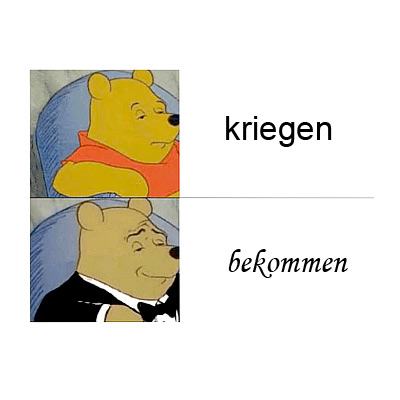
“kriegen” is the better “bekommen”
So what exactly is kriegen?
You might have noticed the word Krieg in there, which is the German word for war. And originally, kriegen was about an idea of “getting something through strife”.
But Germans used it so much that it slowly lost the focus on strife and today kriegen is basically THE everyday option for to get, to receive.
- Ich kriege viele E-Mails.
- I get a lot of emails.
- Practice pronunciation – click once to start recording and again to stop
Some of you are now like “I thought that was bekommen?” and you’re not wrong. kriegen and bekommen are basically synonyms. But kriegen is just the more common option in everyday conversations, not least because it is just shorter.
And I know that some of you are now thinking “So kriegen is just colloquial bekommen.” with a slightly negative undertone.
But colloquial is GOOD!
Colloquial is how people talk. Colloquial is what you WANT.
Like… the term colloquial literally comes from colloquy, which is a Latin word for conversation (co+loqui” – “Speaking together”), and it belongs to the same word family aas fancy words like eloquent, colloquium or interlocutor.
I feel like colloquial has a bit of negative touch. Like it’s the lesser option.
But it’s not. In most interactions, it is the NORMAL option.
Anyway, let’s look at some more examples for kriegen in daily life.
- Kriege ich mein Bier noch, oder habt ihr das vergessen?
- Am I gonna get my beer or did you forget about it?
- Practice pronunciation – click once to start recording and again to stop
- Was kriegst du für das Bier?
- How much do I owe you for the beer.
(lit.: How much do you get for the beer? ) - Practice pronunciation – click once to start recording and again to stop
- Wenn ich dieses Lied höre, kriege ich gute Laune.
- Whenever I hear this song, I’m getting a good mood.
- Practice pronunciation – click once to start recording and again to stop
- “Wenn du ohne Schal rausgehst, kriegst du eine Lungenentzündung.”
“Okay, Mom. Wenn du auf Facebook gehst, kriegst du gute Infos darüber.” - “If you go out without a scarf, you’ll get Pneumonia.”
“Okay mom, if you go on Facebook, you’ll get good information about that.” - Practice pronunciation – click once to start recording and again to stop
- “Hast du meine E-Mail gekriegt?”
“Die wegen der neuen Deadline?! Nein, hab ich nicht gekriegt.” - “Did you get my email?”
“The one about the new deadline? No, I haven’t gotten that.” - Practice pronunciation – click once to start recording and again to stop
You can use bekommen in any of these examples as well and it will mean the same and won’t stick out too much in terms of sound and if you could use only one of the two, I’d recommend kriegen.
And while receiving is a fairly common event in daily life, that’s really just the tip of the iceberg.
Much like to get, kriegen is not limited to receiving.
The second use of “kriegen”
You see, kriegen (and bekommen as well) also carry the sense of managing, getting done.
- Wie kriege ich mein T-Shirt sauber?
- Practice pronunciation – click once to start recording and again to stop
This is not about receiving a clean shirt – it’s about getting it clean, managing to clean it.
And this sense is really really common with the prefix versions of kriegen
- Ich kriege die Tür nicht auf.
- I can’t get the door open.
- Practice pronunciation – click once to start recording and again to stop
- “Wow, wie hast du das Feuer angekriegt?”
“Mit Geduld.” - “Wow, how did you manage to get a fire going?”
“With patience.” - Practice pronunciation – click once to start recording and again to stop
auskriegen, ankriegen, zukriegen, rauskriegen, hinkriegen – there are many more of those and I feel like in many contexts, English would just use the proper verb itself.
Like… in the first example, in English you’d probably just say “How’d you open the door?” but in German, it’s really common to use aufkriegen instead of öffnen or aufmachen, because aufkriegen has this focus on getting done.
All these versions also exist with bekommen and the meanings are the same. So there’s aufbekommen, zubekommen, anbekommen and so on.
But the versions with kriegen are shorter, and by far more common in daily life, especially in colloquial settings like when you’re with friends or ambassadors.
And by ambassadors I mean of course brand ambassadors, which brings us to today’s sponsor:
AG Surf 1 VPN Shark of Legends.
The ultimately online privacy nutritional supplement RPG.
It’s amazing!
Thanks a lot AG Surf 1 for sponsoring this video.
“Emanuel, this is a website. You’re not a Youtube influencer.”
Oh whatever. It’s 2025. Up is down, left is right. Podcasters are scientists. This is a video! Katching.
Just say the right thing and you’ll kriegen money for it.
You’re probably thinking “Emanuel’s aboard the nonsense-bus again” but hey, this time, it actually reminded me of kind of an important exception.
The phrase getting paid, and more generally the phrasing getting “verbed” does NOT work with kriegen or bekommen. The right word here is werden.
- Ich werde oft gefragt, warum ich AG Surf 1 VPN Shark of Legends verwende.
- I often get asked why I use AG Surf 1 VPN Shark of Legends.
- Ich wurde bezahlt.
- I got paid.
The reason for this is that these are in their essence passive voice structures. You could just as well say “I was paid.”.
That’s why kriegen would make zero sense here.
And the same goes for “getting” combined with an adjective. That too would be werden.
- Ich werde müde.
- I’m getting tired.
kriegen really is about getting an actual “thing”.
But in that sense and also in the sense of “getting a thing into a state”, it’s super duper common and you should definitely add it to your active vocabulary.
And that’s pretty much it for today. Hooray :)
If you want to check how much you remember, you can take the little quiz I have prepared. And of course if you have any questions or suggestions, just leave me a comment.
I hope you enjoyed this, have a great week and I’ll see you next time.
Bis dann.
Further reading:
- The family of “kriegen” (a more detailed look at the prefix versions)
- German Passive Voice (A look at the two types of Passive and how to use the werden-passive)
- The Meanings and uses of “werden”

 Audio Speed
 Dark Mode
That was a great lesson. I really felt the difference and will be on the lookout to use kriegen more.
Hi,
I’m having the same problem as before! This is the first time I’ve logged in this week and the site is telling me that I must have logged in before!
Thanks very much. Dean :)
Did you try clearing cookies and copy pasting the URL text?
Just a side note here about the concept of “to get” in German.
kriegen = to get by receiving, perhaps originally, by wresting from the possession of another person, hence, “der Krieg” (war), the act of getting by means of force!
holen = to get by going to fetch, cf. “Ich kriege ein Bier” (I’m getting myself a beer [….by whatever means necessary]) vs. “Ich hole ein Bier” (I’m simply fetching a beer, maybe from the fridge or
merely from the local liquor shop on the corner).
Is there still a notion of “strife” when using “kriegen” in the sense of “bekommen”? I mean, in the example “Ich kriege di Tür auf” or “Ich kriege die Feuer an” is there an implication of “effort was needed”?
Remnants of it, maybe. You don’t feel them when you say “ich kriege ein Geschenk”, but your examples do sound like you’re making an effort.
It can be contextual though, or sound based. The same examples with “aufbekommen” and “anbekommen” mean the exact same. With “kriegen” it sounds a bit more expressive, but also the word “kriegen” itself sounds more “striving” than “bekommen”. Like… that “krrrriiiii” could be a noise you make as you try to open the jar.
And don’t let’s forget here about “mitkriegen”, shall we.
“Hast du’s mitgekriegt?” = Did you get it?
mitkriegen = to get in the sense of to pick up on, e.g. a joke,
an idea etc.
To me, mitkriegen is more about catching information, like something on the news or some office talk.
“getting it” in the sense of “understanding” is not what I’d use mitkriegen for.
Hmmm, an intriguing distinction you raise!
I have used this verb myself when inquiring whether someone’s heard, i.e. literally “gotten”, what I’m saying, although not necessarily comprehended the gist of what I’m trying to say.
Perhaps I’m merely splitting hairs.
This context works for me too. It’s basically asking if someone “received” the information.
But “getting a joke” or a “twist” is not about hearing it, but instead “understanding”. You can “hear” a joke and not “get” it.
How true
Almost forgot about “ABbekommen” = to get something off
Du, ich kann den Deckel eben nicht ABbekommen? = I just can’t get the cover.off!
And “abbekommen a piece of the pie” :)
So “ich habe einen neuen Job gekriegt” doesn’t work?
To me it does. Was there something in the post that suggests it wouldn’t?
yes, I was confused by “getting hired” in the quiz being wrong, as I thought you’d express this idea like I did
Ohhh, okay, got it. So what I meant was the verb “to get hired” in all its shapes. THAT would not work with “kriegen” but of course the context of “getting a job” can be expressed with it.
That’s what I would say.
Thank you to the yourdailygerman donors funding my account to read this!! Much love <3
“Du, ‘hab’ richtig Angst vor Insekten!! Krieg‘ (auch: Mach’) doch die Spinne weg, bitte, bitte, bitte!!!
Hallo Emanuel,
wollte kurz sagen dass du mir sehr geholfen hast und ich lese deine Artikel gern :)
Ich spreche Englisch als Muttersprachler und der folgende Satz passt zu mir nicht.
“Whenever I hear this song, I’m getting a good mood”
Ich sage lieber “…, I get a good mood” (besser gesagt ist “.., it puts me in a good mood” meiner Meinung nach, aber ich verstehe dass dieser Satz “kriegen” als “get” nicht gut zeigt). Achtung, ich weiß nicht ob jeder Muttersprachler mir zustimmen würde, ich kann nur sagen dass es sich mir sehr komisch angehört :)
Ich spreche Englisch naemlich nicht als Muttersprachler, wuerde trotzdem Folgendes zwar aendern:
“Hearing this song always puts me in a good mood”
Na Kinder, wie waer’s?
Noch ein Englisch-Muttersprachler hier: Ja, stimme euch beiden zu. “Mood” ist für uns bildlich quasi immer ein Ort, wo man sein kann, nicht etwas, was man bekommen oder haben kann.
Hi Emanuel. Thanks for yet BBC another excellent article.
I’d suggest that instead of “ I get often asked” the more natural way of saying this in English is, “I often get asked”.
Ha, don’t know how BBC appeared in there ♀️
Yes, the latter is the correct choice here, so far as I can tell! Normally, the adverb always precedes the auxilliary. At least, this is what our teacher taught us and she was from the States. Then of course, there are exceptions, I’m sure.
Oh yeah, you need “kriegen” to speak and understand normal German, just like you need “gucken.” And it’s delightful for (maybe especially American) Anglophones longing for a Swiss army knife of a verb like “get.” (As noted in the article, it’s not for all uses of “get,” but still: wonderful.)
Maybe worth mentioning for learners looking out for it in everyday life: Emanuel’s pronunciation is a bit cleaner on gekriegt than you might hear out in the wild, depending on the speaker’s accent. The ie can tend to shorten and the g can soften so that the ge- form sounds more like “gekricht.” Just a heads-up that you may be hearing it more than you realize without recognizing it. :)
Since you mentioned “gucken”… do they use that down in Munich too? I always thought they’d “schauen” all things while the North of Germany perfers “gucken”.
“Guck mal” was the first German my son actively used, here in BW
Oh, that’s cute! And totally “on brand” or a child trying to get attention or share or show off.
I would definitely say it’s less, but you do hear it. Maybe out in Deep Bavaria you wouldn’t encounter it, but I think there are enough transplants from other parts of the country down here that it’s a thing.
They do love “schauen,” though. You actually hear “Wiederschauen” a lot more than “Wiedersehen.”
I knew a lady years ago born and raised in Hamburg who worked as a customer service rep. for a major bank and when saying good bye to clients or depositors, would typically say” ‘Wiederschau’n!”
That pronunciation note is useful. Thank you!
In the Rhineland area, around Bonn, for instance, I often hear “gekricht” for “gekriegt”, “Wann flichs
tdu?” for “Wann fliegst du?” etc. It’s definitely a regional/dialect thing.Tschüss Spargel… ich habe dich kaum gekannt.:)
Ich verstehe es nicht :)
I think they are referring to not learning vegetable words that no one uses!
Ohhhhhh… true, lol. Thanks!
i’m more than happy to give up asparagus to learn kriegen.
And of course, I said that because I understand that asparagus is very important to many Germans. there are probably those that would rather me not use the word.kriegen but would insist on me understanding why white asparagus is the end all be all…
Yeah, I don’t get the huff either. I mean, I do like to eat it when it’s season but I wouldn’t miss it if it disappeared from the planet. I do love sea asparagus though, but I can pretty much never find it anywhere in German supermarkets.
Hi Emanuel, thank you for the article!!! Super helpful. Just wondering for the t-shirt sentence, should it be: “Wie kriege *ich* mein T-Shirt sauber?” Or is it supposed to be without the “ich”?
Good catch, no the “ich” needs to be there :)! Fixed it now, thanks.
Very helpful, as usual, Emanuel. Thank you. I think there’s a typo (Tippfehler) in one of the examples above: “Ich kriege dir Tür nicht auf” should be “Ich kriege die Tür nicht auf,” oder?
Yup, thanks. That’s kind of a new typo I have “started” making recently for some reason. I often catch myself, but not always.
Can I also think of “erhalten” as a synonym of “kriegen” and “bekommen”, or is it used differently?
That one only means “receive” (besides its other meaning of course) so it does not work for getting a door open or a project finished. And it sounds rather formal in the sense of to receive.
“Erhalten” is definitely the more formal of the three, often used in writing, e.g. “Ihr Communique habe ich soeben erhalten….”, whereas “kriegen” is flat out colloquial and inappropriate in the above sentence, although “bekommen” can mean either to receive, to get, or of course, to have as in “Franssens haben erst Zwillinge bekommen!” = The Franssens just had twins!
“Neither “erhalten” nor “kriegen” would work in the latter context:-)
Supercalifragilisticexpialidocious!
…every time I hear that word I fall into chalosches….
Hallo,
You’re krieging typo corrections here:
“I have one underused words for you” (I have one underused word for you)
“because is not just one word” (because it’s not just one word)
“lit.: … do you get for the beer?” (lit.: … what do you get for the beer?)
“tip of te iceberg” (tip of the iceberg)
“Lex Fridman is a scientists” (Lex Fridman is a scientist)
Question 3: “the same goes for their prefix version zoo” (the same goes for their prefix versions too)
Question 6: “fertig kriegen” (fertigkriegen)
Great article and yes, “kriegen” should be A1, totally agree :)
Bis bald!
Danke wie immer :).
“prefix version zoo”… that was actually on purpose, as in the actual “zoo” of prefix versions. Is that too obscure? Should I change it to “zoo of prefix versions”?
I thought it should be “too” at first glance, then I had a better look and smiled to myself. I like the idea of a prefix zoo! (Zoo of prefix versions sounds clunky.)
I could see the prefixes in ihren Kafige(n)! I thought it worked well.
There is a YouTube German teacher, whose links I see fairly often, who has a big video on how you should never use words like kriegen because you’ll sound like a Trödel. I really dislike her videos.
There’s this weird genre of “STOP USING [insert most idiomatic word ever] – Here are 10 better options”, and they seem to be doing well because many German learning Youtubers make them, and then teach the students some random “synonyms”, none of which are nearly as natural and universal as the original. Maybe it was one of those :)
Me hates those things aus tiefstem Herzen. Together with anything pretending to show how you express a particular idea “from A1 through to C2” level. I have no idea who they’re meant to appeal to, or be useful for, but it ain’t me. (OK, OK: they must obviously appeal to some folk, who seem to equate getting better at the language with releasing an avalanche of pomposity. With ten seconds of extra thought, I imagine the appeal is to beginners who are still hunting for that elusive magic wand of fluency. “Perhaps I’ll just learn all these high-level sentences by heart, and pull them out at the right time? Aaaand… PROFIT! No more ‘machen’ or ‘gehen’ or ‘kriegen’ for me! Lebewohl, meine Lieben Anfänger“)
“Stop using a fork! These options are much better.”
Amazing
Hey Emanuel!
Thank you for this weeks article, email and for this whole website too! I signed up just last week and I’ve been loving it!
These are by far the best materials for learning German that I have ever come across, and I am not exaggerating. I really love the humor sowed into the articles, and all the explanations too, somehow they just get straight to my more technical and order based math-brain. Not something I have experienced with any language course or learning material before.
So yeah, just wanted to say a big thank you! I signed up for 3 months, and will probably do 3 more after, if not more. My current plan is to get to C1 in around 6 months, so yeah, got some work to do still.
Anyways, enough from my rant! Just wanted to say thank you for your work!
——————————————————
Now a bit about the actual article,
After the heading “The second use of kriegen” the second example has a mistake I believe, it should be “die Tür”. The audio is correct, I just got a bit confused why dir is in that sentence.
Also just another small thing I noticed was in the 4th example sentence of this same heading, the English translation “I get often asked…” sounds a bit off to me, maybe “I often get asked…”? Or maybe the problem is just in my head here… could be.
——————————————————
Anyways, those were just small stuff I thought I’d point out :) Keep making these cool articles for us!
P.s.:
I really love the ai story generator, it has been so much fun to play with! And very useful too, for reading some German.
Thanks a lot for this great feedback :)!
And yes, it should definitely “die Tür” and “get often asked” is absolutely my German seeping in. We say “Ich werde oft gefragt” and “Ich oft werde gefragt” would be wrong.
Just to take it a step farther: I think “often” feels almost too correct/formal to use with “get asked.” I’d expect that you’d be way likelier to hear EITHER:
OR:
Definitely not a big deal, and the word order is more important. But just a lil Ergänzung :)
Danke