YourDailyGerman
← Vocabulary

Modal Particles

German particles like doch, noch, schon and eben are short little words that Germans use all the time, but they can be surprisingly difficult to translate. In this section, we’ll explore what they mean, how they shape the tone of a sentence and how to use them naturally.

Your progress in this section:

Join to start tracking.

Login Sign Up

The meanings of “ja”

What does “ja” mean in German besides “yes”? Learn how Germans use it as a modal particle to express shared knowledge, surprise and strong warnings.

Vocab: ja

Read article →

Learning to use “doch” – The Exercise

Using "doch" is tricky and needs practice. Today, we'll do just that.

Read article →

How Germans use “halt”

Germans use "halt" a lot as a sort of "verbal shrug". But it's also increasingly popular as a premature "excuse" for what they're saying - read more today.

Read article →

The Meanings of “etwa”

Most of you know that 'etwas' means 'something'. But German also has 'etwa' ohne 's' and it's actually kind of common. Today, we'll learn what it means.

Vocab: etwa, in etwa, etwaig

Read article →

The Meanings of “eben and gerade” (Part 2)

We'll explore how "eben" and "gerade" are used in context of time and as these weird particles that seem to appear anywhere. Featuring: a really scary cat.

Vocab: eben, gerade, eben gerade, gerade eben

Read article →
Members

The meanings of “eben” and “gerade”

"eben" and "gerade" are brothers in spirit. One is about "flat", the other about "straight" and Germans use both of them in the context of time. But why? And how?

Unlock with membership →
Members

The meaning and use of – “eigentlich”

Dictionaries say "eigentlich" is "actually". But they're not a great match because "eigentlich" has a completely different vibe and most learners use it wrong.

Vocab: eigentlich, uneigentlich

Unlock with membership →
Members

The meaning of “nämlich”

"nämlich" looks like namely, but that's not really a fit. "nämlich" is actually hard to translate but easy to understand. And today, we'll do just that.

Vocab: nämlich, namely

Unlock with membership →
Members

The meaning of “allerdings”

"allerdings" can express agreement. And it can express a contrast. How does that make sense? Well, that's what we'll learn in this episode.

Unlock with membership →
Members

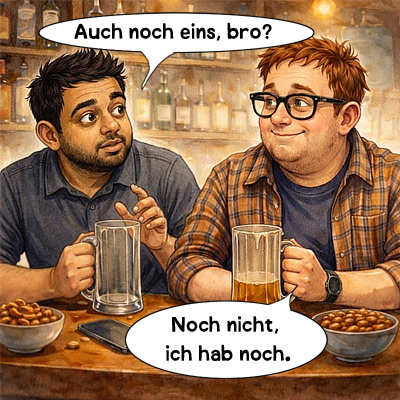
The meanings of “noch”

"noch" can mean "still", "yet", "else" and a few other things. But why? Today, we'll find out and see how to use phrases like "noch mal" or "noch nicht".

Vocab: noch, jetzt, noch nie, noch mal, noch eins, immer noch, nur noch, was noch

Unlock with membership →
Members

The meaning of “überhaupt”

"überhaupt" is the main German option for "at all" and it works in questions, statements and with negations. Today, we'll learn why, and how to use it properly.

Unlock with membership →
Members

Word of the Day – “gar”

"sogar" means "even". But why? Today, we'll learn about the meaning of "gar" and "sogar" and we'll see what those have to do with pasta :)

Vocab: gar, sogar, gar nichts, garen

Unlock with membership →
Members

The meanings of German “so”

A thorough look at the German "so", its various idiomatic uses in everyday German and the differences to English "so". With lots of audio examples.

Vocab: so, also, so so, so lala, geht so, sowieso, achso

Unlock with membership →
Members

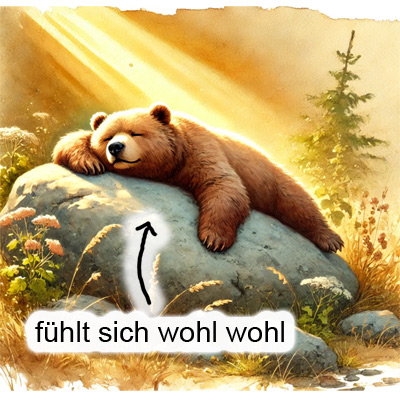
The meanings of “wohl”

The German "wohl" can mean "well". But it has some other uses in daily life that are absolutely not intuitive. Today, we'll find out more.

Vocab: wohl, wohlhabend, obwohl, wohl wahr, sehr wohl, wohl kaum, wer wohl, zum Wohl

Unlock with membership →
Members

The meaning of “sonst”

A fun look at the meaning of "sonst". We'll see how to use it in conversation and explore related words like "ansonsten", "sonstige" or "umsonst".

Vocab: sonst, ansonsten, sonstige, umsonst, sonstewo

Unlock with membership →
Members

The Particle “mal” Explained

Sometimes mal means “at some point.” Sometimes it just makes a sentence sound more casual. Today, we'll learn how Germans use it in various ways.

Vocab: mal, noch mal, nicht mal, erstmal, gerade mal, schon mal

Unlock with membership →
Members

The meaning of “zwar”

"zwar" hard to translate but its essence is not hard to understand: it sets up a "but". Today, we'll learn how to use it and also check out "und zwar".

Unlock with membership →
Members

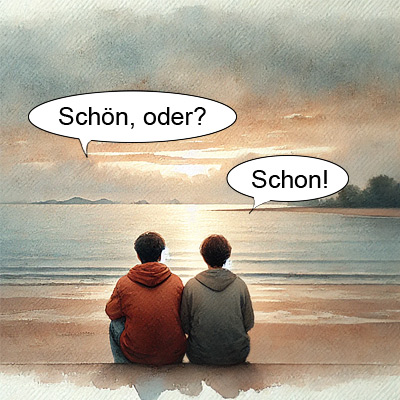
The Guide to “schon” – Meanings and Usage

"schon" is the German translation for "already" but it's actually broader than that. And it's also a particle that's kind of the direct opposite of "nicht".

Vocab: schon, schon wieder, schon mal

Unlock with membership →
Members

The meaning and use of German “halt”

"halt" comes from "halten", but in daily life, Germans use it as a coloring particle to express "a verbal shrug". Or a shield against criticism.

Unlock with membership →
Members

The meanings of “denn”

'denn' can mean 'because', but it's also a really common addition to questions in daily life. Today, we'll find out what exactly it expresses there.

Unlock with membership →
Members

The 3 meanings of “doch”

"doch" has three core functions - reverting a "no", toning down commands and most importantly: seeking affirmation. That's the one most of you are looking for.

Unlock with membership →
Subscribe for free


My German Learning Newsletter

Once a week (or so).

We don’t spam! Read our privacy policy for more info.

×

3 day trial

The full power of my site for 72 hours.

All lessons and all tools, no credit card needed because I'm not a shark.

×