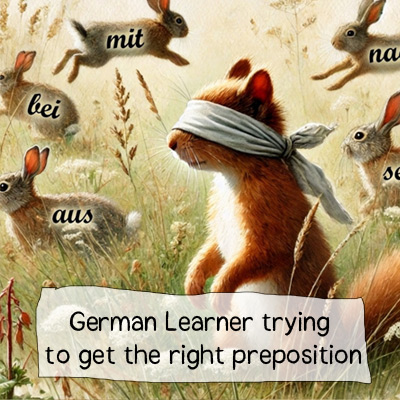
Prepositions are words that express the relations between and entity and an activity or another entity. That can be in the spatial domain, but also in all kinds of abstract ways.

German and English have a LOT of prepositions, compared to Spanish for instance. Many of them look similar in German and English, but their meanings and uses rarely line up, so it’s better to not get too hung up on what the dictionary says.

German prepositions are always followed by a case (mostly Dative or Accusative) but to complicate things further, an important group of them can go with Dative OR Accusative depending on context and what you want to express. Lots of fun waiting for you :)

0 0 votes
Article Rating

My Articles

What are Prepositions – Grammar Terms Explained

Prepositions are one of the fundamental word types in English. But do ALL languages have them? Do we even need them? Today, we'll learn all about it.

Read article →

German Two-Way Prepositions Explained

Two way prepositions are prepositions that can go with Accusative or Dative. And which one to use depends on what YOU want to say (and if that makes sense).

Read article →

German Verbs with Prepositions – An Exercise

A fun exercise about some of the most important German verbs and the prepositions they so desire :). Special guests: da- and wo-compounds and some really really dumb puns.

Read article →

Verbs With Prepositions – Practice Tool

Practice and drill the most common German verbs with prepositions like "warten auf" or "freuen über" with my interactive tool - two modes, lots of settings.

Read article →

Questions and Comments

Do you have questions about the usage or meaning of “Preposition”? Just ask here and I’ll try to clear it up.

guest

0 Comments
Newest
Oldest