Hello everyone,
And welcome to your German Word of the Day.
“OMG, the OG series?!?!”
Yes, it’s still running, there are still plenty of useful German words and families to explore, and today, we’ll take a look at:
The Meaning and Use of “sich weigern”
Which means we’ll also look at verweigern and a couple of other relatives you’ll come across in daily life.
But let’s start with weigern.
Sich Weigern
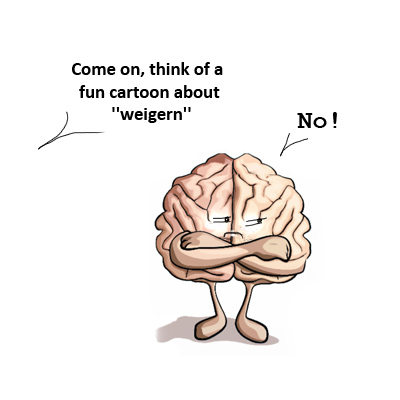
Sich weigern is essentially what your brain does when you ask it to recall that word you’ve learned just this morning.
You’ll like: “Brain, give me this word we learned this morning.”
And you’re brain is like: “No, not doing it!”
So basically, sich weigern means to refuse, in the specific sense of refusing to do something you’re told to do.
- Thomas weigert sich, die Küche aufzuräumen.
- Thomas refuses to clean the kitchen.
- Practice pronunciation – click once to start recording and again to stop
- Ich habe mich geweigert, diesen Sonntag zu arbeiten.
- I refused to work this Sunday.
- Practice pronunciation – click once to start recording and again to stop
It does not work for refuse in the sense of refusing an offer or invitation. That would be ablehnen or simply nicht annehmen.
And sich weigern ALSO doesn’t work for refusing an order.
Which might make you go like “Wait, I thought sich weigern is refusing to do something you’re told to do. Isn’t that an order basically?”
And you’re totally right that in terms of meaning it does fit, but the problem is the grammar.
Sich weigern is an actual, true reflexive verb. That means, it’s ALWAYS reflexive and doesn’t work without it. The reflexive pronoun is in Accusative, so basically, we are the direct object ourselves.
- Ich weigere mich, du weigerst dich…
- I refuse, you refuse…
And this structure kind of makes sense once you know that the verb comes from an adjective that meant something like resistant, stubborn. If we follow the lineage further back, we actually find a connection to the Latin root vince, which was about fighting and wining. You know it from words like victorious, convince or invincible.
But for us, the notion of resistant is more useful, because through that lens, sich weigern kind of means “making oneself resistant/stubborn”. THAT’S where the reflexive pronoun came from.
And that’s why you CAN’T “weigern” an order, because order is a noun and would be a second direct object.
Sich weigern pretty much always connects with an action in form of zu-construction.
- Der Barista hat sich geweigert, mir Zucker zu geben.
- The barista refused to give me sugar.
- Practice pronunciation – click once to start recording and again to stop
Or just by its very lonesome, if the context makes it clear.
- “Der Kunde wollte, dass ich ihm Zucker gebe, aber ich habe mich geweigert.”
“Sehr gut, John. Du denkst mit. Man merkt, dass du einen Master hast.” - “The customer wanted me to give him sugar, but I refused.”
“Very good, John. You use your brain. It shows that you have a Master’s degree.” - Practice pronunciation – click once to start recording and again to stop
Cool. So that’s sich weigern. It’s always reflexive (the self reference is in Accusative) and it’s about refusing to do something you’ve been told.
And I guess I should note that it sounds a tiny bit formal.
You could use it for a cat refusing to the cheap dry food I bought, but that sounds a bit … I don’t know. Like the cat voiced its opinion, or put in a formal complaint.
I mean, it did put in something into my shoe that day. Maybe that’s what a ‘formal complaint’ looks like in cat-speak. Little did my cat know that I can also put in these kinds of complaints, so I went to eat Mexican food and then I…
“Dude, Emanuel, can we move on please.”
Oh… yeah, sorry.
Moving on.
verweigern
Verweigern is kind of the result oriented cousin of weigern. The prefix ver- is wearing its signature vibe of ‘away’ and the verb is basically about denying or refusing someone something they want.
And here, we don’t have to deal with reflexive pronouns. The thing you’re ‘refusing to give’ is the direct object (so, Accusative) and the person you deny it to can be added as Dative object.
- Thomas verweigert die Zusammenarbeit.
- Thomas is refusing cooperation.
- Practice pronunciation – click once to start recording and again to stop
- Thomas verweigert seinem Mitbewohner Zutritt zur Küche.
- Thomas denies his flat-mate access to the kitchen.
- Practice pronunciation – click once to start recording and again to stop
Now, this does seem like it could be a handy verb, but it’s honestly just another one for Mt. Passive, that big mountain of passive vocabulary.
Why?
Well, sich weigern sounds a little formal but people do use it in daily life. Verweigern sounds SUPER formal and it’s also not reliably idiomatic. It ONLY works with nouns, but not even all the nouns.
If your cat wants a snack and you’re like ‘Nah bro, you’re too fat.’ that would not really be a context for verweigern even though you’re ‘denying the cat a snack’.
It’s stuff you see in a doctor’s report or police report.
- Der Patient verweigert die Nahrungsaufnahme.
- The patient refuses the intake of food. (… refuses food.)
- Practice pronunciation – click once to start recording and again to stop
So yeah… you won’t need to use this actively, but you will see it sooner or later in formal contexts.
And the same goes for the related words, which brings us to the last section for today.
die Weigerung and die Verweigerung
The noun die Weigerung is pretty much the verb weigern in noun form, so it’s the act (or statement) of refusing to do something someone wants you to do.
- “Maria hat meine Weigerung, die Küche zu putzen, akzeptiert.”
“NEIN, habe ich NICHT!” - “Maria has accepted my refusal to clean the kitchen.”
“No, I HAVEN’T!” - Practice pronunciation – click once to start recording and again to stop
Like the verb sich weigern itself, die Weigerung usually connects a zu-construction. And it sounds SUPER formal.
The more important and more useful noun is definitely the cousin with ver-: die Verweigerung.
This also means refusal, but here the focus is on the thing the other person wants but is not getting. So Weigerung is about you saying ‘No!’, Verweigerung is more about the result of you saying ‘no’ – someone doesn’t get something. And that something can be simply attached as a first part of a compound.
- Arbeitsverweigerung – refusal to work (of a person)
- Befehlsverweigerung -“order refusal”, insubordination
- Kriegsdienstverweigerung – the refusal to do mandatory military service
These compounds with Verweigerung are all hellah formal and you cannot just play around and make up new ones, sadly. I mean, you can. It’s a free country. But it’s also Germany, and we don’t do playful creativity here, except in Kink.
So… as the Haiku goes.
Passive Word Mountain
Snow covered peaks in summer.
It’s nice from afar.
But seriously.
I do doubt that you’ll need these words in active conversation, but I’m sure you’ll see them sooner or later, if you consume German media or content. Or to say it in German.
- Wenn ihr deutsche Medien konsumiert, werdet ihr unweigerlich Wörter wie ‘Verweigerung’ sehen.
- If you consume German media, you’ll inevitably see words like ‘Verweigerung‘.
- Practice pronunciation – click once to start recording and again to stop
And that’s it for today.
Yes, every post has to unweigerlich come to an end :).
This was our look at the meaning and use of sich weigern, verweigern and the related nouns.
As always, if you want to check how much you remember, just take the little quiz I have prepared.
And if you want to PRACTICE the words of the lesson… well, just get some reading comprehension based on them with my awesome new tool below.
And of course, if you have any questions are suggestions, just leave me a comment and we’ll talk more there.
I hope you enjoyed it and that your brains are not sich weigern to remember a thing or two.
Have a great week and see you next time.
Oh, and here’s the link to the older article on the same topic… pure nostalgia.
‘sich weigern’ – The Quiz
Text Comprehension Practice with ‘weigern’
***
What's your level?
Sets how challenging the text and vocabulary will be. B2 and C1 are members-only levels.
***

 Audio Speed
 Dark Mode
Maybe that’s just me, but in the 4th quiz question it’s a bit hard to notice that there are actually 2 text fields to fill.
Oh, nice catch. Fixed it, it should show a clear border now.
Hi Emanuel, in the article you wrote: “And that’s why you CAN’T “weigern” an order, because order is a noun and would be a second direct object.” so how CAN you “weigern” an order?
Note that this is a grammar issue, not a meaning issue.
– Ich weigere (a noun).
Does NOT work, because the direct object of weigern is the reflexive pronoun.
– Ich weigere mich, den Befehl auszufuehren.
This does work. We’re not following the order, but the phrasing is using the verb ausfuehren.
If you want to connect the noun directly, you’d use “verweigern”
– Ich verweigere den Befehl.
Does that help?
Ja, danke!
Hello! I just wanted to say thank you to the nice people who have paid extra so that people who can’t afford it can also learn German, much appreciated :)
Emanuel answers queries and explores issues not usually covered, even in an American college classroom.
I once observed several German classes at a US university (won’t mention which, of course) and no instructor seemed to care to delve into what really makes German tick.
Hut ab, Alter!
Thank you Emanuel for another great article! German is pure quirky bliss:)
I also wanted to thank everyone who has gone an extra mile supporting Emanuel’s site and thus making possible for people who cannot afford the membership to get a sponsored one (like me!). I’m really grateful I have the opportunity to engage more and deeper with the German language in this fun, excessive, engaging manner, while being part of this very cool community. so, thank you lots guys <3
(I'm really struggling with changing my profile pic tho xD it was automatically taken from I-dont-know-which-place-of-my-cyber-traces!!!!!)
These pictures are pulled from Gravatar :). Chances are you signed up there at some point in some way. You can’t change it here, but if you disable it on Gravatar, it’ll be gone here as well.
Welcome!
The puzzle of language, any language, comes in unraveling her component parts!
English has its quirky spelling/pronunciation chaos, German it’s case endings
I really like having the quiz and the reading comprehension at the end. That’s very helpful.
The link to the older article on the same topic – pure nostalgia – is linked to this article.
Nah, I just used the same cartoon in this new one as in the old one :). The rest is different.
https://yourdailygerman.com/sich-weigern-meaning-german/
Thanks for this awesome German tutorial! I look forward to it now every day
Happy to report that it all worked perfectly. And also, that I managed to ace both the test and the comprehension, a performance which must have been alcoholically enhanced(*). Hey, it’s late on a Saturday night, and there’s horrible, horrible tennis on the TV!
(*) Or, at least not alcohol-impaired ;-)
Inebriated
Crushing the German practice
Life is good today.
By the way… Peter Thiel wants to know more about this performance enhancer for his next enhance-olympics.
Er hat sich geweigert, die Bundeswehrpflicht ein zu willigen.
Er hat die Bundeswehrpflicht verweigert.
Same basic meaning, merely a different way of saying a like idea.
I also have no text generation. I answered all the prompts and got “generating text…preparing questions”. And then…nothing. At all.
I am reading on an iPhone 12, running iOS 26.5.
I just fixed it. Might have to reload the scripts though, so maybe it won’t work right away for you since you just loaded the old broken script.
LOL. Not just for you. Es weigert sich, ein text auch für mich zu vorbereiten. Schade!
Sorry for some correction:
Es weigert sich, einen Text auch fuer mich vor zu bereiten.
Hab’s repariert.
Hi – the text comprehension is … um … refusing to generate for me. Is this a very meta example?
Hahaha, that would be super meta indeed.
So it literally just worked 10 minutes ago but didn’t load the layout. Now it does load the layout and doesn’t work for me either. Arghhhhh
Update: should be fixed, but probably needs a full browser reload (ctrl+f5 on windows).