Hello everyone,
welcome to our German Word of the Day.
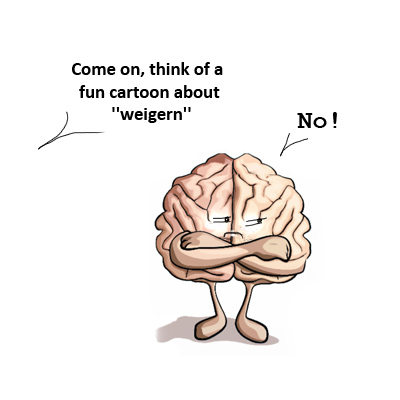
And this time, I have one of those YUSIOYKI-words for you.
That looks like Japanese (if you don’t know Japanese like me) and it’s short for “You See it once you know it” and it’s basically one of those words that you never really notice or feel like you could use until you randomly learn them somewhere and then, all of a sudden, they’re everywhere.
Just like opportunities.
Yeah… that’s some deep, spiritual wisdom right there.
But who cares, that’s not what we’re here for.
We’re here for the German freakin’ language and today, we’ll have a look at the meaning of
sich weigern
And yes.
It’s one of those that are always reflexive.
And what is sich weigern?
Well, it’s what Thomas does when his girlfriend Maria asks him to put his dirty dishes into the dishwasher.
*cue quiz music
- comply
- refuse
- start an argument
- he doesn’t have a girlfriend
Technically, the correct answer is of course 4, but within the fictitious scenario it would be number two – sich weigern means to refuse.
- Thomas weigert sich, sein Geschirr in die Spülmaschine zu räumen.
- Thomas refuses to put his dishes into the dishwasher.
- Practice pronunciation – click once to start recording and again to stop
- Meine Chefin wollte, dass ich ihr den Rücken massiere, aber ich habe mich geweigert.
- My boss wanted me to massage her back, but I refused.
- Practice pronunciation – click once to start recording and again to stop
- “Deutsch, wenn du dich weigerst, von mir gelernt zu werden, dann musst du damit leben, dass ich dich nie spreche.”
“Oh nein!!” - “German, if you refuse to be learned by me, then you’ll have to live with the fact that I’ll never speak you.”
“Oh no!!” - Practice pronunciation – click once to start recording and again to stop
As you can see, the self reference is in Accusative, so it’s “Ich weigere mich!” and so on.
And just to make sure – sich weigern is NOT about refusing an offer. The German word for that is ablehnen.
- Das Einhorn hat mir hausgemachten Moonshine angeboten, aber ich habe abgelehnt.
- The unicorn offered me homemade moonshine, but I refused.
- Practice pronunciation – click once to start recording and again to stop
Sich weigern is really specifically about refusing to do something.
Or actually, we should say refusing to do something that someone tells us to do. It works for humans, and also for animals
- Meine Katze weigert sich, ihr Essen zu essen.
- My cat refuses to eat its food.
- Practice pronunciation – click once to start recording and again to stop
But it wouldn’t work for a door refusing to open. That would sound like the door has some sort of will or something.
So yeah, that’s sich weigern. It does sound a bit formal and official but I do use it an daily life and I’d say it’s worth adding to your active vocabulary, at least if you’re level B1 or above.
Are there any English relatives that could help remember it?
Well, not really.
The origin is the disgustingly ancient Indo-European root *u̯eik- which was about fighting, overcoming, which does fit the meaning we see today quite well.
But the Anglo-Saxon branch of this disappeared a long time ago, so the only relatives are the ones that came via Latin and those are the words around victory... convince, invincible and so on. Not sure if these really are a good mental crutch for the meaning of weigern.
Maybe it’s more helpful to think of it as “Why?????” Like… someone tells you to do something and instead of doing it you go like “WHY?”
Not exactly weigern, but maybe it’s a nice mnemonic.
But anyway, now, of course there are also a few related words, so let’s look at those now.
First up, we have the noun die Weigerung, which of course means the refusal.
It sounds very stiff and formal though, and you won’t find that often in daily life.
- Thomas’ Weigerung, zu akzeptieren, dass er keine Freundin hat, führt immer wieder zu immaginärem Streit darüber, wer den Geschirrspüler einräumt.
- Thomas’ refusal to accept that he doesn’t have a girlfriend, keeps leading to imaginary arguments about who is filling the dishwasher.
- Practice pronunciation – click once to start recording and again to stop
Next up, we have the adverb unweigerlich, which means something like inevitably or unavoidably.
- Werden die Zinsen jetzt gesenkt, werden die Preise unweigerlich steigen.
- If the interest rate are lowered now, prices will inevitably rise.
- Practice pronunciation – click once to start recording and again to stop
But the most important relatives by far are the verb verweigern and its noun die Verweigerung.
The verb verweigern is about denying someone something.
- Thomas verweigert dir Zutritt zur Küche.
- Thomas is denying you access to the kitchen.
- Practice pronunciation – click once to start recording and again to stop
And this sense of denying and the idea of refusing that we already had are REALLY close.
Like… take the example above. You want to go to the kitchen and you’re like “Thomas, Bro, let me go in.” but Thomas is like “No, my girlfriend is in there …. studying.” and he blocks the way.
He is refusing to let you enter and thereby DENYING you entry. Refusing is for action, denying is for a “thing”, in a way.
Anyway, grammatically, what is being denied is the direct object (in Accusative) and you MUST have that so that’s not optional.
And if you want to include the person who gets denied something, that’d be the indirect object, so that’ll be in Dative.
- Maria will wissen, warum ihr das Visum verweigert wurde.
- Maria wants to know why she was denied the visa. (the visa was denied to her.)
- Practice pronunciation – click once to start recording and again to stop
- Zugriff verweigert – Sie haben keine Berechtigung, dieses Beispiel zu öffnen.
- Access denied – You do not have permission to open this example.
- Practice pronunciation – click once to start recording and again to stop
And the noun die Verweigerung pretty much carries both ideas, so if the focus is on someone not getting something, then it’s denial and if the focus is on someone not GIVING something, then it’s refusal. Though it is actually more common in the latter sense, overall, it’s mainly used in compounds.
- Das Team droht mit Arbeitsverweigerung, sollte der Ping-Pong-Tisch wirklich entfernt werden.
- The team is threatening refusal to work, should the ping pong table really get removed.
- Practice pronunciation – click once to start recording and again to stop
- “Thomas, was du machst ist Realitätsverweigerung.”
“Du meinst, was Maria und ich machen…” - Thomas, what you’re doing is denial of reality.”
“You mean what Maria and I are doing…” - Practice pronunciation – click once to start recording and again to stop
And that’s pretty much it for today :).
This was our little look at the meaning of sich weigern and its relatives, and even if you think you’ve never seen this verb before… I’m pretty sure you have and I’m even more sure you will now.
As usual, if you want to check how much you remember, you can take the little quiz I have prepared. And of course, if you have any questions or suggestions, just leave me a comment.
I hope you liked it and see you next time!!

 Audio Speed
 Dark Mode
Thomas verweigert dir Zutritt zur Küche.
Zugriff verweigert – Sie haben keine Berechtigung, dieses Beispiel zu öffnen.
What’s the difference between “Zugriff” and “Zutritt”? They’re both translated in those examples as access.
“Zutritt” – access as in entering something physically (“treten”)
“Zugriff” – access as in being allowed to “grab and take” something (“greifen”)
Danke
Hallo guys, I’m a new sponsored member and i just want to thank everyone who made it possible for me to be here with you. This blog is something that i always wished it existed, like the way you (Emanuel) dive deep into the language is truly unique and couldn’t find anywhere EXCEPT HERE. Vielen Dank! I hope i can sponsor others in need one day too. Love you guys <3
Vielen Dank!
Well you must be a great teacher as I got my first 100% on a first try – ever. Thanks for lowering the bar for me :) Also, I think the examples have reached a mastery level of humor and insanity: Thomas’ Weigerung, zu akzeptieren, dass er keine Freundin hat, führt immer wieder zu immaginärem Streit darüber, wer den Geschirrspüler einräumt. Just…wow! :)
They really do write themselves sometimes, I’m just riffing on an idea basically :)
Weigerst du dich, mit Gabel und Messer zu essen? – Doch, ich weigere mich mit Gabel und Messer zu essen!
:-)
Wait, would you use “doch” here? Because to me, it sounds like how a non native would use it, but you’re a native speaker, right?
Yes, I am. However, as fellow native, you know that “doch” can on occasion even replace “Ja” as a particulate upgrader in order to emphasize an affirmative statement.
It does come across as a bit slangy, I realize.
Du, Markus! Kommst du morgen abend, oder? – Doch, klar! = Aber natuerlich [komme ich, scherzt du bloss?]
Er kommt heute abend nicht, denkst du? Doch, ich denke schon! = Er kommt ganz bestimmt, bin dessen praktisch sicher.
I’m not convinced :).
These two examples to me are not the same as the first one, because both include either a direct negativ or an implied one.
The first one however is a yes or no question and answering those with pure doch sounds weird to me.
That said, since you’re a native speaker, it’s of course correct. Just, if a learner were to use it that way, I would correct them.
It would work for me if you throw in some self doubt.
– Weigerst du dich?
– Ja, doch, glaube schon.
But just a straight up “doch” as an answer to a yes or no question doesn’t work for me personally.
I now see what you mean here. Yes, sure, the above two example sentences are not identical to your query regarding my sentence. My students struggle with Abtoenungspartikeln, those modal particles which add ever so much to the idiomatic or slangy flavoring of any given utterance!
Vielen dank to all who chipped in to my sponsorship. I look forward to being a member of this blog.
A heartiest of welcomes, fellow German language lover! Happy to have you…. Ich heisse dich, deutschen Sprachbeflissenen, aufs Herzlichste willkommen:-) ‘Freut uns, dass du dabei bist!
Ha, eine Begrüßung und veritable Herausforderung für den Wortschatz.
Na, herausgefordert werden muss schon jeder Lerner.
Bei reflexiven Verben wenn ein Objekt gibt soll reflexive Verb in Dativ verwendet werden. Wie zB ich habe mir die Zähne geputzt. Also dir Frage mit Spinat sollte mir sein anstatt mich
Nope!
Bei reflexiven Verben wenn ein Objekt gibt soll reflexive Verb in Dativ verwendet werden
Ich würde empfehlen, diese Regel komplett zu vergessen, denn sie ist auf mehreren Ebenen sinnlos und irreführend.
In unserem Beispiel ist “Spinat” das direkte Objekt von “essen” und nicht von “weigern”.
– Ich weigere mich, [Spinat zu essen].
Das ist richtig, “mir” ist falsch.
Couldn’t agree with you more, Emanuel! Often a plethora of rules can easily confuse the learner, especially those who might not be completely sattelfest (confident and secure) in their knowledge.
Best are usually examples of the structure instead of slippery explanations of the structure itself.
In class, I almost always eschew grammatical explanations, even at the advanced intermediate level, focusing instead on clear instances of application within a given context. I find it works like a charm.
Hello Emanuel. Hope you are feeling better. I forgot to renew my membership but now have done so but I don’t think it has been re-activated. Missing the fun of being a member! Thanks
Hi Andrew, I just checked and it looks like you forgot to complete the payment. There’s another button after one gets send back from Paypal, it’s easy to miss.
Could you check your account please and let me know if you were charged or not? I’m 99,99% sure that there’s no charge.
You’re absolutely right! I will try again.
Yep, those pesky reflexives!
Er hat SICH geweigert, im Unterricht Deutsch zu sprechen.
Im Unterricht hat er SICH geweigert…….
Weil er SICH geweigert hat, schmiss ihn der Lehrer ‘raus aus dem Klassenzimmer heraus.
The exact position of the reflexive pronoun “sich” can be tricky, as it changes depending upon the sentence. If the personal pronoun is used, the “sich” will always follow. However, if the name is used, the “sich” will precede.
Im Unterricht hat SICH Thomas geweigert, Deutsch zu sprechen.
Weil SICH Thomas geweigert hat, schmiss ihn………
It looks kind of confusing in the beginning, I know.
Would you say this is a strict rule or more of a trend?
Because I feel like this is also idiomatic, though a bit less common maybe.
– Weil Thomas sich geweigert hat, …
Naturally idiomatic as well as slang usage will vary over time. In my generation, “…weil sich Thomas…” went according to the DUDEN gold standard of acceptably correct German. The trend though, as Sick and others point out is tending in the direction of a slightly more lax usage, e.g. “Ich kann heute abend nicht kommen, weil ich bin krank” vs. “Ich kann heute abend nicht kommen, weil ich krank BIN.” etc.
Point well taken though, Emanuel!
By the way, only wish to point out a typo in my post. The sentence ought to have read. “Weil er sich geweigert HATTE, schmiss ihn….”
:-)
Actually, I am not so sure if this particular instance (the reflexive before/after a noun) falls in the same category as the verb second after “weil” thing.
I highly recommend Google ngram for this.
Here’s a plot for “meine Mutter sich” vs “sich meine Mutter”. They’re very similar in their frequency and “meine Mutter sich” has many instances in literature, so I don’t think it’s appropriate to call it colloquial or slang.
I would say the position of the reflexive is underlying the same forces that govern word order overall, so novelty, impact on overall message and so on.
The reflexive will trend left, but in the right context, it can show up right even of a noun.
I’d probably concur, although, as I mentioned the other day,
I remain a prisoner of my generation, and in school we always learned “….weil sich meine Mutter…” vs. “weil meine Mutter sich….”.
Again though, language does change, as in that “weil ich bin krank” vs. “weil ich krank bin” example.
When I was at school Emanuel we were taught that Denial is a river in Egypt.
Always has been!
I was kinda surprised to see sich weigern is actually on the Goethe Institut word list for B1 – clearly I’ve never really paid this verb enough attention, because i wouldn’t have been able to tell you the meaning other than guessing a negative vibe from context.
When I was reading this i was thinking about Mellville’s short story Bartelby the Scrivner , about an employee who consistently responds “I’d prefer not to” whenever he is asked to do anything.
I read the article yesterday and was wondering when I would encounter a weigern “in the wild” and I just encountered a “verweigern” in the book i’m reading. Weird how this works. I’m looking forward to hearing someone actually say it irl. Could be wrong but think that might be a while longer…
Well, let me know :). But my girlfriend had been living in Berlin for 6 years and she claimed she never encountered “weigern”, which is impossible. There really are these words that the brain gets, but then kind of ignores.
i find these formal words harder to learn somehow. Words like knallen, quietschen, abhauen and zerbrechen are all kinda easy , maybe cus there is a kind of kinetic excitement to them. weigern, dunno, its obviously one to know, but eludes my ability to get excited by it and recollect it, at least until now…
just spotted a sich weigern “in the wild” ……it only took a couple of days and its a nice one:
“..ich denke sogar, ich könnte ihm mal die Zehennägel schneiden, wenn er schlaft, wie es früher auch meine Eltern bei mir machten, wenn ich mich wieder einmal weigerte, die Nägel zu kürzen, und also mit Krallen herumging.”
Ha, I was sure you’d see it soon :)!
Can’t read and I did not read posts for months.
Check the bottom of the newsletter please.
Is there much overlap with abweisen and sich weigern where they become interchangeable? Perhaps in the below example? Or do you usually abweisen someone before they even ask you to do something? :D
The vibe is different.
“abweisen” has a vibe of “sending away”, while “sich weigern” has a vibe of being defiant.
I’d say that “abweisen” is more for requests in an asking sense while “sich weigern” is more about resisting a request is in “n order”.
In the massage example, the implication (in my mind) is that the boss is kind of presuming compliance, so it’s NOT a “hey, could I ask you a favor” type of situation.
Does that help?
It does! Now I’m going to go report that boss to HR…
The former really means “to reject”, similar to “ablehnen” for to turn down or reject as well. The latter, “sich weigern” means simply “to refuse”, although lexically, the precise difference can be rather subtle!
Shouldn’t that be : Fressen zu essen? because it’s a cat?.
The aurora borealis would be nice to experience, as well as flying around with reindeer, of course.
Meh, the reindeer flying is really overrated. They fart all the time and it goes right into your face. Also, they argue all the time while flying because they’re speaking reindeers, and it’s quite awkward to witness them doing relationship talk while pulling the sled.
But yeah… aurora borealis would indeed be amazing! Fingers crossed :)
Hello,
Ich werde mich nicht weigern, ein paar Typos zu Korrigieren :)
ficticious (fictitious)
denyed (denied)
Though it is actuall more common (Though it is actually more common)
Wow, you’re in one of my favourite cities :))))
I recommend (if you like the stuff I’m about to describe):
1 – Aifur, on the Västerlånggatan (which literally means long west street) – it’s a Viking restaurant where one can enjoy a real Viking experience, with live music and all the waiters dressed up as Vikings, as well as the furniture, even the cutelry, it’s an actual challenge to eat with a fork that only has two prongs ;)
2 – The ABBA museum (ONLY if you like ABBA)
3 – Two great Konditoreien (if you like places like that):
The Vete Katten, on the Kungsgatan (King Street) and
Sundbergs, in the Old Town (Gamla Stan), founded in 1785, on the Stortorget
There are many, many more interesting spots, the walk along the waterfront when one goes to the museum island, the big park kungsträdgården (King’s garden), you can go to the cinema if you want to because nothing is dubbed… and there’s the shopping… but you’re a guy, so most probably not :)
Let me know what you did in Stockholm :)))))
Bis bald!
Cutlery
Are you Swedish? I know I can’t tell you how many Swedes who spoke truly excellent German, when last in Sweden! Noch viel Lernerfolg, Lycka till, Elsa!!
Nej, men jag lär mig svenska :)
Are YOU Swedish? I’ve been many, many times in Sweden, I love it and am trying to learn the language!
No, I’m German, but conversely I’ve been to Sweden on several occasions, being as we’re so close:-)
I speak fluent Swedish, naturally not as easily as German or English. Och du lar dig aven tyska, eller hur?
Glad you’ve joined the blog!
En tysk kille på en tysk inlärningsblogg?!? Eftersom tyska är så jättesvårt, eller hur? LOL
Ja, ich lerne Deutsch gelichzeitig, aber ich bin nicht neu auf dem Blog, ich bin schon eine Weile dabei :))
Ich freue mich auch darüber, dass du auf dem Blog bist!
As German’s my first language, I can’t judge its difficulty, however, in comparison with both Swedish and Modern English, German has an arsenal of grammar, long absent from either of the former!
German’s hypotactic sentence structure in “Nebensatz” or subordinating word order doesn’t exist in either Swedish or English.
By the comic term, do you mean yusuke sensei? Anyway, it’s a very wrong Japanese spelling. I could’t read out that
Nah, it was COMPLETELY made up and not supposed to be actual Japanese or anything near it :). It’s supposed to resemble “you see it once you know it”.
Ok, endlich verstehe ich dieses Lied
https://www.youtube.com/watch?v=JxS5M6OStN8
Wer dieses Lied hoert, vergisst nimmer das Reflexiv, weil es hier viermal geschrieen ist (im zweiter Vers)
Das neues Quizformat ist sehr elegant :D
Hallo lieber Emanuel,
Danke für diesen nützlichen Artikel über zwei Verben Sich weigern(acc.) und Verweigern(dat.).
Ich habe schon beiden in meiner Lesung gesehen ,aber wusste ich nicht klar, was ihre Bedeutunsunterschied ist. Jetz es ist alles klar geworden .
Bis bald