Hello everyone,
And welcome to your German Word of the Day, today, with the epic return of the series that everyone has forgotten:
False
Friends
EXPLAINED
Hell yeah, let’s go!!!
In this series, we take a pair of false friends in German and English and explore the differences, how to actually translate the words and of course, which language is to blame.
And the pair we have today is:
die Rente vs. the rent
It’s not really something that gets in the way of daily conversations, but both words are indeed part of many people’s everyday life and while both words are about money, they’re very very different.
Like… take these examples:
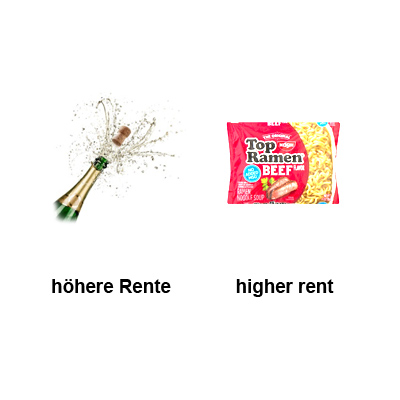
- Your rent is going to go up 30%.
- Deine Rente geht 30% hoch.
The English one is horrible news. The German one on the other hand will have people go like “That’s amazing.”
Because in German, the core meanig of die Rente is pension.
So what’s going on here?
The origin of both words is the Latin rendere, which is a combination of the prefix re- and the Latin verb dare, which meant to give. So rendere literally meant giving back and the Latin noun rendita had a theme of compensation or yield.
In English, the focus slowly narrowed down to the specific sense of “income generated from giving someone else use of your property” – be it an apartment or a bike. So even though most of us think of rent as something we pay, it’s at its core the money that someone gets as “yield”.
And that’s not so far from the German Rente. Only that in German, the word shifted toward money you regularly get from insurance or government, with the main one being the old-age pension. Which, at least to an extent, is also made up of return from investments, or investment yield.
And by the way, German also has the word die Rendite, which specifically means investment return (and sich rentieren which is about an invest paying off.)
So die Rente and the rent are a really interesting pair – virtually no overlap on the surface, but once you dig a little, you find a lot of similarities.
Which language is to blame for the pair? Well, it’s kind of undecided, so let’s go with German. Thanks a lot German for making everything confusing.
Anyway, so the main use of die Rente is the pension you get once you go into retirement.
- Viele Junge Leute sind nicht sicher, ob sie im Alter tatsächlich eine Rente kriegen.
- Many young people aren’t sure if they’ll actually get a pension in old age.
- Practice pronunciation – click once to start recording and again to stop
- Die Partei verspricht eine Rentenerhöhung.
- The party promises a raise of pensions.
- Practice pronunciation – click once to start recording and again to stop
Technically, that’s not the only kind though.
There’s also Waisenrente for example, which is a regular payment for orphans, the Witwenrente, which is widow’s pension, the very long Erwerbsminderungsrente, which is for people who cannot fully work anymore, and the Labradorente, which … erm… I guess is a payment that you get when you own a labrad… oh … oh no, wait, it’s an animal, that last one, never mind.
But yeah, the main use by far is the pension for retirees.
In fact, you can also find die Rente used in the sense of retirement. Like in these examples from phantasy land:
- Noch vier Monate bis zur Rente – Angestellter gibt noch mal alles.
- Four more months till retirement – Employee gives it their all one more time.
- Practice pronunciation – click once to start recording and again to stop
- Thomas plant, mit 45 in Rente zu gehen.
- Thomas is planning to go into retirement at 45.
- Practice pronunciation – click once to start recording and again to stop
And a retiree is officially called der Rentner/die Rentnerin in German.
- “Wollen wir am Wochenende wie zwei Rentner den ganzen Tag auf dem Balkon sitzen und Leute beobachten?”
“Klingt super. Bin dabei.” - “On the weekend, should we sit on the balcony like two retirees the entire day and watch people?”
“Sounds great, I’m in.” - Practice pronunciation – click once to start recording and again to stop
And I have to say… it’s probably just a learned association, but the word Rente really sounds old to me. I immediately think of gray hair, wrinkles, grandma curtains, more fragile bodies – the word Rentner even sounds a bit like bones grinding on each other. Like… I do want to become old, but I do not want to become a Rentner.
German Government: “Noted!!! We’ll make it happen for you.”
Wait, no! That’s not what I meant.
“Too late, you just waived your entitlements.”
Oh yeah?!?! And you just waived my vote!!
“Oh schei**… bitte! We were just kidding. Your Rente will be amazingly high.”
Exactly, thought so!!!
All right.
So that was the word Rente.
Now, what’s left for us is of course to talk about how to actually translate the English rent.
Words about “rent” in German
And the German word for renting is mieten. The origin is a Germanic root that was about “reward” but it seems like it never really caught on in English or the Scandinavian languages. I mean, English apparently has the word meed as a relative, but I’m not sure if that’s ever used.
Anyway, in German, the root found a home, and became the base for anything rent-related.
The verb mieten is to rent, die Miete is the rent and der Mieter and die Mieterin are the renter. Or tenant, respectively.
- “Ist das dein Auto?”
“Nein, das habe ich für den Urlaub gemietet.” - “Is that your car?”
“No, I rented it for the vacation.” - Practice pronunciation – click once to start recording and again to stop
- In Berlin wohnen 85 Prozent der Bevölkerung zur Miete.
- In Berlin, 85 percent of the people rent.
- Practice pronunciation – click once to start recording and again to stop
- Liebe Mieterinnen und Mieter, leider ist dem Investor die Rendite zu niedrig. Daher werden wir Ihre Mieten erhöhen. Wir bitten um Ihr Verständnis.
- Dear tenants, unfortunately, the returns are too low for the investor. As such, we’ll raise your rents. We ask for your understanding.
- Practice pronunciation – click once to start recording and again to stop
There are also loads of rent-related compounds and the common form there is with “Miet-“.
- Maria hat heute ihren Mietvertrag unterschrieben.
- Maria has signed her rental contract today.
- Practice pronunciation – click once to start recording and again to stop
- Wegen dem Baulärm hat Maria eine Mietminderung beantragt.
- Because of the construction noise, Maria has requested a rent reduction.
- Practice pronunciation – click once to start recording and again to stop
Then, there’s of course vermieten et al. which basically look from the perspective of the person renting out something.
- RentYt, das neue, heiße Startup aus Berlin sucht Investoren. Es ist eine App, wo ihr buchstäblich alles vermieten könnt. Sogar eure Zahnbürste.
- RentYt, the new hot Startup from Berlin is looking for investors. It’s an app, where you can rent out literally everything. Even your toothbrush.
(If you want to invest, you can send an email to the CEO at [email protected])
- Practice pronunciation – click once to start recording and again to stop
- Ich verstehe mich gut mit meinem Vermieter.
- I get along well with my landlord.
- Practice pronunciation – click once to start recording and again to stop
- “Gibt es an diesem Flughafen eine Autovermietung?”
“Gibt es Wasser im Ozean?” - “Is there a car rental office at this airport?”
“Is there water in the ocean?” - Practice pronunciation – click once to start recording and again to stop
Let’s mention the words with unter- as a prefix, which is about subletting an apartment.
- Darf ich meine Wohnung untervermieten, wenn ich im Urlaub bin?
- Can I sublet my apartment when I am on vacation?
- Practice pronunciation – click once to start recording and again to stop
- “Maria sagt, ihr neuer Untermieter ist faul, arrogant und dumm.”
“Hat sie sich wieder verliebt?”
“Ja, genau!” - “Maria says her new subtenant is lazy, arrogant and dumb.”
“Has she developed a crush again?”
“Yeah, exactly.” - Practice pronunciation – click once to start recording and again to stop
Oddly enough though, there is NO verb untermieten for the act of “sub-renting” from a tenant. There, you’d say zur Untermiete wohnen.
- “Thomas, du kriegst keine Dates, weil du bei deiner Mutter wohnst.”
“Zur Untermiete!! Ich zahle!”
“Trotzdem. Hotel Mama ist Hotel Mama.” - “Thomas, you’re not getting dates because you live with your mom.”
“As a sublet!! I am paying!”
“Still!! Mom’s basement is mom’s basement.” - Practice pronunciation – click once to start recording and again to stop
And last but not least, let’s give a quick shoutout to anmieten, which is a more formal option of renting that you’d use for instance if you’re renting a bunch of office space for your new startup RentYt, the platform where you can rent out anything, from your car to your socks, and make money- like Uber, but for stuff.
- Das heiße neue Startup mietet eine Büroetage an.
- The hot new startup is renting an office floor.
- Practice pronunciation – click once to start recording and again to stop
I’m manifesting big time. I can feel it. This app, that’ll secure my rent, my Rente and my yacht.
“Emanuel, how about you finally finish that card game about prefix verbs first.”
“Yeah, and the book you’ve been talking about.”
But, but… what if someone steals the idea?
“Emanuel, no one is going to steal this idea. It’s… uhm… it’s too big to steal!”
Okay, okay. I’ll focus on the cardgame then.
So yeah, that’s it for today.
This was our little look at the pair die Rente and rent and the German words around Miete.
As usual, if you want to check how much you remember, you can take the little quiz I have prepared for you.
And of course, if you have any questions or suggestions, just leave me a comment.
I hope you liked it and see you next time.
Oh… and if you don’t know about the card game and the webapp for it, you can check it out here:

 Audio Speed
 Dark Mode
I’ve never heard of the word meed. It makes me think of mead, which I only know because of Harry Potter and assume is common only in the UK and Universal Studios Florida
Thanks for the article, all this renting vocab is useful since I’ve moved out of Hotel Mama to the big apple ;) wo alles so teuer ist, ich glaube ich werde nie in der Rente gehen
How do you say “I don’t think I will ever go into retirement?” Instead of “I think I will never go into retirement”. The “ever” is tripping me up
Some typos I noticed (if it’s ok I point them out):
…is also made up of return from investments, or investment yield. -> italics on investment
and sich rentieren which is about **an invest paying off**.
“Kapitalistenarsch, Kapitalistenärschin” — Buchstäblich LOL! Toll!
When record, my score is NaN% with a red X. That doesn’t sound good. What’s going on?
Did you give the site permission to access the mic? You can check that when you click on the little lock symbol next to the URL in the address bar. There, you can allow and disallow camera and mic for websites.
Hi Emmanuel,
Thanks for your reply. I managed to get permission. When record, the words from the sentence appear in red blocks, with my score being 0% (followed by the encouraging AWESOME!). Now, while I’m not fluent, I’m fairly confident my accent isn’t 0! Could there be another explanation? I’d love to use this tool. And, by the way, I think your site is terrific.
Did you try to listen to your playback? I suspect nothing is recorded. Also, could you tell me what device you’re using and what browser?
Hi Emmanuel, I appreciate you helping me out on this. I don’t hear any playback, and for that matter, I’m not sure how to activate it unless it’s supposed to be automatic. As far as my device, I use an iPad and the browser is Safari.
UGG. I just read further on your FAQ on this. Since I’m using an Apple device, I guess I am screwed! Bummer. It looks like an awesome tool.
Yeah, I’m really sorry for this apple issues and it’s still on my list. I take a jab at solving it every now and then, but I always stop as soon as I get stuck and so far, no luck.
toller Artikel wie immer Emanuel. Dankeschön.
Very enjoyable thank-you
Danke!!
My first 100% on try 1. Yea! Thanks as always.
Danke schön!
Not completely on topic, but once a colleague. co-worker actually, was asked at a party we both were attending what he does for a living. He replied “I am undertaker here in Berlin.” He meant “entrepreneur” (Unternehmer = word for word translation “undertaker”) instead of what in German would translate as “Leichenbestatter”.
Needless to say, he was red-faced with embarrassment!
Ops, that’s a funny mess up indeed :).
Such faux pas happen constantly. A common error when I was first learning English in school was to use German words in a false context when attempting to communicate with English native speakers, for example, “Oh, you fahrt a lot to Germany?” or “Yes, I think we have a nice shmuck shop along the Ku’damm.” etc.
Haha, nice one. DId you really say “you fahrt to Germany”? My inner child would love to hear this from someone some day.
Indeed and this time I was red-faced with embarrassment LOL
Classic corpse-related one was a friend of a friend who went into a Späti and asked for a “Tote” instead of a “Tüte”
Glorious!!
German tourist to an English bookseller upon finding the establishment less than clean:
“Excuse me, but how often you putz your shop, please?”
Hallo,
Just one typo!
which is about an invest paying off” (which is about an investment paying off)
Useful article, as usual with this false friends series :)
Aced the quiz!
Bis bald!
I just wanted to say a big thank you for giving me a complimentary subscription to your articles. Your site has so many great resources, and having full access is really awesome. I really appreciate your generosity and the chance to dive into all these. I’m really passionate about learning German right now, and your content is helping me a lot.
Thanks again for this amazing gesture. I’m excited to make the most of it and keep enjoying all the fantastic content you offer.
“Mieterverein” would be a good one for all those living in germany to know (if they don’t already). I can recommend anyone who is renting to look into membership. You pay a relatively small monthly subscription and If you ever have any rent related problems e.g. your landlord wants to put your rent up you can speak to a lawyer for free. I’ve you need to go to court to fight your landlord they will also get a lawyer on it. Well worth looking into.
I’m not a member of “Mieterverein”, but I do recommend it!!
“Das ist schon die halbe Miete” is a great way of saying “that’s half the battle.”
There are “buy nothing” groups over here where people give away all kinds of things for free, even leftover food. I hadn’t heard of it until a friend used it to give away a half-eaten pie after a party. Posted at night, gone the next morning. The person who came by was really happy to have it.
Bit of a drive-by, as I’m heading off for some dreaded manual labour at my sister’s house :-/
“English apperantly has the word ‘meed’ as a relative” I can happily confirm that that’s one I’ve never tripped across, so if it’s out there it’s either (relatively) rare, or used in particular contexts that I’ve not encountered. Seems it might still be used in poetry (very occasionally), but let’s be honest, that doesn’t really count ;-)
It might also be worth noting that English happily kicks along with the word “render” meaning “produces/extracts (eg, via melting)” or “give back” or even “makes” (“renders xyz redundant…”, “render an image”), or covers a wall in plaster(!). Gack, too many meanings! But the core notion is definitely there in spades.
A few quick corrections…
==================
return from investements, => return from invest**ments,
English apperantly has => English app*a*r*e*ntly has
Marias sagt, ihr neuer => Maria** sagt, ihr neuer
Has she developped a crush => Has she develop**ed a crush
yes, I don’t recall coming across meed. My dictionary lists it as “archaic” and has a citation from Milton that uses it i.e from the 1600s.
Meed may have gone out of style, but I mete out both rewards and punishment regularly. I suspect they are related… Or 2 seconds with Google says mete comes from a word for measuring (messen…)
I didn’t think of “mete out” and “meed” but i can totally see why they might be suspected of having a connection. I checked DWDS which confirmed the connection between mete and messen you mentioned but there I couldn’t find a connection between mete and meed…
If “mieten” and “meed” were related to the family of “messen”, this would certainly be mentioned in DWDS and Etymonline.com. I think the “mieten”-family really isn’t a thing in English (with the exception of “meed”)
Agreed, never ever heard of meed in all my life. Only ‘mead’ the medieval drink
One correction near the beginning:
“Only that in German, the word shifted toward money you get regularly GET from insurance or government”
Extra ‘get’ in there