Hello everyone,
So I have a bit a breaking news here, actually.
Yes, I’m not a news website and don’t usually “report news”, but this is too relevant to all German learners because there are big changes coming in 2026 to
German Noun Gender
Yes, you read that right.
There will be an actual noun gender reform in 2026 and thing are arguably getting easier for learners.
Today, I’ll bring you up to speed on this, because the mainstream media is probably not going to report it until next week. Pfff, legacy media… so slow.
Anyway, let’s jump in.
German Noun Gender – The Lawsuit
It all started with a lawsuit a few years ago. A bunch of interest groups including defense industry, marketing agencies and also social rights activists filed a lawsuit that the current system for grammatical noun gender in German is “unfair” and a in fact violation of the AGG – That’s short for Allgemeines Gleichbehandlungsgesetz (general act on equal treatment), casually also known as Antidiskriminisierungsgesetz – a law meant to align Germany with a core EU directive about equal treatment.
It was a very complicated lawsuit, but to give you one example, Rheinmetall, a German weapons manufacturer argued that it was discriminating that they had to gender a missile as feminine (die Rakete ), totally dismissing the phallic destructive masculine qualities of the product.
They showed that French missiles, which are grammatically masculine (le missile), sell for 10% higher prices and are perceived as 12% more destructive than comparable German missiles.
This is just one example, it was a very complicated lawsuit that dragged on for years, but last year, the Bundesverfassungsgericht (the highest German court) finally ruled in favor of the plaintiff – noun gender was discriminatory against Rheinmetall (and everyone else involved).
Lawmakers had to act lest Germany be compelled to pay the EU fines for violating their Directive.
They were prepared though.
Experts in floating think tanks had been busy for years to prepare.
The main challenge was that you couldn’t just change the gender of nouns, because while Rheinmetall might be happy that a Rakete is re-gendered to der, you’d never know who comes out with a lawsuit next after you changed a noun’s gender.
And also, native speakers would have had to actually (re)learn all German noun gender, something many human rights groups objected to calling the practice “inhumane”.
One radical proposal was to just liberalize noun gender entirely, so you could essentially pick your article at will, but Bavaria, the state in the South that hates individual freedom, threatened to leave the EU so this was dismissed.
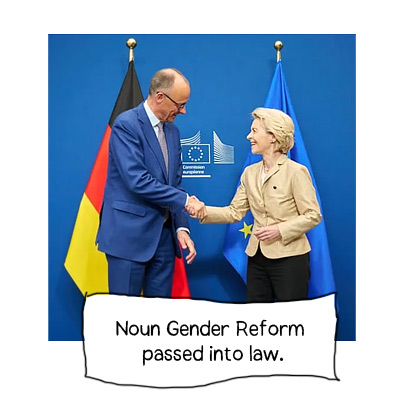
Eventually, a quite clever compromise was found and yesterday Friedrich Merz, our current chancellor, signed the Gender-Rotations-Gesetz (GRG-2026) into law.
German Noun Gender – Rotation
So how does noun gender change in 2026?
Well, it’s a very German solution that’s inspired how school holidays are organized within Germany – noun gender rotation.
Every 2 years, noun gender will rotate.
So all feminine nouns will rotate to being der, the masculine ones will rotate to being das and so on.
That way, every noun gets to be every gender over the course of 6 years and no one can sue for discrimination.
Sounds complicated but for native speakers this actually isn’t an issue, because we know the gender of each noun, so we just have to move it over one spot. Easy.
And that’s not all. This is a very German law after all, it needs complexity, and that’s why the rotation is staggered.
For example, all feminine nouns will rotate to der on first of June 2026, but only those.
And then, half a year later, all nouns that were originally masculine will rotate to being neuter and six months later, those that were originally neuter will rotate to being feminine.
And there is a grace period of 6 months after each rotation where both genders, the “old” one and the “new” one, are valid.
It’s a bit confusing, but here’s a chart from the ministry that can help:
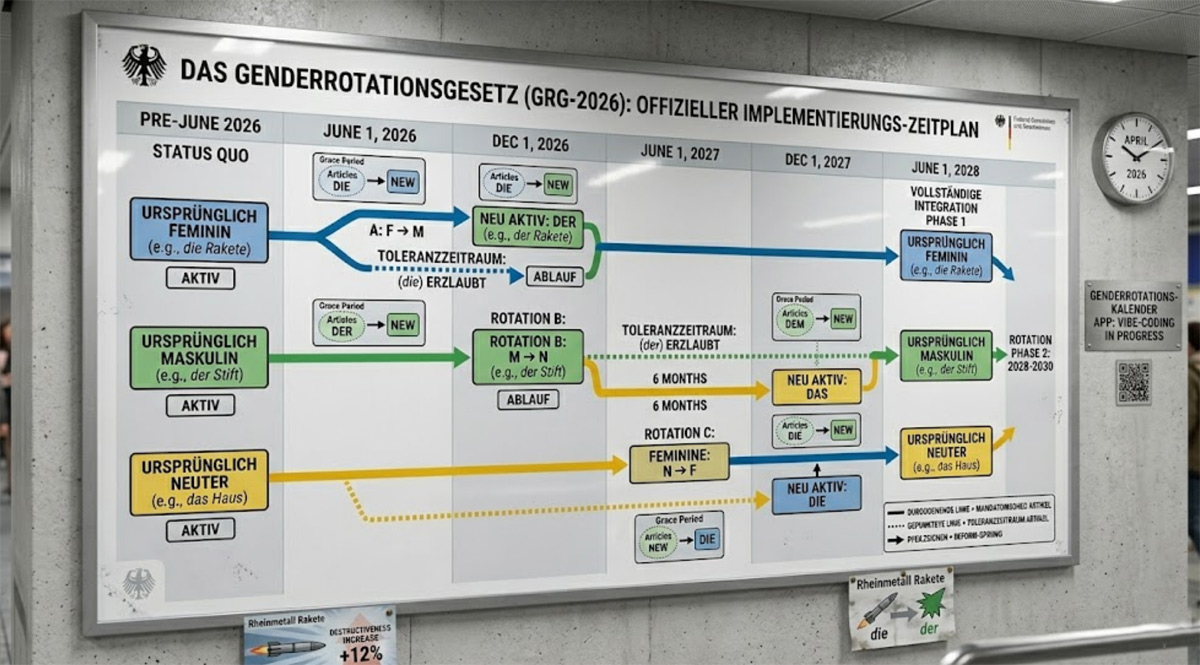
For learners like you, this actually brings some opportunities, because there are many periods, where you can get by with only using two genders.
TestDaF, Telc and even the random gender quiz in class MUST abide by the law when grading your stuff.
All you need is a “Rotation Calendar”, where you can check which gender is the most common at a time, which one is in grace period and which one is currently inactive.
This makes it much easier to get it right.
Good news is I’m currently vibe coding an app for that.
It’ll probably be finished in a few days, and I’ll definitely share it with you then.
But yeah… this is the German noun gender reform and it starts 1st of June THIS YEAR!
Crazy stuff, I did not expect that to happen this fast.
Get ready for an onslaught of YouTube videos about this too. For learners, this is definitely a win in my opinion, but I’m curious what you think?
Do you like the reform? Is it too complicated?
And those of you who learned the classic genders… do you feel cheated now?
Let me know all your thoughts in the comments, have a great day and I’ll see you soon with the Gender Rotation Calendar App.
Bis dann!

 Audio Speed
 Dark Mode
hahaha
April Fool’s!
It could have been the occasion to emulate the English system: masculine or feminine for the subjects who have these characteristics. Neuter for all the oher words.
That would be too easy. We can’t have it be too easy. The textbook German course industrial complex needs to make money.
Absolutely brilliant! I was so ready to pass this on to my U3A German speaking group! Glad I checked the comments! Well done! Thank you!
I think your April Fools Day thing should’ve been to get rid of das, so there’s only der and die, only masculine and feminine. It would have been timely given that the US government only recognizes male and female now.
Just getting to read this. YEAH, NO WAY, lol is what I was thinking….
From my floating think tank, I can only say, for dizzying us with your staggering rotation, you are a love.
Ah April fools. Got me.
This is imo utterly ridiculous. Now I have to retrieve the correct article then mutate it adding processing time. Why not just use a single article. Like das for all. No gender; all neutral. This would be like “the” in english. Now that would ease the burden on learners
i’m reading it on 6 April and all I could think about was that it is fair….but way too complicated. I was hoping for a rotation that was der for all for a year and then the die year followed by the das year. That would have been helpful…but I suppose boring. A very clever April Fools Joke because it bordered on being belieable. When i lived in Mongolia from 2004-2008 about 1/3 of the cars had the steering wheel on the right since a lot of cars came from Japan. It was quite confusing when you got in someone’s car since you never knew which side to get in on if you sat in front. It wasn’t always so smooth driving in Ulanbaatar with so much traffic and there was a concern about the traffic. They decided that on odd days the cars with the steering wheel on the left would be able to be used and on even days the cars with the steering wheel on the right. People thought…well that might be the solution to the traffic problem…but it was just an April Fools Joke. It did make people think twice before knowing it was a joke.
Lol, yeah, I totally believed that until you said it was in fact an April’s Fools joke. It’s definitely one of those stories that could be real.
Der Genusvorschlag ist absurd!
Funny thing is, the way the world is now…this is in fact believable.
Yeah, sadly it’s hard to tell what’s satire very often.
I really thought it was real until I read the comments… because
1. I’m reading this on Apr 5
2. I think German could actually do this
thank you for infırmations
This was an April’s fools joke, just to be save :). None of this is true.
FROHE OSTERN ALLERSEITS!
April, April!!
Absolut toll!! This April Fools piece is on par with the BBC April Fools video from the late 1950s about the Spaghetti Trees of Switzerland that supposedly are in the Ticino. Here is a link: https://www.youtube.com/watch?v=tVo_wkxH9dU
Yeah, no problem.
I thought it must be April Fools joke, but laughed anyway, so very good one!
Wow, you definitely fooled me. I was about to give up on learning German. Remembering the genders of nouns is already one of my biggest struggles
Hilarious though, because the beginning part about the missiles sounded just ridiculous enough to be true.