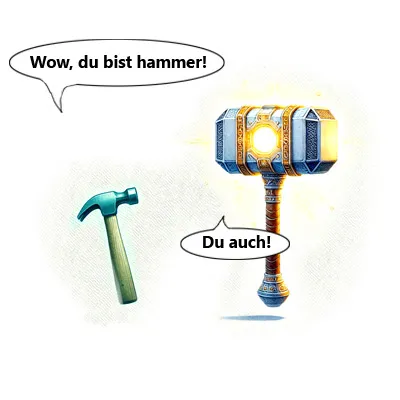
Hello everyone,
and welcome to our German Word of the Day. This time we’ll have a look at the meaning of
der Hammer
Hammer is a comestible. It’s usually made from porc and it’s either dried, smoked or wet cured. So basically it’s like ham just … hammer.
Wow. “Like ham, just hammer”?!
That must have been one of the unfunniest jokes ever. Oh boy, so much for my new years resolution of making better jokes. But hey… it can only go uphill from here. Or can it.
Anyway… of course, der Hammer is the exact same thing as the English hammer, the tool to put in nails. What you might not know though is just how much Germans like the word.

 Audio Speed
 Dark Mode
Would this sentence then technically be correct (and impressive)?
Thors Hammer ist hammer hammer
IT definitely works and I’d say it’s technically correct but ONLY in colloquial German :)
Cool, thanks :)
Du bist nicht der Hammer, sondern der ganzen Werkzeugkasten, Lieber Emanuel:)
Gur
Meinst du “gut”?
So funny! I can’t wait until I can use “hammer” in conversation!
hammer
Ich höre gerade das Lied “Schöne neue Welt”von Culcha Candela und es gibt einen Abschnitt – “Alle sind Hammer drauf.” Heißt das – “Eveyone’s all riled up”? And could I say “Ich bin Hammer auf”something else? Danke!
“Hammer drauf sein” means something like “to be in a really awesome mood or more generally, to be really cool.
It doesn’t work with “auf” though. In general, you need to think of these words like aus and auf and their (d)r-versions as separate things. They have a similar core idea, but their functions are different.
Cool – thanks!
A)mein Einhorn ist der hammer
B) Diese food ist hammerlecker,aber hammerkalt.
C) Du bist hammer klug
“hammerklug” is one word, and “Food” is “das” so “dieses”.
Other than that, no mistakes :)
I just found this thread and have a question, hope someone is still here to answer me. I’m about to buy a Mercedes E63S (a very fast German car for those who don’t know), and may purchase a personalized (vanity) license plate for it. Among several ideas is a plate which reads “Der Hamr” which I believe would be a double entendre, because 1) it would pay homage to the original Mercedes AMG Hammer cars from the ’80’s, and 2) it would indicate that the car is “awesome, high intensity, high impact and/or extreme” (and since the car has over 600 horsepower, this is fitting). I also like that its two meanings would not be obvious to many people, and only those “in the know” (or those who speak German) would understand the plate.
Is “Der Hamr” correct, or do I want to use “Das Hamr” or some other similar phrase?
Thank you!
William
“der Hamr” is fine, but a German native speaker does need a bit of creativity or humor to make the connection.
Could you make it just “Hammer” without the article?
Hi Emanuel, what about the phrase “einen Hammer bringen”? Jemand hat mir grad gesagt “du bringst nen Hammer” und ich war mir nicht ganz sicher dass ich verstanden habe.
Danke sehr!
Hmm, I’d understand it as something like either “dropping a cool one liner ” or “do something pretty strange/crazy” (like coming half an hour late to the most important meeting ever).
But it doesn’t sound very idiomatic to me. Who said that to you? A German native speaker? From what area then?
Ok, that kinda fits with the context. Yes, it was from a German native speaker from Nordrhein-Westfalen.
We use hammer in a similar way in England. “I went out last night and got so hammered I can’t remember half of it!” – positive experience. “I’ll hammer you if you don’t pack that in” – negative experience.
Wow. Feierabendhammer… where has this been all my life. I need one.
Du bist hammerinformativ :)
Was fuer einen hammer Artikel!
Ich wollte wissen, funktioniert der Hammer auch mit genitiv?
Zum Beispiel: “Du warst der Hammer der Party” – the highlight of the party.
Ich hab’s noch nie so verwendet, aber man würde es auf jeden Fall verstehen, denke ich.
Was Genitiv angeht… hammergängig sind folgende Formulierungen: “Der Hammer der Woche/des Tages/des Jahres etc”
Thank you so much for your course, love it!
Heute haben wir eiskalten Wetter, aber meine lange Unterwȁsche is hammer.
Nice! Nur ein kleiner Fehler: “eiskaltes Wetter” (nicht “kalten”, Wetter ist das)
Thanks for the correction. I am so struggling with Adjektivendungen. I have to find a way to practice them until I have a firm grasp. However, I have been having a blast with Hammer.
Wow, was für ein Hammer Wort. Ich hab es niemals in dieser Sinn gehört. Ich spiele ein parr Apps auf deutsch, die etwas ähnlich wie “es hat sich ausgehämmert” oder so etwas verwenden. Ich wieß laut die erklärung darunter, was sie damit gemeint aber kann mich es auf englisch nicht übersetzen. Wießt du wie es auf englisch sagen würde.
Bonusfrage – welche app spiele ich, die dieser satz enthalt?
kennst du das, dann bist du ja der hammerkerl. Existiert das?
So, ich habe meine Google Skills aus der Scchublade geholt und ich glaube du spielst “Boom Beach” und der Satz kommt irgendwann im Zusammenhang mit General Hammer.
Die Formlulierung ist ziemlich gängig:
– Es hat sich ausgeverbt.
Das heißt so viel wie “That was it with the verbing” in sense of someone is forced to stop doing what they’ve been doing.
Ich glaube, das Beispiel von dir würde ich so übersetzen
– No more hammering from now on.
https://www.youtube.com/watch?v=awJOmYSShQw
Oh, that one :)
Here’s the original video (I hope it plays outside Germany)
https://vimeo.com/20363113
Meine Freundin ist gegangen.
Ich stand alleine da, hammer schockiert.
Sie war eine Hammerfreundin aber ich habe alles hammer vermasselt.
Ich hammer vermisse sie. Ohne sie wäre ich ein Zimmermann ohne Hammer.
Hammer scheiße! Was soll ich machen?
Hahaha… hammerobergut!!
Nur eine Sache hat nicht funktioniert:
– Ich hammer vermisse sie.
Dasgeht nicht, denn das Verb muss auf 2.
– ich vermisse sie hammer(doll).
(mit Adjektiv ist hier besser)
I never thought Hammer could be so cool, unless I forget it outside in this Hammerwetter! (Can I use it, sounds a bit like Donnerwetter)
Anyway, It’s only yesterday my colleague told me that they often shorten the pronunciation of words in Schwäbisch, and Hammer becomes Hammr! and Wir haben Hammer becomes Wir habn Hammr.
Thanks Emanuel. You are hammerawesomefantastic!
In Berlin it would be “Wia hamm hamma”. There’s also this joke sentence
– “Hamma hamma nich” (Hammer haben wir nicht)
Meh, not really a joke but anyway.
One thing though. “Hammerwetter” actually sounds positive to me.
When you add hammer to an adjective it just makes that extreme. But when you combine it with a noun, it sounds positive
– Hammerpreis (really good price)
Hammerhammer (really awesome hammer)
ONly if the context is crystal clear, it can sound negative. “Hammergestank” would be “horribly strong stench” for instance. Good thing you tried that out. I wasn’t aware of that nuance before.
I thought wir was supposed to be pronounced wia normally? or am i supposed to pronounce the r
No, you don’t have too. “Wia” is proper… with a short and under-enunciated “a”
This was great, I can’t wait to try it!
Let me know how it went.
Hammergut!