Hello everyone,
and welcome to our German Word of the Day. And it’s time for another one fo those words that people use every day but that are kind of below the radar when it comes to learning vocab. Today we’ll look at the meaning of
überhaupt
Überhaupt consists of the two parts über and Haupt.
Über is a preposition. In a local sense, it lines up very well with its English cousin over, and über is also the main German translation for about.
Just think of two people discussing a plan that’s in front of them on a table. Their heads are “over” it and they talk “about” it. That’s kind of the connection there.
Anyway, let’s take a second or two to look at the word Haupt. Because there are a couple of surprises waiting for us.

 Audio Speed
 Dark Mode
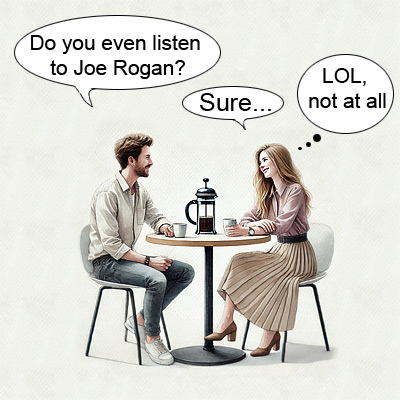
I think in a lot of these cases an english translation would be ‘to begin with’
‘I didn’t eat your yoghurt. Where did you get that idea to begin with?’
‘Well, I don’t like opera to begin with’
‘I’m not learning Chinese to begin with’
‘Maria really isn’t my type to begin with’
‘If I come to begin with, it won’t be before 10’
‘What good is that supposed to do to begin with’
‘To begin with’ isn’t the *best* translation in every case, but it’s usually *a* translation that makes sense and is idiomatic. In fact, you use it in one of your last examples.
Also, do note that these some of these cases are more colloquial and wouldn’t fly in written english
So if I understand correctly, überhaupt pertains to what I would call an ‘anterior condition’? Like, something that precedes the current topic in a logical way.
So for example in the Chinese case, ‘I don’t learn Chinese’ is anterior to ‘my Chinese course is better than yours’ because it’s a pre-condition thereof. (davon?)
Or, with the opera example, if I don’t want to go to the opera (to begin with x), it doesn’t make sense to look for time and tickets
I’ll take a shot at explaining behaupten as ‘to claim, or hold one’s ground’. Inflicting, or discussing one’s place at the head of a clan, or as chief, would require one to claim the title first, and then hold one’s ground against challenges.
Makes perfect sense to me :)
Cool. Does that mean I “win a free tour of your studio for me and 2 friends including a free coffee from your kick ass vending machine*?
;)
Absolutely! Vending machine is broken though :/. I’ll let you know once it’s up and running again.
The second sentence of your English translation for this example has an error:
“Aber ich hab’ deinen ach so teuren Bio-Vanillejogurt nicht gegessen. Woher willst du das überhaupt wissen?
But I didn’t eat your oh so expensive organic vanilla yogurt. How do you wanna know that anyway?”
“Wanna” should be “even”, or omitted altogether.
“How do you even know that, anyway?” (“Even” adds more of a “gotcha” vibe)
“How do you know that, anyway?”
I think the “bare” version without “even” works better then. Though the “gotcha”-version is also possible with the right tone of voice in German.
This is the same with English. Tone can totally add the “gotcha vibe” without using the word “even”, but regardless of tone, adding the word “even” makes it sound like you’re suspicious, rather than simply inquisitive.
Correction to my previous post: I came across ‘uberhaupt’ in Kants Religion within the limits of reason alone.
How can a disposition count for the act itself, when the act is always (not eternally, but at each instant of time) defective?
Wait, is the part in parenthesis how “überhaupt” was translated?
überhaupt sorry. Is that correct?
I can’t tell. I need the original and then also a reference how “überhaupt” was used at the time Kant was alive. I can imagine the word’s usage has changed significantly. If this is an official translation, then it’s probably very well informed and I’d assume it’s what Kant meant, but yeah… I definitely need to see the part in German.
Came across this word in Kant Religion within the limits of reason alone. Be ye holy (in the conduct of your lives) even as your Father in Heaven is holy.
I actually think I’m grasping the meaning of this. In English, there are idioms that capture the meaning, I think. One of them is “on top of it all” meaning of utmost importance, sort of. Your examples take to this fairly well. One aspect of the meaning is to negate something because überhaupt has such a superlative meaning. Like *after all of that* still *this*. Your explanation of it being the “head” like the one in charge, or the person at the top, or the most important aspect, or and idiom “in spite of that”.
Looking at your examples:
Hast du den Film überhaupt gesehen? In other words, Have you the film (after all of that) seen it? In context of what *was* said, after having said that, have you *even* seen it?
Incredulous negation!
Morgen? Hast du überhaupt Zeit? Do you have, on top of that, time?
Kann man da überhaupt irgendwo parken? The top or main thing… Can you, on top of that even, park there?
Wissen Sie überhaupt, wer ich bin? Do you, on top of that, know who I am?
So, I’m seeing that, in English, the little word “even” accomplishes much of the same task.
Wann warst du überhaupt das erste mal in Paris? When were you even in Paris for the first time?
Ich komme, wenn überhaupt, erst um 10. Here, with *wenn* (if) ‘after all that’, ‘on top of that’ ‘the main thing being’
I come, if (after the most important stuff) [ here head meaning on top of what’s in charge of me] first at 10.
Wenn es überhaupt mal schneit, dann nur ganz wenig. Here *it, mal schneit* is the most important thing, which is snow. If (it, the most important thing… is the time for snowing), then it will only be a little bit.
So basically it elevates the topic of discussion to the highest level of importance, then questions and negates it.
So basically it’s a superlative negator, or as I say above an incredulous negation. Adding additional superlatives, or even a negation like *nicht* just forces it to be negated even more so. For example, if über (the top) *haupt* head or that of chief control or importance, the top thing, all of it is *nicht*, then it is the lowest of the low, the least to the point of non existence. In other words, not the überhaupt; but the nicht überhaupt, or the “nothing”.
Ich weiß überhaupt nicht, was dein Problem ist. I know (absolutely the least possible thing) what your problem is.
I guess I’m trying to say that placing something at the *head* of something, or the most important, top, thing in charge works. It works to make the ‘main thing’ or as you say, ‘the general idea’ wildly over the top; or to negate and push it to the bottom. Idiomatically of course. Überhaupt.. das war der grundgedanke.
Interesting thoughts and analysis!!
The parallel between “even” which often is a translation for “überhaupt” and “on top of that” is pretty clear. For some reason though, thinking of “überhaupt” and thinking of “on top of that” doesn’t make me “feel” the same way. “überhaupt” does what you described but it doesn’t feel “peak” in any way.
Maybe because in these contexts like “do you even have time?”
it’s used for somewhat of a prerequisite, rather than the actual deal.
– Warst du überhaupt in Paris?
Like… we need a positive to that first, before we can actually start the conversation. In some way, this question is the most crucial one, because it decides over whether there is a conversation or not, but at the same time, it’s a bit like a prologue. And maybe that’s why this “on top of that” notion doesn’t feel the same to me. That one clearly implies that there’s other things to build on.
Phew…. not sure if I’m making any sense :). It’s just … “on top of that” doesn’t feel like a good match to “überhaupt” even if it makes sense intellectually.
But that’s just me though and for people who are not natives it might be perfect :)!
Aber ich hab’ deinen ach so teuren BioVanillejogurt nicht gegessen. Woher willst du das überhaupt wissen?
But I didn’t eat your oh so expansive organic vanilla yogurt. How do you wanne know that anyway?
typo with “expensive”, and then “How do you wanne know that anyway?” should be “Why do you wanna know that, anyway?” or “None of your business.”
Thanks for those, “expensive” is one of my “most favorite” typos.
As for the second one… the idea of the German sentence is asking how the person got the idea to begin with. Is there any way to translate that with “want to”? If not, I’d go for
– How did you get that idea anyway/to begin with?
Your rather awkward phrase “tell me about the basic reality” might be more simply expressed by the ubiquitous American slang expression: “Get real!”
Definitely more idiomatic than mine :). Doesn’t get real sound a little pushy though? I feel like it’s quite a bit stronger than “überhaupt”.
hoofd is a Dutch word , meaning “head”. Kop is also a Dutch word meaning “head” but only used for an animal’s head or slang for a human
head. It is very disrespectful to call a human head “kop”. Hoofd is used in hoofdstad meanng capital, hoofdzaak, meaning Hauptsache
hij is het hoofd van het department, hij is het hoofd van de Sioux, etc. Kop is used in he is at the head of the peloton: hij is aan de kop van het peloton.
überhaupt fühlte er sich jetzt wohler.
I have read your page still don’t understand the use of überhaupt in this sentence from my grammar book :'( could you please explain it to me?…fantastic website btw :)
This is a quite rare way to use the word and I think you can only find it in books. The idea is something like “overall” but for a good translation, that fits the tone, I’d need more context.
What’s interesting about this is that the “überhaupt” can’t be moved elsewhere. Grammatically yes, but then the sentence becomes weird. It really only works in the beginning. Hope that helps a bit.
Getting my head to think German is crazy confusing…but yeah that helps. As long as it’s the sentence that’s a bit odd and not just me copletely missing the point :p thanks a lot!
I feel like the best translation in a lot of these examples is actually “even.” “Do you even know who I am?” “Did you even see that movie?” “Is there even anywhere to park in there?” “When were you even IN Paris?” etc. When “even is added (as in, as you point out, “at all”) tfor emphasis and the sense of disbelief.
That’s nice. It really seems like a good match.
Auf Englisch heisst “behaupten” auch “to maintain” und “to assert”, die beide gleichbedeutend mit “to claim” sind. Damit ist das reflexives Verb sinnvoller, weil “to maintain oneself” und “to assert oneself” ähnlicher wie “to hold one’s ground” wirkt. (passt da “wirkt”, oder?)
Hoffentlich leuchtete das ein, besonders weil mein Deutsch nicht so gut ist! :)
Ja, das hat voll und ganz eingeleuchtet :)… was “wirkt” angeht… also wenn du meinst “to assert oneself ” WORKS more similar, dann nein. “Wirken” funktioniert dann nicht. Man würde “funktionieren” benutzen.
Wenn du meinst, “to assert oneself” LOOKS/SEEMS more similar, dann jein… man würde “wirken” verstehen, aber ich würde es nicht verwenden, da “to assert oneself” nicht ähnlich wirkt sondern ähnlich IST (it doesn’t appear similar, it IS similar, grammatically). So ein bisschen so, wie wenn du eine Katze siehst, und du sagst “Das wirkt wie eine Katze.” Technisch und faktisch ist es richtig, aber es ist trotzdem komisch. Hoffe, das macht Sinn für dich :)
Hello! Many thanks. Could you kindly tell me if it is OK to use “schließlich” instead of “überhaupt” here?
Während der Fahrt dachte ich nur darüber nach, was geschehen wird. Was sollte ich überhaupt sagen? Wie würde sie reagieren? Schließlich hatte sie den Kontakt vor über zehn Jahren abgebrochen!”
In other words are the two words interchangeable (at least in some contexts)?
Thanks again.
So first of all, the example you gave is perfectly fine… but the words are not interchangeable. “Schließlich” comes from “schließen” (to close) and that’s why there is an idea of conclusion in it which is lacking in “überhaupt”
– Während der Fahrt dachte ich nur …. . Was sollte ich schließlich sagen?
This sounds as if you’re justifying your thinking because you don’t know what to say.
– throughout the whole the journey/drive I kept thinking about what was going to happen. I mean, would could I possible say.
You can see this closure idea in the following sentences where the “schließlich” justifies you’re worrying about er reaction by telling us that she stopped contact 10 years ago. “Überhaupt” wouldn’t work there as it would sound a bit like “besides, she stopped contact 10 years ago, to begin with”
And back to the first sentence… the same sentence with “überhaupt” is different. Then the “what am I going to say” is just one part of the problem, one thing you’re worrying about.
– Throught the whole drive…. What would I be saying to begin with?
Hope that makes sense :)
Vielen Dank! Ich lese gern Ihre Blog.
Das freut mich wirklich :)
Hi
I learned German like in the 80s, I am coming back but won’t dare to write a comment in the language :)
I recently found this blog and have to say the way you explain things make me “feel” German – e.g. that entry about Enttäuschung.
If I could order a “word of the day”, that would be the core -scheid- (and -schied- if it’s its cousin) and all this entscheiden, verschieden etc.
BTW, what is a German word for a killer of a Hottentot mother of a stutting dumb that was placed in a case made of lattice work designed to keep possums? Isn’t it just the Hottentottenstottertrottelmutterbeutelrattenlattengitterkofferattentäter? ;)
“BTW, what is a German word for a killer of a Hottentot mother of a stutting dumb that was placed in a case made of lattice work designed to keep possums? Isn’t it just the Hottentottenstottertrottelmutterbeutelrattenlattengitterkofferattentäter? ;)”
No, I’m afraid it’s a killer of that opossum cage that had apparently been made out of the mother of that stuttering dumb Hottentot. Apparently it’s something out of Marquis de Sade’s novels ;)
Yeah, Grateful reader is right :)… you have to read these compounds from right to left in a way…
Attentäter + Lattengitterkoffer + Mutterbeutelratte ….
And then for the “+” you have to fill in the connection by guessing :)… I don’t know if you know this word already but a really great one was this:
Rindfleischetikettierungsüberwachungsaufgabenübertragungsgesetz
IT’s a name of a law but the repealed it, I think. The abbreviation was also golden:
RflEttÜAÜG
Note the proper use of capital vs. non-capital letters :D.
The “scheiden”-family is a good idea by the way. Ich setz ‘ es auf die Liste…
BTW, this word demonstrates a couple of principles on which the German compound word system is based. Like “s” after -ung and “en” after a feminine noun (Aufgabe). These are not “strict” rules, but nevertheless… Perhaps a good topic for a future post? ;)
Good topic? Yes, definitely. Will I do it it? Meh.. I don’t know… firstly, I don’t really know about this and then there isn’t really much explaining needed and I am sure there are good lists about this elsewhere… for example on your hard drive (wink wink) ;)
By the way… do you know these “soundified” verbs people use in German comics sometimes? … like… I would open a can with a screw cap and there would be written “*schraub” next to the lid. This form actually has a name :D
sounds like an onomatopeia https://www.tfd.com/onomatopeia
Nice try, but no… you can do that to any verb… like, if one guy hands something over to another one you could write a little *geb next to the hands for example :)
https://de.wikipedia.org/wiki/Inflektiv
;)
Wieder Offtopic: theoretisch ist zwar “möchte” eine konjunktivische Form von “mögen”, es hat aber eine besondere Bedeutung, die von den restlichen Sinnen des Verbes ziemlich stark getrennt zu sein scheint. Meine Frage diesbezüglich: kann man “möchte” verwenden, wie man normalerweise andere Konjunktive gebraucht? Z.B.: Ich kann das tun, doch ob Sie das mögen würden… -> Ich kann das tun, doch ob Sie das möchten… ?
Gute Frage. Die Antwort ist nein.
Wenn sie das mögen würde, wäre das was anderes (aber sie mag es nicht)
Wenn sie das möchte, wäre das was anderes. (aber sie möchte es nicht)
oder auch hier:
Sie sagte, sie würde das nicht mögen.
Sie sagte, sie möchte das nicht.
Das ist einfach nicht das gleiche.
Ich glaube, die meisten Menschen empfinden “möchten” als eigenständiges Verb und sind sich der Verbindung zu “mögen” nicht bewusst… oh Gott… ich schreibe heute aber gewählt :D.
“Mögen würden” klingt nicht so gut und ich glaube, man würde es, so möglich, vermeiden, indem man beispielsweise “gefallen würde” sagt oder einfach “mag”.
Hmm, es ist als ob diese Verben eigentlich verschiedene Verben wären, die nur historischich miteinander verknüpft sind, ohne einen Bedeutungsüberlapp zu haben. Vllt das Einzige, das es verhindert, die offiziell abzutrennen, ist dass “mögen” in diesem Fall ohne eine Konjunktiv-Form bliebe, was nicht so schön wäre ;)
Naja, das, und die Tatsache, dass “möchte” nur im Präsens funzt :P
Das kann man ja ändern:
Heute möchte ich ein Bier. Gestern möchtete ich einen Wein.
Eigentlich sind die doch offiziell getrennt… ungefähr so wie in English “can” und “could”.. vielleicht sogar mehr.
Von wem denn? Nicht im Duden, dessen bin ich mir sicher :P
Stimmt, hab’ grad geguckt… und bei DWDS ist es auch nicht… aber frag’ mal Otto Normalverbraucher, was der dazu meint :D
Da gibt es noch so einen fornehmen Gebrauch, den ich nie so ganz kapiert habe.
Deine Mutter bittet, du möchtest sie bitte zurückrufen.
“vornehm” :).. dieses “möchten” kommt von dem alten “mögen”. Ein König hat zum Beispiel gesagt:
Das ist so was zwischen Wunsch und Befehl… beim König natürlich ein de facto Befehl. Wie auch immer… etwas ähnliches ist die formelle Wendung
Das benutzt man heute auch noch.
Und das “möchte” in deinem Beispiel ist einfach nur die “verfreundlichte” Version davon, die allerdings kein bisschen freundlicher ist.
Mit “möchtest” klingt es für mich fast schärfer.
Woher willst du das überhaupt wissen?
Why use “woher” here in stead of waruum?
Danke!
Well, you’re right that “warum” could work too… but not in this situation. Here’s what I had in mind: person A accuses person B of eating it. Person B says “I didn’t do it” and then asks where person A got this information to begin with.
A situation for “warum” could be this. Person A asks person B how much many calories a can of beans has. Person B says that he doesn’t know and both keep guessing a bit until person B asks WHY person A is asking in the first place
Keine Ahnung. Warum willst du das überhaupt wissen?
Hope that helps
Very good!
Hallo! Offtopic: gilt alles von Folgendem als korrekt oder?
Es kommt drauf an, was…
Es kommt an drauf, was…
Es hängt davon ab, ob…
Es hängt ab davon, ob…
Ich denke darüber nach, ob…
Ich denke nach darüber, ob…
Also …
Es kommt drauf an, was…
Es hängt davon ab, ob..
Ich denke darüber nach, ob…
Die sind alle ok, und das ist auch die Standardstellung.
Es hängt ab davon, ob…
Ich denke nach darüber, ob…
Die sind so naja naja… eigentlich falsch aber wenn der Mund schneller ist als der Kopf dann kann das schon mal vorkommen.
Es kommt an drauf, was…
das geht nicht. Wenn, dann mit “darauf”, aber die verkürzte Form klingt super unrhytmisch. In diesem Fall geht übrigens auch folgendes:
Es kommt an auf, was…
Ok. “Geht” ist vielleicht ein bisschen übertrieben. Man sollte das nicht schreiben. Aber ich habe es schon gehört und gesagt. Warum fragst du? Suchst du nach einem tieferen System :)
Naja, ich denke über die Ausklammerung nach, und die Hälfte von den Beispielen stellen genau diese dar, obwohl in abgekürzter Form, mithilfe jener Adverbien… Ich habe vermutet, dass so was wie “Es hängt ab davon, ob…” dazu dienen könnte, die Betonung ein bisschen zu “verschieben”. Anscheinend nicht ;)
Hoffentlich behandelst du auch die Ausklammerung bzw. die Ausrahmung in der Zukunft. Ich hab schon darüber eine Menge Artikel gelesen, und verstehe, weshalb es in manchen Fällen notwendig ist, doch nicht in allen.
Das hast du gut geschrieben Emanuel! Danke :) Sollte folgende Satz : “Wann warst du überhaupt das erste mal in Paris?” aber nicht eher “wann warst du überhaupt zum ersten mal in Paris? oder “Wann war überhaupt das erste mal in Paris” sein? Es hört sich jetzt ein wenig seltsam an :)
Hey, schön, dass du noch dabei bist :)… und gute Frage. Ich selbst empfinde “zum ersten Mal” hier als ein bisschen sperrig/klobig. Ich habe dann aber überlegt, ob “das erste Mal” ein Anglizismus sein könnte. Daher habe ich auf Google geguckt. “Ich war das erste mal in” gibt 1,2 Millionen Treffer, “ich war zum ersten Mal in” gibt 300.00… bei Google ngram war das Ergebnis ähnlich
https://books.google.com/ngrams/graph?content=war+das+erste+Mal+in%2Cwar+zum+ersten+Mal+in&year_start=1800&year_end=2000&corpus=20&smoothing=3&share=&direct_url=t1%3B%2Cwar%20das%20erste%20Mal%20in%3B%2Cc0%3B.t1%3B%2Cwar%20zum%20ersten%20Mal%20in%3B%2Cc0
Es geht also beides und “das erste Mal” ohne Präposition wird häufiger benutzt. Wahrscheinlich nach der gleichen Logik wie
Ich war Montag beim Arzt.
anstatt
Ich war am Montag beim Arzt.
Deine dritte Version heißt übrigens was anderes:
Wann war überhaupt das erste Mal in Paris?
When was the first time (for whatever we’re talking about) to happen in Paris (as opposed to Warsaw or Berlin)
Wenn man die gleiche Bedeutung haben will, wie bei den anderen beiden Sätzen, dann müsste man sagen:
Wann war das erste Mal, dass du in Paris warst.
Nicht so schön, kommt aber vor.
Geht in Holländisch nur die Version mit “zu”? Und heißt du eigentlich wirklich “Jurgen” ohne Umlaut :)?
Haha, ich bin eigentlich auch nie weg gewesen. Ich war die letzte Zeit nur richtig beschäftigt deswegen konnte ich mich weniger auf das Deutsch lernen konzentrieren. Ich habe trotzdem alles gelesen was du geschrieben hast! (ich bekomme ja auch jedes mal eine Mail wenn du hier was neues gepostet hast :) )
Du hast recht, die dritte Version bedeutet was anderes aber ich wollte nur zeigen dass ich in so einem Satz “das erste Mal” nutzen würde und in dem anderen Fall wenn es sich direkt von einem Person händelt (also ohne Beisatz) dann würde ich eher die zu-Version nutzen. Aber das ist nur mein “falsches” Gefühl…. Auf Niederländisch ist es halt einfach so und eine Satz wie “Wann warst du überhaupt das erste mal in Paris?” geht dann einfach nicht. Aber deswegen sind es ja auch unterschiedliche Sprachen :) Ich habe mal eine Deutsche Freundin gefragt was sie in dieser Situation sagen würdet und sie hat auch die “das erste Mal” Version gewählt. Also sie war mit dir einverstanden :) Mein Gefühl für Deutsch muss sich offensichtlich noch weiter entwickeln…
Zu deiner Frage: Ja ich heiße wirklich Jurgen ohne Umlaut :) Auf Niederländisch gibt es überhaupt keinen Umlaut. Also die meisten Deutschen, mit denen ich rede, können meinen Name auch nicht richtig aussprechen und sagen entweder “Jürgen” oder “Joergen”. (“u” klingt wie “oe” auf niederländisch :P ). Sowas wie der richtige “u” klang gibt es einfach nicht im Deutschen :)