Hello everyone,
and welcome to new episode of Colloquial German – the series where we look at all the stuff that people use in real life but that you won’t find in the standard textbook and teaching materials.
“So basically the cool stuff?”
Yes, the cool stuff :).
And today, we’ll learn a phrase that is really common but that’s also kind of confusing.
Ladies and gents, get ready for:
The Meaning and Use of “stehen auf”
And the reason it’s confusing is that German also has the verb aufstehen. Which means to get up and it’s a separable prefix verb, so the auf can split off and appear elsewhere in the sentence.
- Ich stehe um 7 auf.
- I get up at seven.
This has NOTHING to do with the expression stehen auf.
Well, except that there’s stehen in it.
Stehen auf , or I guess we could say auf etwas stehen, is the verb stehen that then with the preposition auf, pretty much like to stand on.
But auf etwas stehen has taken on a figurative meaning and that is VERY common in daily life and a good way to talk about liking.
Today, we’ll learn all about how and when to use it, so if you’re ready, let’s jump right in.
The normal uses of “stehen auf”
The combination stehen auf has a normal day job as to stand/be on (top of) in a literal sense.
- Die Tasse steht auf dem Tisch.
- The cup stands/is on the table.
- Practice pronunciation – click once to start recording and again to stop
And it’s also used in a more figurative sense of writing. German uses stehen for writing, and it’s either in something (books, emails) or auf something (labels, signs, …).
- Was steht auf dem Schild? Ich kann das nicht lesen.
- What does the sign say/What’s written on the sign? I can’t read it.
- Practice pronunciation – click once to start recording and again to stop
Oh and stehen auf is also sometimes used in the context of settings, like here:
- Der Kühlschrank steht auf Stufe 4 und ist trotzdem zu warm.
- The fridge is on level 4 and still, it is too warm.
- Practice pronunciation – click once to start recording and again to stop
So these are the “normal” uses of stehen auf, and they’re already enough to make it worth learning.
But it there’s more.
Auf etwas stehen – The Colloquial Meaning
The expression auf etwas/jemanden stehen is a super common informal way to express liking.
So yes… it’s a forth option besides mögen, gern and gefallen.
It does express genuine liking, similar to mögen, but it’s WAY more colloquial sounding than that. Almost a bit slangy or “cool”. It doesn’t work so well for serious emotions, and I feel like stehen auf sounds a little more greedy, or lusty at times.
Like… you want have it. You don’t just appreciate it for what it is.
Anyway, let’s look at some examples and see.
- Ich steh auf Regen.
- I like/dig rain.
- Practice pronunciation – click once to start recording and again to stop
- “Willst du mal meinen Veggie-Burger kosten?”
“Nee, ich steh nicht so auf Soja.” - “Do you want to try my burger?”
“No, I don’t really like soy (that much) .” - Practice pronunciation – click once to start recording and again to stop
- Ich steh’ voll auf Marias Parfum.
- I really like Maria’s perfume.
- Practice pronunciation – click once to start recording and again to stop
In these, we had the ‘target’ directly included, but of course we can also reference it, and the way to do that in German when a preposition is involved is of course… a da-wrod. So in our case drauf or darauf.
- Wenn ihr darauf steht, unfreundlich behandelt zu werden und zu viel Geld für Scheißgetränke zu bezahlen, dann werdet ihr diese Bar lieben. (fictional review of a bar)
- If you like being treated in an unfriendly manner and paying too much money for shitty drinks, then you’ll love this bar.
- Practice pronunciation – click once to start recording and again to stop
- “Du trinkst in letzter Zeit öfter Schwarzbier, oder?”
“Ja Mann, da steh ich grad voll drauf.“ - “Just lately, you have drunk more dark beer haven’t you?”
“Yeah dude, I‘m really into that at the moment.” - Practice pronunciation – click once to start recording and again to stop
- “Ihhh… du riechst nach Döner.”
“Komm schon, da stehst du doch drauf.“
“Nee, voll nich. Geh weg.” - “Ewwwww… you smell like kebab.”
“Come on… I know you like that (that gets you going).”
“No… I soooo do NOT. Go away!” - Practice pronunciation – click once to start recording and again to stop
Now, so far, all the ‘targets’ were things, but stehen auf also works for people.
- Ich glaub, der neue steht auf mich.
- I think the new guy has a crush on me.
- Practice pronunciation – click once to start recording and again to stop
- Hey, äh… du bist echt nett, aber ich steh auf Frauen.
- Hey new guy… you’re really nice, but I like women.
- Practice pronunciation – click once to start recording and again to stop
You might have noticed it from the examples already: auf jemanden stehen is usually about THAT type of liking. The romantically interested one.
You can say the following to your crush, but not to your best friend… well, except if you have a crush on your best friend.
- Ich steh auf dich.
- I like/dig you.
- Practice pronunciation – click once to start recording and again to stop
All right.
Now, those of you who are currently in the “case phase” (the phase when you worry about getting the German cases right and try to make sense of all of them) might have been wondering “Wait, why dich and not dir.”
So, let’s talk about that for second.
“stehen auf” – The Cases
Auf is a so called Two-Way preposition. That means it can go with Dative AND with Accusative.
The normal use of stehen auf, the sense of actually standing on something, works with Dative, because stehen is stationary, and in “stationary” context, Two-Way Prepositions go with Dative.
The colloquial, abstract use on the other hand, the one that’s about liking or “digging”, works with Accusative.
And this is actually a general trend in German. Here they are back to back.
- Thomas steht auf dem Tisch. (Dative – Thomas is standing on the table.)
- Thomas steht auf den Tisch. (Accusative – Thomas digs/really likes the table.)
- Practice pronunciation – click once to start recording and again to stop
- Ich warte auf dem Schiff. (Dative – I’m on the ship, waiting.)
- Ich warte auf das Schiff (Accusative- I’m waiting for the ship.)
- Practice pronunciation – click once to start recording and again to stop
In both examples, the Dative covers the literal, location related meaning.
The Accusative is used for the abstract combo of verb and preposition.
And I can imagine that’s quite confusing for learners. But luckily it makes sense… or we can make it make sense. Get ready for some mind bending:
Liking does have some overlap with wanting. And wanting something or someone has a fair bit of direction in it. You have a goal, and even if just on a very abstract level, you’re “moving” toward it. And stehen auf with Accusative kind of captures this “directed” mind.
- Steve steht auf Maria.
- Practice pronunciation – click once to start recording and again to stop
He wants her, he desires her, his mind is bent on her, his soul is directed toward her. Damn Steve, that’s creepy… no wonder she thought about getting a restraining order.
But seriously, we can think of this Accusative as capturing the “directed-ness”, that is part of wanting and liking.
And if that doesn’t make sense to you, then I got another option, which is also a theory as to where stehen auf actually comes from.
There’s a similar phrasing to stehen auf: fliegen auf. It means the same but I think it’s a bit older and definitely somewhat out of fashion today. What’s cool about it is that the Accusative makes perfect sense there because fliegen is a directed movement, and that is connected with Accusative.
Just think of a flock of seagulls darting down on an open bag of potato chips someone left at the beach. They “fly on top of it” because they dig that stuff.
This fliegen auf might have inspired stehen auf and people just kept the case.
Wow, that was a lot of case talk :).
Let’s wrap this up then with something lighter… a word play. There’s a woman who has written a book about how to get healthy and strong feet.
And now guess what it’s title could be….
Starke Füße – da steh ich drauf.
German humor.
Dumme Witze? Ich steh drauf :).
Anyway, that’s it for today. This was our look at the phrase stehen auf, which is a colloquial way to express liking. And which is SUPER MEGA COMMON.
What about you? Have you heard this phrasing in daily life? Do you use it? Were you confused by it at first? And what do you stehen auf? Leave a comment with your example and see if you used it correctly. And of course if you have any questions about any of this, let’s clear that up in the comments, too.
I’m out for now. I hope you had fun.
Bis nächstes Mal.

 Audio Speed
 Dark Mode
Einhorn 1 : I stehe auf deine Augen
Einhorn 2 : Tut mir lied,aber Ich denke von dir.
Einhorn 1 : Bitte! Ich werde dich sogar auf mich stellen lassen.
Einhorn 2 : Ich rufe die Polizei
English
Einhorn 1 : I like you eyes
Einhorn 2 : Sorry,but I don’t think about you
Einhorn 1 : please! I will even let you walk on me
Einhorn 2 : I am calling the police
Pretty good, but two mistakes:
– Ich denke von dir.
This does NOT mean “thinking about you.” I think I just told you in another comment what the difference is between “denken an” and “denken von”. Do you remember ;)?
– Ich werde dich dich auf mich stellen lassen.
This is a weird sentence but you do need two “dich” here. One is for who you’re letting, and the other is a reflexive pronoun for “sich stellen”.
Dankeschön.
I remembered your comment about an vs von. It should be “an” here
Warum ist Ich steh auf Regen. und nicht Ich steh auf den Regen. Brauchen wir Artickle in diser konstrukcion oder nicht?
It’s pretty much the same in English – without the article it is a statement about rain in general, with the article it is a statement about one specific rain
– I like rain.
– I like the rain. (the rain that’s falling right now)
Hope that helps :)
Great article! In particular, I like how you compared “stehen” with “warten”, which made it easier to understand.
Here is how I look at “Ich warte auf Akkusative vs. Dative” issue. “Warten” is intransitive (does not have a direct object) like in English in the sense of waiting for sth. So, I can say “Ich warte”, but I can also add where I am waiting: “naben dem Schiff” “unter dem Schiff” (not likely :-)), or “auf dem Schiff”.
On the other hand, a lot of German verbs are best learned together with a proposition (as in English) [verb + preposition combo], and they can be thought off as a different verb. So, “warten auf” means “waiting for” and is transitive, that is, requires a direct object, which is in Akkusative.
The same apparently applies to “stehen auf”.
Hallo. Ich (steh oder stehe) auf diese Website. Im confused why you’re using steh and not stehe?
Good question. In spoken German, there’s a STRONG trend to skip the “e” ending at the ich-form.
-Ich hab’/mach’/geh’…
I want the examples to be authentic and using “stehe” here feels super weird. This “e” skipping is so common, that we don’t even have to mark the missing letter with a ‘ … like … steh’ . I think in 10 years you might find this in textbooks.
Aus irgendwann Gründe, “fliegt auf” (oder לעוף על) hat zu sehr bekannt Umgangsprache ausspruche geworden. Das ist sehr lustig, es in Einer alt ist und doch in Anderer sehr häufig
Ich meine auf die Hebräisch Sprache
Ah… hätte ich mal beide Kommentare gelesen :)
Meinst du in Hebräisch? Oder in Deutsch?
Man sagt übrigens “einerseits” und “andererseits” :)
everytime I have a chance to learn a lot thank you so much
Great to hear that. Thanks!
Guys, in the couple of months i have followed this blog (8 to be exact) i have noticed a HUGE improvement not only in my German level, but (i’m sure it has happened to all of you) in my confidence level in general. This is the 5 th language i’ve learned, and the first one on my own. This community is awesome and every input is really an awesome exchange of energies and ideas. I want to thank you guys who donated a bit more so that some of us can keep on progressing and feeding on this post, and endorse lots more people in the future. Let’s support Emanuel (and his new intern Dakota,,from thé Biergarten ;) ) so that all of us un this community become fluid and just learn about the truly unique language that is German. Vielen Danke dudes
LEBEN LANGE UND ERFOLGREICH..to all and to this kick-ass blog..
(In thé same spirit, i am an official translator in Spanish, French and Portuguese so if any of you habe questions.related..my mail [email protected])
– If you like being treated unfriendly …
Can you be “treated unfriendly”? “Unfriendly” is an adjective, which makes me want to stick another “-ly” on the end … “being treated unfriendly-ly”. But that looks awful, so I’d probably go with “in an unfriendly manner”, or I’d avoid the problem with “brusquely”.
Oh wow, that’s true. “Unfriendlyly” sounds really weird. I’ll go for “in an unfriendly manner” then, I think. Would “unfriendlyly” be even grammatically correct?
“Unfriendlyly” ist falsch; es soll “unfriendlily” sein – mit einem I. Danke, dass du mich es nachschlagen gelassen hast! (Or should that be: “…, dass du mich gelassen hast, es nachzuschlagen”? Or something else entirely?)
Also richtig wäre:
– Danke, dass du mich das hast nachschlagen lassen.
We don’t really have a way of dealing with converting “ly” adjectives into adverbs in English (for obvious reasons), but as this is colloquial speech, I would have no issue with saying “If you like being treated unfriendly”. In an academic setting, I’d use higher-brow language, but in many places American English is trending toward use of adjectives in place of adverbs in daily usage anyway. Mach dir nichts draus ;)
If it existed, I think it’d become “unfriendlily” :). Dictionary.reference.com claims that “friendlily” exists, so I guess in theory “unfriendlily” could exist too, but the site also says “unfriendly” can be an adverb (the way you use it).
I don’t have a problem with the phrase as you had it originally, but I think because of that awkwardness, a native speaker would tend to go for a work-around (“if you like people being unfriendly to you” or something).
You used it in some of the translations of your examples, but I’d say “be into something/someone” is THE go-to way to understand “auf etw./jmdn. stehen” – it would work in almost all your examples and really has the same sort of register and tone, at least in American usage.
Even in the kebab situation? ;)
Oh, totally :D
– “Ihhh… du riechst nach Döner.”
– “Komm schon, da stehst du doch drauf.“
– “Nee, voll nich. Geh weg.”
– “Ewwwww… you smell like kebab.”
– “Come on… I know you’re into that.”
– “No… I soooo am NOT. Go away!”
“Wenn ihr darauf steht, unfreundlich behandelt …
If you can stand being treated unfriendly…..
“Ja Mann, da steh ich grad voll drauf.”
Yeah mate, I can actually stand that stuff at the moment
“Komm schon, da stehst du doch drauf.”
Come on..I know you can stand it
It definitely works as a mnemonic device to get the “logic”of the phrase but just to make sure… “to stand sth” is not a translation for “stehen auf” and the two examples are not translations. There’s a difference in intensity.
“I can stand this stuff”… moderate liking if any
“Ich steh darauf”… quite intense liking
You probably are aware of this but I thought I’d mention it for others who just skim your examples without really paying attention :)
Hi
“I can stand this” implies no liking at all.
Q How are you dealing with the 105 degree temperature
A. I can stand it (but I do not like it)
Now if my wife made my favorite meal and asked how it was, I could jokingly say “oh, I can stand it if I have to!” But both of us know it’s the opposite of what I really mean.
And
To be “treated unfriendly” sounds really wrong, even for colloquial usage. Uneducated rather than casual.
At least in my social circles. And two of the folks working in the coffee shop I just asked agree that it sounds odd.
Just one man’s (and two women’s) opinion
Tschuess
“Who would have thought that the dour Germans have so many words for liking”, – ‘dour’ is too strong a word, Germans are not dour, ‘staid’ would be better.
Stehen auf is a common, informal way to express liking : so, if I think of it as, ‘I can stand for that’ / ‘I can’t stand for that’ – it works for me, because we use these sayings, in conection with like/dislike.
I can stand a little rain – Esther Phillips 1975
I can’t stand the rain – Ann Peebles 1974 https://www.youtube.com/watch?v=g5Rjo_imHDE
– ‘dour’ is too strong a word, Germans are not dour, ‘staid’ would be better.
Have you spent much time in Berlin? ;)
Just to say though, don’t be thinking you should change the way you’re teaching, or the use of your dialogue. If I were to do this site in my spoken language, even half of my country folk would not understand me, and I’d probably be locked up if some of my spoken dialogue were translated on the net! ;)
But wait… I do translate the dialogues. Do you mean a literal translation? For stuff like “voll nich” for instance?
“I guess you’re mostly referring to little bits in the dialogues I’m using… what exactly do you mean by backup translation. Maybe I can add something like that in the future…”
it is the dialogues, and I do take note of your dialogues because that is the ‘street’ German language, (more so than the textbook stuff, because I am not looking to take an exam, nor employment. I’m semi-retired with a holiday home) and sometimes your dialogue does not translate by Google/Bing etc, they come up with translations so out there/random and nothing to do with what/how you have said it.
I don’t believe you should now translate your dialogue too! But when I come across something you’ve said and I can’t fathom it, I’ll ask…
Thanks for being so friendly and your reply is appreciated. :)
My german friends say that using “stehen auf” and “fliegen auf” to tell someone directly that you like them is considered really vulgar and inappropriate. Can it have different cultural meanings depending on which parts of Germany you are from?
I think it might be more of an age thing. What demographic are they?

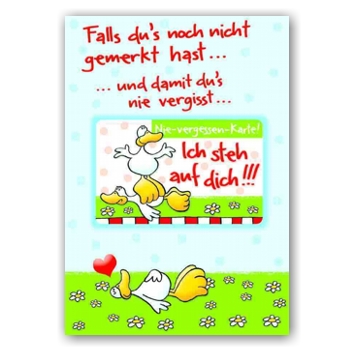
Calling stehen auf “vulgar” and inappropriate really does not the phrase justice. There’s a movie called “Ich steh auf dich” that is rated for 12 year old and it’s a romantic comedy, there are cards with cute animals using the phrase
and there’s a song with that name.
If they find this vulgar then they also should “Ich find dich sexy” vulgar, which they may of course. But it’s not how the average person perceives the words.
Oh, I’m from Berlin btw.
Thanks for replying. They’re in their twenties and from Austria. It’s apparently not as common where they are from. Those phrases seem to be considered pretty rude in their social group.
Well, okay Austrian German is somewhat different for sure and I don’t know anything about it. So I guess, we better not use the phrase there.
Can u explain the difference between drauf and Darauf?
There isn’t really a difference here. “drauf” is just the colloquial, spoken version and “darauf” sounds a bit stiff in daily talk (at least to my ears)
I’m glad that you’re using the words that people use in real life, but sometimes I’m finding it a tad unnerving that I can find no ‘back-up’ translation. Sometimes when I do find a translation, it is completely different, and I often wonder if your usage is quite a lot down to regional dialect? which is ok of course, but would that help me speak the street speak in my region..will I be understood, and by heck they do have regional speak, just a few miles apart and it’s a whole different spoken language!.
But still, my choice of learning is with you, and bugger the consequences.
Yeah, I’m definitely influenced by Berlin regional dialect to some extend. However, I think that the stuff I’m talking about in these posts is somewhat common in all Germany. So I’m not gonna talk about the stuff that I know is specific to Berlin (like messing up Dative and Accusative all the time).
I guess you’re mostly referring to little bits in the dialogues I’m using… what exactly do you mean by backup translation. Maybe I can add something like that in the future…
“You’ve often had a dark beer recently, didn’t you?” – doesn’t really work
“Just lately, you have drunk more dark beer haven’t you?” spoken emphasis on the ‘have’.
Changed it. Danke!
This post is hilarious. Especially the kebab smell conversation.
Semi autobiographical :)
“Die Welt liegt uns zu Füßen, denn wir steh’n drauf, wir geh’n drauf…”
I don’t know how long it took me until I understood that this songtext was meant literally. I mean in figurative sense the translation would be: “The world is at our feet (everybody adores us), because we like/dig it, we are dying…” and literally: “The world is at our feet, because we stand on it, we walk on it.”
Anyway, I don’t know whether it is important to point out but I still thought it funny. You can either say: “Darauf steh’ ich.” or “Da steh’ ich drauf.” which mean basically the same, but the second uses an aditional “da” but shortens the “darauf” to “drauf”. The first would not work with just “drauf”(at least not in this order) and the second not with “darauf”. And you would also not be able to substitute “da” with something like “hier” or “dort” or “es” or “das”. Only “da”. You could probably say: “Hierauf stehe ich.” although that does not fit the tone, so it would be understood more literally.
What I wanted to say, this phrase does not leave much room for experimentation. Either you have a grammatical object: “Ich stehe auf [object].” or you use the forms: “Ich stehe d(a)rauf, …” or even: “Ich steh’ da drauf, …” But it is probably safest to use “drauf” only with the additional “da” and if you have a “da” already it can only be “drauf” not “darauf”.
I think I wrote too much.
I never really got the “wir stehen drauf” wordplay either. For all who are interested… it’s a song called “MFG” by “Die Fantastischen Vier”. You can learn a lot about German acronyms there. Like… a LOOOOT.
As for the “Da… drauf” – I actually have a post on this coming up :)
Ich stehe auf deinen Blog!
Darf ich nicht sagen daß ich DICH aufstehe wenn ich meine nur daß Sie hammer sind?
(And is that an ok use of hammer?)
Danke!
Du kannst auch sagen, dass du auf mich stehst, aber eben nur wenn du einen “crush” hast :). Die Verwendung von Hammer ist perfekt.