Hello everyone,
and welcome to our German Word of the Day. This time we’ll have a look at the meaning of:
lesen
Lesen means to read and I know that doesn’t sound like the most exciting word ever. I mean, reading itself is quite boring, right?
So reading about reading must be boring squared.
But I promise that it’ll actually be an interesting lesson. For one thing, lesen has REALLY fascinating family ties to English and also, there are quite a few useful prefix versions of lesen, like auslesen, ablesen or reinlesen and not all of them actually have to do with reading.
So are you ready to dive right in at full bore?
I mean full speed?
Cool.
The Etymology of “lesen” and “to read”
The English word to read is related to riddle and reason as well as to the German verb raten . The core of this very old family is some sort of reasoning.
The word to read fits right in there because in essence it describes the process of interpreting or making sense of weird signs… be it coffee ground, musical notes or the scribbles that your loved one referred to as a “shopping list”… gee, I got buller and mulk but I have no idea what “flonr” is.
The German lesen describes exactly the same thing… you can lesen a text just like you can lesen someones facial expression or the flight of birds.
Reading and lesen really pretty much translate one to one. But the words are not related at all. But there are a few words here and there that are related to lesen.
Here now are a few examples for words related to lesen. Maybe you can see some connection
lesson… lecture… lexicon… legend… elite… elect… election…
elegant… select… collect… collection… neglect… negligee … legate
intellect … intelligent… legal … legislation … lex… privilege…
delegate… legion… colleague… legacy… alleged
Daaaamn. Isn’t that crazy?
All those are related to lesen.
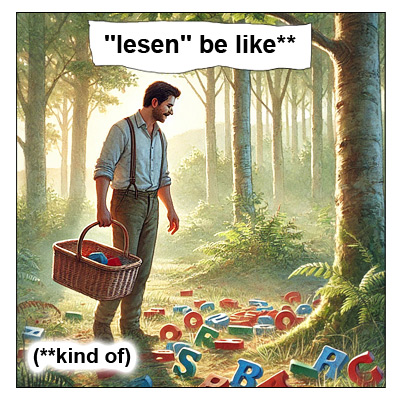
Now, most of them come from Latin but the real origin is the super ancient root les/g which meant to collect, to pick up and which was mostly used in context with berries and stuff like that.
In Latin, they had the verb legere which still had the old meaning of collecting and picking up. But now it wasn’t for berries anymore, but for all kinds of selections. Select, elect, collect, elegant and elite… all those come from the background of choosing. Even intelligent, which comes from the idea of “being able to discern between items”. And then Latin had the word lex.
The Lex Caesar for example was nothing other than a collection of laws or rules that Caesar had thought up. And this is where the word legal and many others come from.
Like privi-lege is a “private right”. And a delegate is someone equipped with some right to speak for you and so on.
But besides all those, legere had taken on another meaning… to read. And that’s where lecture and lesson come from.
Now, German also had this old *les rootwith the sense of collecting which then took on the meaning of reading.
Maybe at first it referred to the picking up of runes… I don’t know for sure.
Either way, while the English reading is about interpreting, the German lesen, as well as reading in most of the Romance languages are based on the idea of collecting – picking up the letters with your eyes if you will.
Now, this collecting-idea is actually still part of lesen and food advertising is especially fond of it… verlesen, erlesen auserlesen… they don’t use it as verbs but as ge-form adjectives and it’s always about how special and fancy something is.
- Genießen Sie unsere erntefrischen Säfte aus handverlesensten Früchten unseres Gartens.
- Enjoy our harvest-fresh juices made from the hand-selectedest fruits from our garden.
- Practice pronunciation – click once to start recording and again to stop
- In unserem Restaurant erwarten Sie auserlesene Gerichte die Sie überraschen und begeistern.
- At our restaurant, exquisite dishes await you, that will surprise you and inspire you. (I’ll just go with the literal translation here :)
- Practice pronunciation – click once to start recording and again to stop
- Diese erlesenen Weine aus der Region passen perfekt zum Sommer.
- These select wines from the region are perfect for summer time.
- Practice pronunciation – click once to start recording and again to stop
And speaking of wine… the word for harvesting grapes is still die Weinlese.
Besides these, there is also auflesen which is also used in a non marketing context as to pick up sometimes and Auslese which is one word for selection sometimes used in context of evolution, but overall I’d say they’re not very useful in your active vocab. It’s enough to understand them… or at least be aware that they don’t have anything to do with actual reading. So… passive pile, here they come :).
All right.
Now let’s do some prefix action.
The Prefix Versions of “lesen”
The reading-lesen can be combined with many prefixed. Some are very similar to English, and some are not…. but context will make it clear most of the time.
- Die Mutter liest ihrem Kind eine Geschichte vor.
- The mother reads (out) a story to her child.
- Practice pronunciation – click once to start recording and again to stop
- Ich glaub’ ich geh’ heute nicht zur Vorlesung… keinen Bock.
- I think I’m not going to the lecture today… I don’t feel like it. (university context only)
- Practice pronunciation – click once to start recording and again to stop
- Ich habe das Buch in einer Nacht durchgelesen.
- I’ve read the book through in one night.
- Practice pronunciation – click once to start recording and again to stop
- Ich muss den Stromzähler ablesen.
- I have to read off the electricity meter.
- Practice pronunciation – click once to start recording and again to stop
Just a quick breath… and round two…
- Hier klicken um ins Buch reinzulesen.
- Click here to read a sample.
- Practice pronunciation – click once to start recording and again to stop
- Bist du sicher? Ich glaube, da musst du nochmal nachlesen.
- Are you sure? I think you have to read up on that again.
- Practice pronunciation – click once to start recording and again to stop
- Ich lese mich in ein Thema ein.
- I thoroughly read up on a topic.
I read myself into a topic (lit.) - Practice pronunciation – click once to start recording and again to stop
- “Mann, der Thomas hat echt ein tiefes Verständnis von moderner Kunst.”
“Ach, das hat er sich alles nur angelesen.” - “Wow, Thomas sure has a deep understanding of modern art”
“Meh, he’s just read it all at himself.” (lit.)
“Meh, it’s all just book knowledge.” - Practice pronunciation – click once to start recording and again to stop
Quite a variety and those are just some examples… there’s also überlesen (to over-read, to miss something of the writing) , querlesen (to skim, to diagonally read) and mitlesen (to read along) or einlesen and auslesen which are used a lot in context of computers.
And of course there has to be a ver-version.
Yeah… besides the one we had earlier that was about selecting.
Oh and because it’s ver, it doesn’t only add one notion to lesen but two verlesen has 3 meanings… the for-notion and the wrong-notion … I’ll add a link to a look at ver below.
- Der Manager verliest sich während er das Protokol verliest.
- The manager makes reading mistakes while reading out the minutes.
- Practice pronunciation – click once to start recording and again to stop
Besides verbs, there are a few other words like lesenswert (worth reading) lesbar (readable) or Leseratte (book worm).
Leseratte is weird actually… it doesn’t sound the least bit negative although it has rat in it. Well, I guess reading was really the thing in the last centuries. I for one am glad that we have video now. That’s much better.
Lesen is just like… so like.. slowish, kinda… i guess. Oh, someone just posted a Vine… haha, thats hillarius .. anyway where was i … ah right… outro. So… this was our look at the German word lesen. It comes from a root that meant collecting/selecting berries and so basically describes our eyes collecting letters.
As always, if you have any questions or suggestions or if you want to try out some examples just leave me a comment. Es ist immer schön von euch zu lesen.
I hope you liked it and see you next time.
further lesen:

 Audio Speed
 Dark Mode
Great lesson. 9 years ago! Still You have a lot in your to-do list…it’s truly said that we don’t live long enough to learn German:))))
Thank you Emanuel.
this is the article does not seem to appear in the list of verbs even though it is prior to 2021
Oh, you’re right actually. I suppose there are more that I missed. That archive was the very first one I had, back when it was just 10 articles or so.
And I have to update it manually, and I often forget.
Ich habe neulich den Roman “Der Vorleser” (aus?)gelesen. Als ich (mir) das Buch aus der deutschen Bibliothek ausgeliehen habe, hatte ich Angst, dass ich beim Lesen zahlreiche Wörter im Wörterbuch nachschauen müsste. Es war nicht der Fall. Das Buch liest sich leicht. Höchstwahrscheinlich dank seiner oft kurz abgefassten Sätze.
I also checked the book’s title in English (The Reader) and observed a loss in meaning due to the translation. I think I am growing some appreciation for the German prefixes after all :d
Hah… warte mal ab (abwarten – wait and see). In ein paar Wochen bestellst du dir einen Präfix-Fanshirt :)… hier ein paar Anmerkungen (es sind nicht wirklich Korrekturen):
– (aus)gelesen… “gelesen” reicht hier völlig aus und klingt am idiomatischsten. “Auslesen” gibt es zwar auch, wird aber selten benutzt. Wenn mit Präfix, dann “durchlesen”… auf jeden Fall ist das wie normale Leute reden.
– Als ich mir das … ja, mit “mir” klingt es tausendmal besser.
– … dass ich beim Lesen zahlreiche….
rein technisch müsste die Form wohl sein:
– würde nachschauen müssen
Das sagt mir zumindest mein Gefühl. Warum kann ich dir nicht sagen. Vielleicht weil wir über die Vergangenheit reden, und “müsste” sehr jetzt-ig klingt.
– Es war nicht der Fall… besser : das war nicht der Fall. Das Wort “es” funktioniert nicht so gut um auf etablierte Fakten zu zeigen.
– dank seiner oft kurzen Sätze…. das abgefassten kann raus, denn was ist der Unterschied zwischen einem kurzen Satz und einem kurz abgefassten Satz. Und wie kann ein Satz noch kurz sein ausser kurz abgefasst :).
Ich habe das Buch nicht gelesen und auch den Film nicht gesehen. Der Titel ist aber doppelt passend, denn mit kurzen Sätzen lässt es sich bestimmt auch gut vorlesen.
Nice! Also, one question occurred to me. During my studies here in the field of mechanical engineering I’ve come across the word “auslegung”, and I wonder if it is connected to the same root (*les/g), and it’s meaning has something to do with selection of appropriate parts for a project. And also there is “legierung”, which I would say is including a selected material inside another one (metal alloys).
Interesting thougths. So… “auslegen” actually comes directly from “legen” (“liegen”) which goes back to an INdo-European root with the same meaning. “Auslegen” has a whole host of meanings and already had it way back in Middle HIgh German. One of them is “to interpret” … I don’t really see a connection. The only way it makes sense to me is with laying out cards or something.
As for “legierung”… I thought the exact same when I was writing the article. But “Legierung” comes from Latin “ligare” (to bind, to bundle up) which is also present in “legato” in music. It might be that there is some very super crazly ancient connection… like… you’d bundle up the wood you collected. But I couldn’t find anything backing that anywhere so I guess that’s to remain a mystery :)
Die Olivenlese wird hier in meiner Heimatregion noch per Hand durchgeführt, und diese veraltete Technik steigert drastisch die Erzeugungskosten. Die Oliven kann man ersatzweise erst durch einen Apparat von den Blättern befreien und schließlich durch ein Netz von dem Boden auflesen. Der Apparat sieht wie ein metallischer Besen aus und vibriert, aber wie er heißt weiß ich leider nicht- vielleicht sollte ich mich in ihn einlesen.
PS: Tausend Dank übrigens für deine vorherigen Korrekturen und Vorschläge und auch im Voraus für die Weiteren!
Wieder sehr guter Text! Also:
– …befreien und schließlich durch…
“Schließlich” passt hier nicht, da wir nur 2 Arbeitsschritte haben. Es klingt zu sehr nach “finally” or “at last”. Das Wort, was du brauchst ist “anschließend”.
– … in ihn einlesen.
Das ist nicht falsch, und manchmal wird sowas vielleicht auch gesagt, aber es klingt komisch. Normalerweise liest man sich in ein Thema ein, nicht in ein Gerät… “einlesen” ist ja auch ziemlich intensiv. Das klingt schon nach 2 bis 3 Büchern
Rest war perfekt wie immer :)
I’ll never read another German wine label (Spätlese, Auslese) without thinking about “reading” the wine label! Ha! Very interesting.
Didn’t you think about that before? I mean, I can’t tell but I imagine it to be confusing to see “lese” there :)
No, it’s the absolute truth — I never thought the “lese” part of the wine name had anything at all to do with the verb “lesen” which always I knew meant “to read.” I think it is because as you explain, the “select” and “elect” meanings of “lesen” aren’t at all related to the “to interpret” meaning of the English “to read”. Those associations aren’t at all readily apparent. I think in another article of yours, which I read sometime ago, you point out that “discover” and “recover” and lots of other words with prefixes whose root is “cover” are related to the root word, but most people would not make that connection unless it is pointed out to them, and then it does make sense. Now that I know “lesen” has the “select” idea as part of the word, spaet-lese and aus-lese when describing a wine does make sense. However, previously it never occurred to me that this ending was attached somehow to the verb “lesen”. That’s why I keep coming back here! ;-)))
Wow, that was odd. I do have an article on the whole covering-thing… on stock! It isn’t published yet. I was really confused for a moment and thought I’d accidentally published it or something :D.
Hi Emanuel: I just went through some previous entries and I can’t find it, but in your explanation of one of the “verb” words of the day, (one of those where you list the word “and its prefixes”), you do some explaining about prefixes and show that we have some of the same conventions in English. You then use the “cover/recover/discover/ etc” words as examples to make your point. I can’t find it now, but it is somewhere here in this wealth of information you’ve written. So, again, it was not a specific post on the “covering-thing” but rather, that was the example you used to clarify the concept you were explaining, and it did make a lot of sense, which is why I remembered it. I tend to re-read many of these articles, so I’m sure I’ll come across it again eventually. In the meantime, I’m looking forward to your as yet unpublished article mentioned above! Thanks, and keep ’em coming, please ;-)))
Ich freue mich dir zu lesen , im besonderes mit so schöne musik . Ahmad
Wieder ein paar kleine Korrekturen für dich :)
– Ich freue mich dich(deine Artikel) zu lesen.
“Dir” implies direction and makes it sound a bit like you’re reading to me.
– … insbesondere, im Besonderen, besonders
There are these 3 Versions that all mean “especially”. The second is the most rare one, the first one is a bit technical sounding so in these contexts the best choice is “besonders”
– mit so schöner Musik
“Schöner” weil es Dativ ist (wegen “mit”)
Vielen dank für deine Korrekturen.
Surprised you never mentioned “legible” in the list of related words. ;)
Also “sich etwas anlesen” ist meistens etwas negatives, im Gegensatz zu praktischer Erfahrung?
Vielleicht haben “lesen” und “read” immer noch etwas von ihren ursprünglichen unterschiedlichen Sinnen (sammeln/auswählen bzw. interpretieren): “read into” heißt quasi “eine Bedeutung in einem Text finden, die nicht eigentlich da zu finden ist, sondern aus dem Leser selbst entspringt” statt “(r)einlesen,” “overread” heißt “mehr Bedeutungen in einem Text suchen/finden, als es eigentlich gibt” (besonders indem man zu viel Aufmerksamkeit unwichtigen Details schenkt) statt “überlesen” usw.
Meh… that was just too obvious.
Kidding, I totally missed out on that when in fact it’s the best connection there is.
Zum Thema “reinlesen”… ich habe vergessen, es im Post zu erwähnen, aber “etwas in etwas reinlesen” kann auch heißen “reininterpretieren”… also so wie in English
– Ich glaube, das hast du in die Email nur reingelesen.
Bei “überlesen” ist es aber nicht so und deine Theorie macht für mich Sinn… “over read” wie “over interpret” und “überlesen” wie “overlook”.
Ist “anlesen” negativ… das ist eine gute Frage. Ich denke eigentlich nicht. Wenn man es in Kontrast zu praktischer Erfahrung stellt, dann vielleicht schon, aber im Vergleich zum “Nichtwissen” ist “angelesenes Wissen” natürlich besser.
Spelling correction. Caesar. As in Kaiser, ‘a’ is the first element of the diphthong. The way I was taught Latin we pronounced Caesar like Kaiser, too.
Thanks for another interesting and entertaining (even without the jazz interlude) post.
Words like handverlesensten are the reason I love German so much! Great article, thanks :)
The word doesn’t even make sense with the “sten” in there (the proper word would be “handverlesen”)… but I checked and they do use that in marketing lingo sometimes :D