
Hello everyone,
And welcome back to election weeks.
It’s super intense at the moment in Germany, and I have honestly never seen even remotely the amount of talk-shows that are happening currently. Pretty much every single day, the front runners are on TV, often in town-hall type formats and I actually really enjoy it. It’s engaging and feels much more democratic than, say, 10 years ago when they just did the boring TV duels.
Anyways, today, we’ll do part two of the:
Wahl-O-Mat – German Election Topics Reviewed
In part one, we went over the first 12 questions, so now, we’ll do the second 12 questions (of 38 in total).
And today is particularly interesting, because among other things, we’ll talk about:
- German health insurance system (No matter how complex you think it is… it’s more complex than that)
- education policy (surprisingly chaotic)
- the national debt (Germany is quite unique in that regard)
- and the state of Germany manufacturing
And I think I have a few bits of info for you that you absolutely did not know and that most Germans aren’t aware of either.
#FOMO
Like last time, I’ll largely keep this objective, but I will share my very very own very PERSONAL opinion here and there, because why not :).
And of course we’ll again also do the language component, so for each question, I’m pointing out something interesting about the language that you can take away even if you don’t care about politics at all.
Oh, if you want to check out part one first, here’s the link. There’s also a bit more about what the Wahl-O-Mat is, and why it’s really awesome and helpful.
The Coming German Elections – Part 1
And now, if you’re ready, I’d say let’s jump right in.
The Question:
- Bei der Besteuerung von Einkommen soll der Spitzensteuersatz angehoben werden.
- The top tax rate on income should be increased.
What’s this about:
Currently, the top tax rate is 42% and it’s to be paid when you make north of 68.481 Euro taxable income.
Germany does NOT have state income tax, so you only pay one sum to federal.
- progressive, so if you make 100K, the first 30k get taxed at a different rate than the last 30k.
The real tax rate is the effective tax rate and for most people it is far lower than 42%.
Some parties now plan to increase the top tax rate, while also shifting the threshold higher closer to 100k, so a person making 70k would pay LESS, while a person making 100k would pay MORE than before.
Language used:
I honestly don’t understand why they didn’t just say “Der Spitzensteuersatz der Einkommenssteuer…” but for some reason, they decided to go for this somewhat more complicated phrasing with “Bei…”. No clue why.
Besides that, this is a nice example for the difference between anheben and erhöhen in the sense of increasing. anheben sounds less severe (just a few percent) and also more subdued.
Like… if erhöhen will sound more shitty in the context of taxes and more awesome in terms of salary, than anheben does in the same contexts.
The Question:
- Der Bund soll mehr Kompetenzen in der Schulpolitik erhalten.
- The federal government should have more powers in education policy.
What’s this about:
Germany is a federation and the education mostly rests with the states. The federal government does put out some guidelines and helps getting a semi standardized final exam, but for the most part the states are free as to how to set up their school system, including stuff like how many years does elementary school last and what school types there are. Not all states have a Gymnasium for instance.
The states do coordinate a lot in the so called Kultusministerkonferenz (meeting of the state secretaries responsible for education). I think that’s for instance where they decide which state has their vacations at what time. School vacations vary every year, so a kid in Berlin might have summer vacation very early in one year and very late the next. The idea here is that not the entire country has school vacation at once, but it’s spread out and varied.
But I digress… the question is about whether the federal government should get a bigger say in school matters and my opinion is yes. Germany is so small in size that being super federal in this aspect doesn’t make much sense to me and sounds like a lot of wasted meetings.
Language used:
We’ve had this in other questions already, I think, but I haven’t pointed it out specifically… der Bund. This pretty much THE way to refer to the federal parliament and executive.
And we have another instance of the formal erhalten being used instead of the more normal bekommen. (we had that in part one already).
The Question:
- Aus Deutschland sollen weiterhin Rüstungsgüter nach Israel exportiert werden dürfen.
- Arms exports from Germany to Israel should continue to be allowed.
What’s this about:
Germany exports military equipment to Israel. The question is whether we should stop and the background (besides general pacifistic positions of some parties) is most certainly the war in Gaza.
Language used:
If you ever wondered how translate “should continue to be allowed” – now you know one option. sollen werden dürfen.
And for the super nerds among you, here’s how it would look as a side sentence:
- …, dass aus D. weiterhin Rüstungsgüter nach Israel exportiert werden dürfen sollen.
This feels weird to me writing and reading it though and most Germans (including me) would trip if they try to pull this stunt in actual conversation :).
Specifically, our brains would start thinking if we have to do this switcheroo that we have to do in past tense.
- …., dass er nicht hat abwaschen wollen.
instead of: - …., dass er nicht abwaschen wollen hat. (WRONG)
This second guessing whether we need this switch would trip up most of us.
Besides that, we could note the term Rüstungsgüter, which literally means “armament goods”, and which is an umbrella term for weapons, vehicles and all kind of other military tech.
And lastly, the sentence is a great example for just how different German word ordering can be to English. If you go element by element, you’d get:
- Out of Germany should continue military goods to Israel exported being.
Which is an absolute absurd travesty in English. Like… barely comprehensible. But in German, it’s super smooth and fluid.
The Question:
- Alle Bürgerinnen und Bürger sollen in gesetzlichen Krankenkassen versichert sein müssen.
- All citizens should be required to be insured in statutory health insurance.
What’s this about:
Here we go… the complicated German health system. Let’s go!
Germany has a mixed and somewhat complex system. By default everyone has to join the “gesetzliche Krankenversicherung” (public mandatory insurance). This does not mean government insurance though. There are multiple companies offering insurance within the “public field”, so there is some competition and choice.
These insurers HAVE TO insure everyone, so they can’t really reject sick people, old people or people without a job.
Then, there is private insurance and you can decide to leave public and join private if you’re self employed or earn above a certain limit as an employee (and some other special cases). This limit is fairly high, and it has been increased over the last few years, so only “rich” employees are allowed to switch.
Private insurance gives you better care, covers more, offers better treatment options and also, it’s often cheaper than public insurance, at least if you earn good money.
And as far as I understand it, they can do this because they do NOT have to insure low-income people and tend to have more healthy members. The public insurance has a strong element of socializing in it, so high-income members subsidize low-income members.
Now, if you paid attention, you might have noticed that private insurance gives you better care AND is cheaper AND tends to be open for the more wealthy people while low-wage employees are forbidden to join.
This sounds super weird and unfair.
But here’s what’s going on, as far as I understand it, and as most people do NOT actually know: doctors earn much more from private patients as opposed to public patients. A doctor doing some routine check for a privately insured patient might get 4x the money they’d get for a publicly insured patient, and private insurance tends to also pay all kinds of “nice-to-have” things that really make money for the practitioner. Many doctors can ONLY run their business profitably because of the share of private patients.
So the way I understand it, it’s just a system that has wealthy, healthy people subsidize health care for the less affluent, less healthy, while still having a somewhat free market and giving certain people the impression that they’re not paying for others AND that they can afford themselves the best care, when in reality they do indirectly contribute to the system, they just don’t know it.
For as convoluted as this sounds… I think this is actually a pretty clever system. Market forces and the desire for “me” is satisfied while also being social.
I’d love to hear what you think about this.
The question is about whether all people should have to join the public sector (which still means choice, but less “privileged private care”). Proponents say that it would lower cost for everyone, but considering the scheme that’s going on that 99% of people have no clue about, I’m not so sure if that’s really the case.
Language used:
Maybe sollen [] versichert sein müssen is interesting – shall have to be insured. Yes, you can “stack” modal verbs in German :).
- Die gesetzliche Frauenquote in Vorständen und Aufsichtsräten börsennotierter Unternehmen soll abgeschafft werden.
- The mandatory quota for women on the executive boards and supervisory boards of publicly listed companies should be abolished.
What’s this about:
This quota is about supervisory boards and boards of directors, NOT about CEOs and the like.
The current quota demands about 1/3 of board members of big companies to be women. BUT… this only applies to seats that open up, so no board member gets fired over this.
So far, the real quota went from 5% in 2014 to 7,3% now, probably mostly because no one is resigning.
There are similar regulations for public institutions. Overall, the share of women in leadership roles is a little below 30%, which is pretty bad in comparison to most European countries.
I’m honestly shocked at how bad we are and that we’re worse than several countries like Hungary, Bulgaria or Serbia, where Germans would fancy themselves as “more progressive”.
Language used:
Nothing in particular. The subject is very very very long, but that’s the same in English.
The Question:
- Ökologische Landwirtschaft soll stärker gefördert werden als konventionelle Landwirtschaft.
- Organic agriculture should be promoted/subsidized more strongly than conventional agriculture.
What’s this about:
Agriculture is subsidized in Germany, and the question is as to whether organic farming should get more “love” than conventional one.
This is a super duper complex topic with really good arguments on both sides, and I think as a layman, the only opinion you can have is… your opinion. I “like” organic farming, so I’d be a yes, but give a conventional farmer half an hour in a room with me, and they’ll convince me the other way. Then, bring in an organic farmer and they will turn me again. And so on and so on.
Language used:
A nice example for comparisons and how the verb is usually NOT at the end with them. You could move the als-part before gefördert werden, but it’s less common.
I think the best way to think of this is as the als-part being a “shortened” side sentence. Like… “… than conventional (is being supported.)”
The Question:
- Der Bund soll Projekte gegen Rechtsextremismus verstärkt fördern.
- The federal government should increase support for projects against right-wing extremism.
What’s this about:
Some of you are probably thinking that this is about the government setting up projects “top down”, but I think how this mainly works (not only in Germany) is that there is a certain budget allotted to this, which projects can then apply for. Like… someone starts an initiative in a small town, like for instance a youth Café or a festival against extremism, and they can then apply for funding from that pot.
And yes, with funding like these there is ALWAYS a certain amount of fraud. People making up a project just to get funding. This has nothing to do with government though. It has to do with people. There is way more fraud and scamming in the private sector (because there’s more money there). I think just because a portion of people will abuse the system that does not mean you should withhold funding from all the honest genuine people trying to really do something in their community. Just like most businesses in the private sector are honest, so are most projects that apply for funding.
This question is about whether support for projects against right-wing extremism should be increased.
Language used:
The only thing noteworthy here is the use of verstärkt and I suspect some of you are wondering what the difference is to stärker.
Well, stärker would work as well here. verstärkt sounds a bit more dry and technical. And possibly it leans a bit more toward “more often” or “more widely” while stärker leans a little bit more toward “more money to what’s already there”.
But that might also just be me over-analyzing.
The Question:
- Unternehmen sollen weiterhin die Einhaltung der Menschenrechte und des Umweltschutzes bei allen Zulieferern kontrollieren müssen.
- Companies should continue to be required to monitor the compliance with human rights and environmental protection among all their suppliers.
What’s this about:
This is a big one. I don’t know much of the details, but in essence it’s about the law with the beautiful German name Lieferkettensorgfaltspflichtengesetz. Literally, this means “supply chain due diligence requirement law”and it’s essentially “supply chain act”. It was passed in 2021.
This is the German attempt to follow UN conventions for economy and human rights, and it essentially means that a business has to “ensure” that all the parts and materials they’re using do not violate human rights, for example.
Like, let’s say you’re a manufacturer of machinery and you order some parts from abroad, you need to ensure that these parts were not produced by forced labor for instance and I think also that the material for the parts was sourced in alignment with the core guidelines.
I think the core idea of this is good, as it forces companies to pressure suppliers to improve sourcing or working conditions, which, as we all know, would not really happen if you let the free market reign.
BUT… this also sounds like a documentation nightmare. I think there’s a whole certification industry evolving around this. It’s great once everything is in place. Similar to web safety certificates, for instance, that everyone uses but no one knows about.
But setting up something like for supply chains in a global economy is a herculean task and can sink businesses due to the headache or extra certification costs.
Language used:
Nothing stood out to me, except it’s another example for modal stacking (“sollen kontrollieren müssen”). And it’s a nice example for a sentence being really long and the actual verb (“kontrollieren müssen”) being unclear till the end.
As a native speaker, in this sentence at least, you kind of “know” it already though. Like… you don’t really know the precise verb, but the “idea” is in the vortext and gets more clear as you read, especially you have the “Weltwissen” (general contextual knowledge). Like… if you’ve heard about this law, you’ll suspect this is going to be about controlling, ensuring, adhering or something in that field of meaning.
The Question:
- Die Ausbildungsförderung BAföG soll weiterhin abhängig vom Einkommen der Eltern gezahlt werden.
- The education grant BAföG should continue to be paid based on the income of the parents.
What’s this about:
BAföG stands for Bundesausbildungsförderungsgesetz (federal education support law) which is the law that regulates financial support for people going to university or doing an apprenticeship.
If you have no or low income, you can apply and you’ll get a monthly payment, half of which is a grant from the government and the other half is an interest-free loan from the government. It’s only paid for the “normal “studying time”, so if you need longer for no special reason, you’re on your own then.
I come from a poor background, so I partially financed my studies this way, and this BAföG also allowed me to study in Finland for 7 months, which was also supported, and which I would not have been able to do without. And which was the seed for my interest in language (which was NOT my studies), for my knowing English, so kind of for this website.
At least for the first portion of the studies, it would have been hard to work part time, and I also was mentally and psychologically not in the place to handle studies and a job, so yeah… BAföG gave me a bit of time when I needed it and I’m happy to support others now with my taxes.
The question is as to whether this money should depend on the income of the parents, to which I say a clear YES.
If you have no contact to your parents, or you hate each other, you always have the option to apply for “parent-independent support”.
Language used:
Learners often ask about the difference between zahlen and bezahlen and when it comes to paying in the sense of compensating for a service or good, the two are pretty much synonymous. But in the question here, bezahlen would NOT work, because the money paid is actually NOT a compensation for anything. It’s just a grant being paid and the word for that is zahlen.
The Question:
- Die Schuldenbremse im Grundgesetz soll beibehalten werden.
- The debt brake in the Basic Law should be retained.
What’s this about:
Germans are famous for being big on “saving”. During the financial crisis, the country took on a lot of new debt to stabilize the economy. Compared to today, the numbers were peanuts. But “back then” it made people so nervous that the parties came together to add a Schuldenbremse (debt brake) to our constitution (which took a two-thirds majority to do). This was in 2009 and since then, any government and parliament is limited in how much new debt they can take on. Of course, there are loopholes and stuff, but in recent years this has started being in the way of necessary investment, and it’s ultimately what caused the government coalition to break apart. SPD and Greens wanted an exception to finance stuff, but the FDP (liberal party) said no, because “our children have to pay it back”.
I’m curious what’ll happen in the next government, since the CDU has a financing gap of roughly 60 billion in their program and the AfD even has 130 billion, but both parties do not want to violate the debt brake. And these numbers don’t include new NATO spending yet.
So ultimately, I’m sure that any government WILL work around the debt brake.
And I personally think it’s high time. Germany’s total debt is currently about 59% of GDP. The US is at 124%, Japan is at 260%, Italy is at 138% and China is at around 80%.
In such a context, Germany is RIDICULOUSLY under-levered and we could take on a lot more debt to improve infrastructure, education, research and all kinds of yield bearing investments that our children would be happy to have completed when they’re adults.
I really don’t understand how the CDU and the FDP, who claim to be the most competent about the economy, do not seem to understand leverage and return on invest. They could not run a start-up that way, nor a normal business that wants to expand.
Like… I don’t even have to go to modern monetary theory. The conservative stance is stupid even within old school paradigms.
Now, the GOP in the US also (as usual) campaigned on cutting the deficit, but they have already floated a debt ceiling increase of 4 trillion.
Germany, as a big country with a strong currency, really has to “get with the times”. We’re still in way better financial shape than ANY competitor of similar economic weight.
Language used:
One thing to note is the term Schuldenbremse, which you will hear a LOT in the coming months if you follow German politics. And also, it’s a nice example for using beibehalten, when many learners might have just gone for behalten. Both words are about keeping, but behalten is about keeping in the sense of possession, while beibehalten is about keeping procedures, customs or “habits” in a somewhat formal sense.
The Question:
- Asylsuchende sollen in Deutschland sofort nach ihrer Antragstellung eine Arbeitserlaubnis erhalten.
- Asylum seekers should get a working permit immediately after applying for asylum.
What’s this about:
At the moment, asylum seekers are NOT allowed to work immediately. I think there is a waiting period of at least 6 months, and there may be a longer limit if they live in a designated asylum housing project. I don’t know the details and ins and outs, it’s of course more complex than just that.
My opinion is that they should be allowed to work. I have met several who want to work, but they legally are not allowed to even if they already speak some German. Instead, they just sit around bored all day. Having this lack of purpose is not good for anybody’s psyche. It is not really helping with integrating and also, it’s a loss of productivity and a strain on tax payer money.
I really do not know what the benefit of this is, but then again, I haven’t looked into it, and there probably is an argument to be made against it. I just don’t know it.
Language used:
Couldn’t think of anything specific here, so let’s move on to the last one right away.
The Question:
- Deutschland soll das Ziel verwerfen, klimaneutral zu werden.
- Germany should throw out the goal of becoming climate neutral.
What’s this about:
The current law is that Germany aims to be climate neutral by 2045. This mainly means carbon neutral and as far as I understand it, that does include heating and traffic.
It’s a very ambitious goal, for sure. In 2023, carbon gas emissions have dropped by 10% within a year.
I know that many of you are now thinking “OMG, yeah, because Germany is de-industrializing!!”, so let me go on a little tangent here.
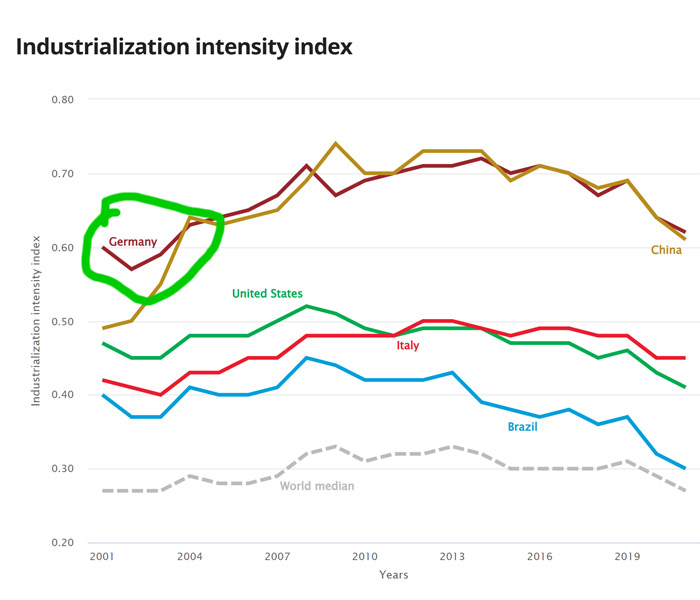
Germany’s manufacturing has a total share of 23% of total output, and 19% of the workforce is working in that sector. The numbers of the US are 12% of output and 10% of the workforce, so when American politicians worry about Germany de-industrializing, it’s kind of strange,
Germany’s output has declined, yes. But when you look for example at the industrialization intensity index, a metric for the role manufacturing has with in economy, you’ll see that it’s declining in MANY countries and that Germany actually is sitting pretty up there together with China, so compared to the average we’re way “over-industrialized”.
Here’s a graph:
Anyway, so the climate goals are definitely ambitious and we’ll probably miss them, but I think it’s great to have ambitious goals. When a certain someone says “Colony on Mars by 2040” that’s called amazing and ambitious by some people. When Germany says “Climate neutral by 2045 while still making steel and stuff!“, it’s called “ideologically driven lunacy” by the same people.
I personally want my country to be ambitious and bold and give it our best shot. It’s a challenge, we’ll have to make adjustments along the way, but throwing out the goal and giving is a clear no for me.
Language used:
This is a nice example for verwerfen which is the best word for throwing out some sort of plan, concept or idea.
***
And that’s it for today :).
Like last time, I hope you enjoyed it, and if you’re up for it, I’ll do a part three with the last third of the questions. Today was a bit more into politics, but I thought it might be some interesting insights that might help give a better idea about what’s going on in Germany, so I decided to be a bit more detailed, particularly about health insurance.
Little disclaimer… I am no expert on any of this. I did do research but if you KNOW that I said something non-factual, please tell me and I’ll correct it.
Of course, I’d love to read if you have any thoughts on any of the matters and if you have any questions, I’m happy to talk more in the comments.
But yeah, I hope you liked it, have a great day and bis zum nächsten Mal.

 Audio Speed
 Dark Mode
About number 15, ” …., dass er nicht abwaschen wollen hat. (WRONG)”
Is this one of those cases where the helper verb doesn’t really go to the very end? A similar construction was covered in the past conditional with modals post “dass ich ein Bier hätte trinken müssen.”
Yes, exactly the same … uhm…”logic”.
I guess the “logic” is something that dripped down through the centuries but is there a “list” of situations where this logic applies? From the example above I’d say that the pattern is “spoken modal past in subordinate clauses”
It’s not specific to past. It’s basically needed as you said correctly in subordinate clauses when you modify a modal verb by a helper verb and have a third verb (for the modal) in the sentence.
– Ich habe ihr gesagt, dass ich nicht werde kommen können.
können – modal
werden – modifies können
kommen – normal verb for können
I will most definitely trip on this one :D
Hello everyone! My name is Teresa. I have just joined the group. I want to thank you for your solidarity and generosity to contribute a little more for others. This is great!!!. And many thanks to Emanuel for helping people like me who want to speak a little better German every day.
I am way behind on the columns and look forward to reading part 3. This has been very enjoyable for me so far. Part of learning a language is learning culture, and this certainly helps.
Hi everyone! I’m new to this community and just wanted to say thank you to all the generous members who contributed extra to support others. Thanks to your kindness and sponsorship, I have the opportunity to continue learning German here. I truly appreciate it, vielen Dank!
I would be up for part 3. My German partner and I already went through the Wahl-O-Mat together, which was an interesting way to get to know each other better, but I didn’t ask him to explain anything to me in detail, so there was a lot I didn’t fully understand.
We also did the Postillon satire Wahl-O-Mat, pretty stupid but somewhat entertaining :) https://www.der-postillon.com/2025/02/postill-o-mat-bundestagswahl-2025.html
I talked about question 13 with my german host mother, and in the US we also have a similar problem, but the thing with increasing the income tax is that most of the millionares and billionares don’t get their money through steady income like most people do, but rather from properties or stocks or other things that generate money, but dont qualify as “income.” So then its just mainly middle class people who are suffering and paying high taxes
It’s true that higher income tax is not the way to tax actual wealth, but there is a portion of society, like board members and ceos who do earn 500k a years. The SPD wanted to raise income tax for these people.
With all these discussions, it’s important to know where the tax rate has been back in the day. In the US, it was above 70% in the 60s, in Germany, it was well above 50% in the 90s.
So when people whine about taxes going ever higher, that’s absolutely not accurate. They have been going down for decades, especially for the rich.
Count me in for Part III! I really enjoyed parts I and Ii. I now feel as t hough I am acquainted with several of the political questions the Germans face.
On the question of health insurance, I like the idea of everyone being insured. Perhaps you remember Americans had passing the infamous “Obama care,” which I’m for. Before that bill passed, I favored what Democrats had proposed, the “Public Option,” which , in my opinion, would have been great. Practically everyone could have had health insurance, and that would not hurt those having insurance through their employers, a significant number here. As for question 16, I said yes until I read the details you provided concerning those insured by private insurance. If most Germans do not what you explained, then they will vote contrary to their interest. About the language, Can one say the following: “Alle …. sollen …. versichert WERDEN (instead of ‘sein’) müssen”? Why ‘sein’? ” Versichert” is just a past particple, not bonfide adjective, right? Yes, you are right about “zahlen/bezahle, behalten/beibehalten.” I had been wondering about “zahlen and bezahlen.” Of course I would have used “bezahlen and behalten.” I knew nothing about “beibehalten.” “Verwerfen is equally new to me. I did not know the Bafög dealt in student loans too. I think WE should have a “Schuldenbremse” with respect to our giving multi-millionaires and billionaires tax breaks.
In Germany, health insurance is kind of mandatory and a portion of young people, especially Europeans who just work here for a couple of years and party, do not like it, because they have to pay even if their country would in theory cover them. But as soon as you work, you HAVE to get health insurance.
The German health insurance system is also a system of complicated contracts and and regulations about what medication costs and what treatments cost. There is a fixed rate for anything a doctor does and they cannot charge more. My girlfriend had forgotten her EU health card last year and we had to go to the doctor in Berlin because of a bad tonsillitis, and she had to pay 23 Euro for the visit plus 10 or so for antibiotics. That was the full non-subsidized charge without health insurance.
This is only possible because of all the complicated contracts and regulations regarding price levels though, that I guess are negotiated among government, health insurers and pharma companies balancing out the various interests and creating a compromise that works for all.
And I’m not sure the US will ever be willing or able to put in this kind of regulatory and contractual work and push it through against its health industry, but without that, a publicly subsidized system like the Affordable Care Act has to be a HUGE strain on tax money and the pharma folk will milk it as much as they can.
This is all just half knowledge and assumptions about the US though, I might be way wrong :).
Re: versichert werden vs versichert sein
“versichert werden” puts the focus on the act of joining/getting the health insurance. But that’s not too interesting, what matters more is what health insurance the people “are in”.
Maybe a bit similar to “Everyone should get insurance” vs “Everyone should have insurance”?
Yes, I understand, but for the ACA, big pharma had to make some considerable concessions. The country’s problem is that we still have too many people uninsured.
Yes, I see the difference between the use if the SEIN or WERDEN. I would to do a number of sentences on my own in order to avoid that mistake when translating or writing original German sentence.
I have a story that I both like and don’t like to tell because it shows how absolutely broken the US healthcare system is.
My uncle had lung cancer. He was sick for years before he was diagnosed. Spent some time in the hospital, but the doctors always said it was pneumonia. Then one day: it’s mesothelioma, and there’s not much we can do. There was one doctor who was willing to cut out a tumor on his lung that was about to grow into his heart. It would be complicated and risky, but it could give him some more time. It had to be done in the next day or two, because otherwise it would be too late.
Insurance denied coverage because the surgery wasn’t medically necessary, or it was too experimental. I forget which. The hospital said they could still do it, but they needed a down payment. $120,000. They said the whole thing would cost a million dollars. My dad cashed out his life savings for the down payment. My uncle had a few more years after that. They weren’t good years, but he had some good moments, and he went when he was ready.
The insurance eventually paid for everything after an appeal that took a year or two.
I totally understand the sympathy for the person who killed the United Healthcare CEO. If anything, I’m surprised nothing like that happened sooner. Will what he did fix a broken system? Maybe not. Not by itself. I don’t know where the political wherewithal and willpower will come from that it would take to reform the system. If that’s even possible.
Unfathomable for a normal German.
The numbers and the behavior of the insurance company are something you have to grow up with to think it’s normal, I guess.
Es muss eine Menge Arbeit gekostet haben, um dies zu produzieren. Ich habe viel gelernt und es hat mir Spaß gemacht, es zu lesen. Ich stimme bitte für Teil 3. Vielen Dank, Emanuel!
Arbeit ja, aber es hat mir auch viel Spaß gemacht und ich habe beim Recherchieren auch einiges gelernt :).
VERY good stuff, thanks Emanuel – a nice balance of law, opinion, and language. Please keep it going.
Here in Canada approx 1/3 of my taxes contribute NOTHING to education, health care, safety, pensions … they don’t even pay off the debts incurred by previous long-departed governments … they are just used to pay the INTEREST on those debts. Does that really make sense?
[bremse = brake, not break]
The interest payments on national debt do sound crazy, for sure.
It’s important though to keep in perspective who these payments go to.
I did a bit of googling just now (not gonna call it “research”) and apparently, 76% of Canadian debt is held by Canadian institutions and investors. That does include insurance companies and retirement funds, so part of the interest paid in fact DOES go toward health care and pensions. Maybe half of it even.
Canada owes 76% of the money to its citizenry, and pays them interest. I agree that it probably can become “too much” (though Japan for instance has been living with above 200% for decades), but I also do think that national debt (government bonds) are a very crucial part of a healthy financial system. They need to exist, as they’re inversely correlated to stocks, so they allow the markets to hedge risk and diversify investment and health companies and pensions funds are some of the biggest investors in the markets.
Another important figure to look at in this context is the bid-to-cover ration. Debt is issue mainly by bond auctions, and if Canada does an auction, there is usually twice as much demand for a bond than there is supply. In Japan, the number is above 3. So for each 1k of national debt, there are three parties willing to loan money to Japan, and that is despite the country being in debt with over 200% GDP.
I think making an effort to reduce debt is constantly needed but it’s more important what the debt is used for. And the interest paid does play a role in stabilizing pension funds, for instance, so it is not money that just evaporates in the pockets of foreign investors.
Sorry for the long post, but find this topic HUGELY interesting and wanted to share a bit of what I have come to learn about it over the years.
Emanuel, I think you’ve uncovered a goldmine here. This is fantastic stuff. I admit to being ganz verwirrt reading about the Zweitstimme and going from 299 to 700+seats. I’m sure if I reread it it will make more sense. Oder vielleicht ich werde einfach tun, als ob ich verstehe ….
I felt weary and overwhelmed half way through, but I was kept sufficiently interested to go all the way through. Germans, I perceive, are lovers of heavy industry. I often help an older German guy with his computer. We got to talking, and he mentioned the “Yalta Conference”, which was after the WWI I think. Part of the terms was to strip all the factories of their machines. The German chuckled heartily “Sis is just wot si German vonted. Si machines need to be upgraded anyvay”.
Lol… the accent is on point :)
Super …. 3. Teil bitte!!!
I vote for a part 3 on German elections. Thanks.
Hallo,
Here are some typos, which you’re obviously welcome to edit out to make the comment less bulky!
“I have honestly ever seen even remotely” (I have honestly never seen even remotely)
[… edited out the corrections :)]
Thanks for the very interesting and informative article, I’m not hugely into politics but your explanations give a very detailed and not over-complicated insight into how German society works, which is very welcome! And, yes, please do part 3 :))
And… although I said I’d share none of my opinions, as some of them might be very controversial and different from yours and from those of some of our friends here on the blog, I will actually share this one: I’m totally in agreement with you over climate goals!
Bis bald!
I’m really happy you’re enjoying these discussions!!
And I actually have a question. You don’t have to answer it or maybe the answer is too complicated, but I really do not understand why Liz Truss is still giving political speeches.
In Germany, if you fail this hard (I don’t mean policy, I mean just leaving office after a mere few months), your political career is dead for at least a decade.
You can sit in parliament of course, but no party would allow you to be a public voice, as they’ll try to distance themselves from the “loser”.
Maybe it’s different in Britain, but for me, it’s super weird. Like… you literally JUST had your shot.
We had this guy, Karl-Theodor zu Guttenberg (CDU) who was minister of defense around 2010. Then it came to light that he had faked his doctoral dissertation, copying large swaths of other authors, passing them off as his own.
He was round guilty of fraud, stepped down as a minister and ALL other political functions that’s pretty much the last anyone has heard of him.
I’m not the most versed person on politics, but I think Liz Truss has found support amongst a right-wing group and is possibly being supported by US lobbyists, which has allowed her to give speeches in the States… Apart from that, politicians’ careers do, in my opinion, die down once anyone is deemed a “failure” (think Theresa May).
Thanks :)!!
I have to admire her self confidence or ignorance, thinking she should give speeches telling people how to govern when she literally just failed at it.
Comedian Jan Böhmermann had an English language video in the New York Times yesterday. While he is funnier auf Deutsch, it explains some of what is going on in Germany, and its about funny German words, so it will be a win-win for followers of YDG.
I heard about this on the German radio but although I read the NY times website daily, I didn’t see the video on the home page. I’ll go find it but they should really highlight this stuff.
The video on the AFD that Junie referenced
https://www.nytimes.com/video/opinion/100000009970138/germany-elections-afd.html
I thought he was excellent.. expected maybe a cringefest, but way exceeded expectations & could imagine watching more.
And – of course – his English is tippy top.. I only heard one word – one – which sounded odd, “ambiguous” – and my native langskills are trash anyhow, so nevermind.
Have kinda ignored him hier in DE, aber no más.
I found it mehhhh :).
He’s one of the best we have on TV, but still… I found this too tame and predictable.
Danke.
I thought that private health insurance is indeed cheaper than the public one, but only if you are young and you are alone. On the other hand, public insurance of one family member covers the whole family as long as other family members do not work. In contrast, private insurance will charge you extra for every family member, so it can make a big difference for a family with several kids.
One very weird aspect of this system is that you are seemingly not allowed back into the public health insurance once you chose to go to private. It’s especially ridiculous when you come from abroad, and they spend months sending requests and checking if your health insurance in other countries happened to be private. I could never quite understand the rationale behind this restriction.
Oh great points!!
I’m in public insurance so I’m not aware of the finer details of the private coverage, particularly with regards to family.
As for why you can’t go back… maybe the idea is that if you decide to switch to get the benefit as a somewhat young single, you’ll have to stay when you get to the “find out phase” when you get older or get a preexisting condition and they hike your rates.
But this is pure speculation.
It is odd to hear that they investigate how you were insured in your home country for instance.
Hey Emanuel,
This was a tour-de-force.
I did the Wahl-o-Mat and just to self-declare, it told me my views are most aligned with the CDU.
Then I saw these articles of yours and it was great to get the clarifications.
I LOVED your non-ideological explanation of the health care system. Germany has a wonderful system. We in Canada have a religion instead of a health care system: emergent things get taken care of, but God help you if you need a joint replacement. But any politician who touches it gets struck by a bolt of lightning from the heavens and dies (a political death) instantly.
Emanuel, this is not a statement that you can prove:
There is way more fraud and scamming in the private sector (because there’s more money there).
Companies that don’t manage fraud and scamming go under. Governments just tax their citizens more.
You’ve done, overall, an amazing job of informing and keeping ideology out of this series of articles, kudos! This is just one little exception that I wanted to draw your attention to.
Really enjoy each of your posts! I read them as a priority!!
M
Point taken! I cannot prove it. But I do have the infamous “anecdata”.
I know for a fact (because I have spend a decade in it) that the hospitality sector in Berlin is full of fraud. Tax fraud, employees stealing, employers stealing, not adhering to cleaning standards, meddling with the liquor, mislabeling drinks and so on.
There is also plenty of fraud in the contractor business and I would include violation of labor safety and other labor laws in that.
And there is plenty of high profile fraud as well. Wirecard is one example, the VW gas emission scandal is another. Or Vivek R.’s biotech scha company, or FTX or the company of Elizabeth Holmes. Bernie Madoff… the list is truly endless.
Yes, some companies will go out of business, but often the fraudsters have made their money. Other times, the fraud causes other companies to go out of business (like a contractor not paying subcontractors who have no financial means to go to court). Some people are serial fraud founders. Or in cases like VW, they just pay the fine, switch out management and go on.
There are plenty of governmental institutions like for instance the Verbraucherschutz or the Hygieneamt that try to fight against this and they only catch the tip of the iceberg.
As for waste… I have seen and heard enough of tech companies and software businesses to know that there is so much waste, if a McDonalds employee who gets timed down to the second knew about this, they’d riot.
So much time is wasted in meetings, people lie with their time lines and management legit doesn’t know what they’re doing. My girlfriend works for a pretty solid mid-size US company who do B2B software and it’s an absolute shit-show. Months of work are spent on planning and designing features that get never realized due to miscommunication. And they don’t go out of business, because the competitors probably suck just as hard and also, you need connections and sales skills. Product is not the only deciding factor.
And lastly… over the last few decades, taxes for the upper part of society have more or less come down, particularly so in the US, where it used to be north of 70% during the time when the US flew to the moon and beat the Soviet Union economically.
Raising taxes is not as simple as it sounds, after all.
People are people, and just like there are lazy or incompetent or greedy people in government roles, so they exist in the private sector.
I’m not saying there is no waste going on with government spending.
But saying market pressures clean all of those same impulses out from the private market is simply not the case.
Absolutely loved this. That will make understanding German politics a bit easier to understand. I would love something on German humour. German politics and German humour are two Brandmauer for my deeper understanding of Germany its culture and people. Thank you for an excellent article.
German humor
Auslaender: Bitte, aehhh, wann das Zug geht, ja?
Deutscher: Ich weiss nicht, wann das Zug geht, aber DER Zug ist schon gleich abgefahren!
The “humor” here is presumably that the foreigner committed a cardinal sin in German by making the train neuter instead of the correct masculine gender which left an opening for the native German to respond with a nasty crack, therefore allowing the poor chap to miss his connection LOL
We have a saying in our language, “Schadenfreude ist die schoenste Freude” aka “Gloating is the sweetest revenge.”
Our sense of humor is deeply cynical, with a sarcastic, almost mordant, streak. The Americans I think are a lot more light hearted
and gentler in this regard.
Thanks for that German humour is something quite difficult to break into. Let’s hope that the political parties have fun.
German humor is delicate at best, and boring, tame mainstream consensus humor at worst. Anything on TV is garbage, but I have seen some good stand-up recently that was not just English stand-up in German language.
Not certain I agree entirely!
I can remember as a kid watching “Wie, bitte?”
with April Reiners (??) and those deadpan intros.by Gert Mueller-Gerbes on RTL. Thought I’d die laughing.
Various cabaret-type comedians such as Hans-Dieter Huesch
(“Das schwarze Schaf des Niederrheins”) or Dieter Hildebrandt are also funny enough even for non-Germans to understand, I’m sure.
Okay, cabaret-style comedy is better, I agree. I was thinking more of the mainstream Stephan Raab, Heute Show and other “comedy” formats.
See what you mean:-)