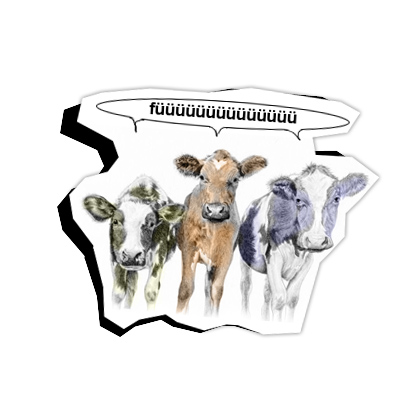
Hello everyone,
And welcome to our German Word of the Day, bottom of the barrel edition.
Hooray!
And the word will look at today is
fügen
Many of you are now like “Yeah, I don’t think I can pronounce that.”
And the good news that, that you probably won’t have to, because chances of you using fügen in daily life are about as high as the chances of the German language getting a girlfriend
“What do you mean? I have game!!! I don’t häve a görlfriend right now because I chose not to. I need space to wörk on myself.”
Oh, you mean like reducing endings or cases?
“No, I do cold showers, I journal, I do breathwork, clean eating, listening to Andrew Huberma…”
Okay, wow, fascinating. Never heard that before. Maybe you can tell us more about this some other time.
Oh boy… I feel like this intro is one step from falling apart completely. Why does this keep happeni… oh, it’s the coffee, that’s why.
So yeah, today, we’ll talk fügen.
It is true, what I said – that you won’t need it much as a verb itself. But it’s the base for a whole bunch of words that you’ll definitely see, so if you’re ready then let’s jump in and explore.
***
The origin of fügen is the horribly ancient Indo-European root *pak-. The core idea of it was something along the lines of fastening, fixing and this is still pretty visible in words like pact, fang or the German fangen (to catch). But there are some surprise siblings as well. Like peace and pacify for instance, which probably came from the idea of a pact, plus the added “stability” that peace brings.
Another nice one is page, which originally was about sheets of papyrus fixed together.
And to give you one last one: also to pay belongs to this family. And the connection is surprisingly simple.
I’ll give you a couple of seconds to take a guess.
Ready?
Paying someone is basically pacifying someone. Keeping the peace.
So yeah, that’s the family that fügen is from, but what does it actually mean?
When you look in a dictionary, you get options like placing, mating or joining together, but I think the best way to capture the core of fügen is a visual – one that you can find in many of these “Satisfying to watch”-clips.
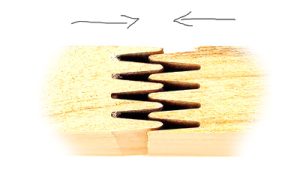
Like… in a weird way, the verb even “sounds” the part. Imagine this image as a video clip and the parts slowly fit together perfectly, along with someone saying: “füüüüügen“. Kind of soothing, really.
But yeah, this image is pretty much the essence of fügen. And I think you can see the connection to the family. Just that the verb doesn’t have the focus so much on the fastening, but rather on the “fitting”. Fitting things together that are meant to fit. Or something like that. I really have trouble putting it into words. So I’d say we stick with that visual. That’ll go a long way.
In fact, let’s try it out with some related nouns.

 Audio Speed
 Dark Mode
I looked up “Sounder of Unicorn” in Google with the quotes and I found only this one page, in the entire world, that uses that phrase (according to Google) — this one. That’s kind of fun. By definition, that kind of makes this page a unicorn too.
Hooray, I have invented something actually new :D.
Emanuel – a pedant writes: there is no plural for availability or I’ve never seen it. “The bar staff has to enter their availability for the following week, …”.
Fixed, danke :)
What do you consider the best German/English dictionary app for American English speakers?
No clue honestly. I always use dict.cc but on web. I don’t use a dictionary app on my phone at the moment.
Another fügen-family word: geringfügig, meaning “slight(ly), marginal, minor, negligible.” Not exactly everyday active vocabulary material, but you definitely run into it in the wild.
Trying to figure out the mind yoga behind that one…
exactly everyday
Oh, you see this every day? That’s a surprise. Are you working in a German company?
Thank you to everyone who has made it possible for me to be sponsored.I really appreciate it.
I got my sponsored membership a bit more than a month ago but sadly had a lot of work and later fell sick so I didn’t had time and/or energy to leave a comment.
Soooooo… here it is! Thanks to everyone who donated and made it possible for me to get this membership and learn.
And ofc thank you Emanuel! I really like your style of writing!
Gute Besserung!!!
vielen Dank to anyone who was willing to pay extra for this! amazing content and community, honestly can’t wait to start learning.. my grades will be most thankful i reckon! I’ll make sure that in the near future i will help out as well, it means a lot <3
Go get that A+!!
Cool: both “verfügen über etwas (akk)” and “verfügbar” were pretty familiar from Duolingo, of all places ;-) But very nice to be able to tuck away the core ideas behind the “fügen” family: it should help the recollection along at all of the appropriate times.
A few corrections…
fixating => I think you might want “fixing” here, rather than “fixating” (which means something like “unable to stop thinking about”)?
receipes => recipes
connection is surpringly simple. => connection is surpri*si*ngly simple.
tile joints => grout (I don’t think English has a distinct name for this space between the tiles, and we tend to label it via the material used to actually fill the gap: the *grout*. Maybe that differs in other English-speaking countries? Opinions pro and contra all warmly welcomed!)
The sounder of unicorn => The herd of unicorns (Not really sure where “sounder” came from here!)
Bonus: a couple of slips from the quiz
==================
doesn’t exists? => doesn’t exist
The meain use => The main use
Thanks a lot for these!
“sounder” is correct though. It’s the collective noun for Unicorns. You think “herd” because they look like horses, but you’re mistaken. It’s either “school of unicorn” or “sounder”, depending on whether they’re sober or not. Source is “Trust me bro” (which is VERY reliable).
Well, I will say it’s a lot less twee than the vomit-worthy “blessing of unicorns” that gets tossed around, but it does seem to be already in use as a collective noun for *hogs* and similar beasties (warthogs, swine, boars). Maybe dem unicorns have a little more of a porcine past than they’d care to admit?
It’s an insult to porcines, really. No can trash a mountain meadow like a bunch of rabid unicorns on a Saturday night.
I’m going to offer up the lovely sounding, but not lovely *acting* corellas as competitors in that department. Flocks of thousands of these guys are ripping up fields and ovals across my home city as I type.
Winged unicorns! Of course they would be in Autralia. What a mad continent.
“Grout” is common in the US too. Other options that come to mind:
– Grout lines
– Seams between the tiles
– Lines between the tiles
Or just plain “between the tiles.” Like, “the floor looks really dirty between the tiles.”
BTW, does the phrase “hopped up on” exist in Australian English? The answer to your question about a sounder of unicorns got me thinking, how often are unicorns sober? As opposed to being all hopped up on something, whether that’s beer, contaminated uppers, or maybe even bloodlust :)
Cool, thanks for the response. I certainly recognise “hopped up on” without having to wonder about what it means, but I think the more prosaic “on the hops” is more widely used here. (“Watch out, (s)he’s on the hops again…” and so forth.)
As for the unicorns: I suspect a sober one is probably just called a horse. Once they lose that oversized party hat the game’s just about up…
Für das, was es wert ist… ich denke, dass das Raum-Zeit-Gefüge wie Stoffe in Allgemein auf Englisch ein „rip” oder ein „tear” bekommen kann. Etwas festes wie ein Spiegel oder eine Fliese (oder die Fugen zwischen den Fliesen) können ein „crack” bekommen. So viel neues Wissen in diesem Artikel. Danke schön!
Oh super, ja “tear” klingt besser. Danke!!
So do unicorns burp a lot? Maybe that’s part of why the universe seems out of whack sometimes.
They had Mexican food in the 90s, so since then there’s been an uptick in burping for sure.
I just wanna say thank you so much Emanuel, your blog is brilliant. I have read tons of articles on it since I found it, and I gotta say I can’t get enough!, your creative way of explaining things never cease to amaze me!. And huge thanks for the members of this learning commuinty who donated extra money so that people like me who can’t afford it have the chance to learn equally, we are so grateful for your kindness and generosity!, hoping I can do the same one day.
To Emanuel and all the donors who have made this membership possible for me – thank you so much! I hope to be able to pay it forward and do the same in the near future!
Thankyou “your Daily german”
Thanks so much! So interesting and funny. And before you said, don’t worry about the dative there, I was just thinking that exactly, what, dative…?
Ah! Fuge (Fugue) is also a musical form. Bach is famous for this, as were many composers before and after him. This all makes sense now!
I thought that dazugeben is the word for “to add” in the context of recipes… mmm…
Also works. “hinzu” and “dazu” are really not that different. “hinzu” is more fancy.
Hi my name is asma and i m from algeria, i’m really looking forward to learning german and be part of this community. i would like to thank Emanuel for this blog and the amazing work that he does and for giving me this opportunity to learn. i would also like to thank everyone in the learning german community especially those who donated and made it possible for me to be sponsored. It really means a lot to me since i can’t afford it.
Willkommen Asma!!
Great article….. and complicated as well :) Understood most of it, the humorous way of explanation is superb feature. If a summary could be added at the end, it will be great.
SOOO good! Fascinating etymology, great visuo-spatial aids, uniquorn humour, so memorable … albeit with occasional typos (think “all-be-it”) :-)
Thanks for the great feedback :). But which typo are you referring to with “albeit”? Did I try to use that in the post?
I love your explanations!! By the way, there are many, many “interlocking parts” in JS Bach’s composition Die Kunst der Fuge!
Yeah, that’s why I thought it would make perfect sense of the word came from this family. The two main voices always fitting together and complementing each other.
But yeah, it’s apparently about one voice running away from the other :)