“Make Down”
***
Hi ihr Lieben,
and welcome to day 7 of our Advent Calendar and today we once again have… a yummy little vocabulary treat.
A verb most of you probably don’t know but that’ll make you sound REALLY native speaker like if you pull it out in the right moment.
I’m talking about the phrase
sich etwas abschminken
At the core of it, we have the noun die Schminke, which is the old school word for makeup. Well… the creamy parts of it, like… I don’t know… rouge or something. And the verb schminken is pretty much about putting on makeup – either onto someone or onto oneself, in which case it’d be sich (Accusative) schminken.
Nowadays, die Schminke is pretty much only used for slap or maquillage that you’d use for Halloween for instance, while actual makeup is simply called das Makeup.
- Maria trägt viel Schminke. (sounds like she’s having a clown face… this white and red one)
- Maria trägt viel Makeup. (sounds like she’s wearing a lot of makeup)
And the verb schminken does sound a bit “unrefined” as well, and the more elegant wording would be Makeup auflegen or Makeup machen.
But you can still find schminken at least in colloquial speech.
- Wenn Thomas auf Party geht, dann schminkt er sich.
- If Thomas goes out to party, he puts on makeup.
- Practice pronunciation – click once to start recording and again to stop
Cool.
And what happens if we add the prefix ab- ? Well, in the article about ab I wrote a while back (link will be below) we find out that the two core ideas of ab are downward and separation.
And so it makes a lot of sense that abschminken is about removing makeup.
- “Schatz, kommst du ins Bett?”
“Ja, ich muss mich nur schnell abschminken.” - “Honey, are you coming to bed?”
“Yes, I just have to remove my makeup real quick.” - Practice pronunciation – click once to start recording and again to stop
But this meaning is NOT why we’re talking about it here.
It’s the figurative meaning that makes it such a colloquial gem.
And that’s basically about crushed hopes.
Like… imagine you were on track for a raise at work, but then, at a monthly meeting, the CEO says things like “nAvIgAtInG tHe CuRrEnT EcOnOmY” or “tHe MaRkEt CoNdItIoNs” and you know you can forget about that raise.
- Toll, die Gehaltserhöhung kann ich mir abschminken.
- Great, I can kiss that raise good bye.
- Practice pronunciation – click once to start recording and again to stop
Of course, you wouldn’t say that IN the meeting, because it’s just too colloquial for that.
And you wouldn’t say it at the bar after work either. Because you simply have no money for the bar after work.
But yeah… that’s the meaning of sich etwas abschminken.
Let’s look at a couple more examples:
- Nach der schlechten ersten Hälfte hatten sich viele Fans den Super Bowl Sieg schon abgeschminkt.
- After the horrible first half, many fans had already kissed the Super Bowl win good bye.
- Practice pronunciation – click once to start recording and again to stop
- An der Abendkasse ein Ticket für die Show zu kriegen kannst du dir abschminken.
- Getting a ticket for the show at the door?! Forget about it!
- Practice pronunciation – click once to start recording and again to stop
In the first example, we’re using the verb abschminken “directly” but that’s actually kind of rare. The phrasing together with können is much more common.
And if you’re now wondering how this use came about and what it has to do with makeup… well, sometimes, all we really need is one meme.
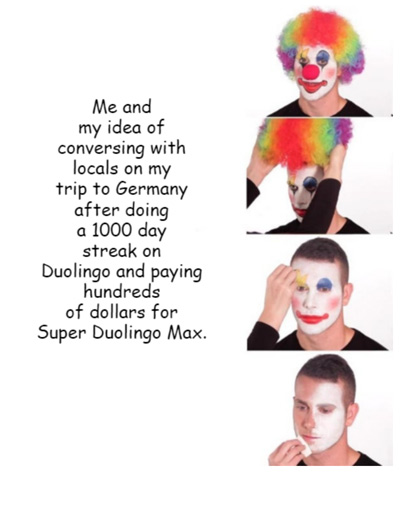
Harsh but true.
And that’s it for today :)!
Let me know in the comments if you’ve heard sich etwas abschminken or if you have any questions about it. Have a great day and I’ll see you tomorrow.
further reading:

 Audio Speed
 Dark Mode
Yes,
I encountered “sich abschminken” on an internet site, but it was awhile back, and I had forgotten it’s mean-
ning. It was great to see it again and will probably remember it now.
Thanks!
I love this expression–it’s quite adorable! Thanks for introducing it to us, and thanks for the Advent Calendar…I enjoy it so much every December!
I also got a kick out of the scholarly discussion below on rouge vs. blush. However, by creamy makeup, surely you meant foundation, not rouge?? (Though I haven’t worn makeup for so long, I’ll probably never be able to speak German with the locals! :D)
Warum, “Ich muss *mich* nur schnell abschminken.” aber, “Die Gehaltserhoehung kann ich *mir* abschminken.”?
Yes, the first one is about actual makeup and the second one is the figurative use. In the first one, the direct object is you (you’re the target of the makeup removal), in the second one the target is the “plan” that gets removed from your face, figuratively.
Thx!
The creamy makeup description reminded me in a way of Schminke Watercolor paints. Is there any connection in Schminke vs schminken???
Yes, it’s the same word family. I’d also wager that they based their brand name on this.
Danke, love this phrase. It still isn’t as cool as my current favourite “stink einfach”! Btw it’s slapstick comedy (not slap, definitely not comedy!).
Uhm, not sure what you mean with “stink einfach”… or do you mean the adjective “stinkeinfach”? If you write it separately, I read “stink” as an imperative… like… “Just stink, dude!”
hi thanks so much for this Advent calendar :-) I love your way of explaining and I find the lenghth of the article perfect.
And I get to learn both english and german.
Happy to hear that you enjoy it :)!
Thanks to all the patrons who allowed me to benefit from a 1-year subscription!
I’m very grateful :)
Willkommen Tiago!
Hallo,
One typo: “which is the a old school word” (which is the old school word).
Oh, and not that I’m expecting you to know that, but “rouge” is something your great-grandmother would have worn when she was young, today’s word is “blush” ;)
Never heard of “abschminken” in this context, but definitely one to add to the active vocab :)
Danke und bis Morgen!
Wait, the makeup item that makes you cheeks reddish is called “blush”?? Like… I’m fixin’ to put on some blush before I go feed the cattle?!
Yep, you want cream blush before going to feed the cattle, liquid blush before feeding the cows and maybe powder blush when you come back home to churn the butter ;)
In Britain, the word rouge went out of common use a long time ago. 50 years ago we called it “blusher” rather than blush.
Oh, I think in Germany it’s still called rouge, but then again, the last time I was in the makeup section was never :D
I think you should put on wellies before you feed the cattle, arf arf
You bet! I always put on wellies in fact, even when I go to the opera.
So a somewhat related expression:
I figure that’s more about the situation – something isn’t going to happen, kommt nicht in Frage, whatever – and less about losing one’s own hopes/illusions, right? How personal does das kannste knicken sound, by the way? Is it more like “you, personally, need to let go of this idea, you idiot,” or just “there’s no point in anyone giving this idea any more thought”?
Another good English expression for “XYZ kann ich mir abschminken” would be “[Well,] so much for XYZ.” Maybe not exactly the same force, but you’d use it in the same kind of situation.
Great question, and also great analysis!
I would say that “kannst du knicken” is leaning more toward just describing how something is not realistic. And it is often used to talk about the “general situation”, but it’s still phrased with “du” a lot of the time.
“abschminken” has a bit more of a negative undertone, for sure.
How common is “abschminken” with “dürfen”?
I guess that’s kind of like “you’ll have to say goodbye to your driver’s license” or “we’ll have to forget about a white Christmas.” Is there maybe an ironic touch to it? Sort of like “you’ll get the privilege of giving up your license.”
Not very common, but this actually reminds me of something that I wanted to talk about for a while… a new fad of using “dürfen” instead of “können” or even “müssen”.
I think I might do an article about it in the calendar, actually. Your two examples are pretty much the same meaning as they’d have with “können”, but they sound a bit more “high register/stilted”.
Hmm, interesting phenomenon: I can see at least the first of the two sentences above working well(ish) with “dürften”, in its probabilistic sense (to mean, roughly, “You’re almost certainly going to be kissing your driving license goodbye for a few years”), but “dürfen” is a completely new one for me. So the first sentence (with “dürfen”, I mean) amounts to something like “You’re going to be able to forget about your driver’s license for a few years”?
As for the second one, I’ve pretty much got nothing, so I’ll just quietly sit down the back and wait for the explanation to arrive, whenever that should emerge ;-)
Ah, no, this is not the use that I mean.
I’ll give you a hint… it comes from the SpIrItUaL cOmMuNiTy and from non-aggresive communication, but people start using it in contexts where it is ridiculous, imo.
Funny that you’d say “whenever that should emerge”, because “emerging” is frequently used by the “spiritual community” as well, whenever they share some boring insight they had at the beach in Koh Phanghan
Despite the, umm, emergence of such a connection, I’d just like to use this opportunity to register my complete independence from this (doubtless(#),) joyous, welcoming, passiv-aggressiv, and assuredly vacuous “spiritual community”. Thank you lines(folk), thank you ball(boys and girls).
(#) In every sense…
The doubtless disclaimer made me laugh! I think I know exactly what you mean.