Hello everyone,
and wohl-come to our German Word of the Day.
This time we “wohl” have a look at the meaning of:
wohl
It looks like well.
It feels like well.
But is it well?
Well… it depends.
Wohl can mean well sometimes, but not always. And it also has a second meaning that’s really useful in spoken German and that has to do with assumptions.
Today, we’ll find out all about it and learn how to use wohl like a native speaker.
Sounds good?
Then let’s go…
… and start with a little bit of history.
Yeah, I know, you’re all hyped up about usage, but patience, young Jedi!
We’ll get there.
Surprised about the origin you’ll be. Many connections discover you will.
The origin of “wohl”
We already established that wohl is related to well, but there are actually some way more famous relatives.
Because wohl comes from the same family as German wollen (to want) and wählen (choose) and the English will.
They all come from a ultra ancient Indo-European root *wel- and the core ideas of this root were wanting and picking (selecting).
Just think of a bush of berries. You want them and you’ll pick the best ones.
So the German word wollen and wählen actually pretty much conserved that.
But also English will has a clear notion of wanting, even though its main job nowadays is as a means to express future tense. You can see the original sense in examples like these:
- I will that into existence.
- The will of the people.
What about well though? How does that fit in?
Well, that’s actually easy to connect too.
Think about it… if something is done the way you want it, or in other words, it’s matching your “will”, then you’d say it’s well.
- “Well done. This coffee is what I wanted.”
“At Starbucks your will is our command, Sir.”
And English then started using well as the adverb more and more and goodly slowly disappeared. No idea why. Goodly… I mean… I speak German goodly. That doesn’t flow as goodly as it flows with well.
But anyway, German doesn’t mark its adverbs and gut still means both things: good and well.
- Du sprichst gut Deutsch.
- You speak English well.
- Practice pronunciation – click once to start recording and again to stop
But German does also have the word wohl.
If you read old German books you might also find wohl used in a sense more close to the English well.
- Habt ihr wohl geruht, (mein König)?
- Have you rested well, (my king)?
And there are a few fixed expressions…
- Leb wohl!
- Farewell/Happy life!
- Practice pronunciation – click once to start recording and again to stop
But in modern German, the well-wohl is used pretty much only with one verb: fühlen.
wohlfühlen – wohl for feelings
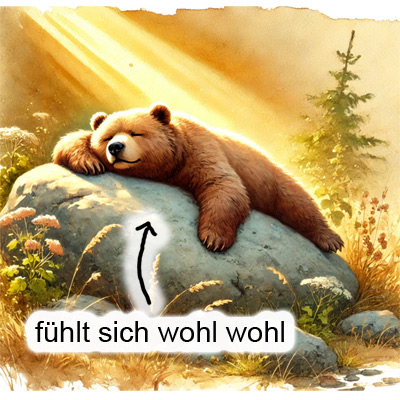
wohlfühlen, or we should say sich wohlfühlen because thanks to fühlen it’s always used reflexively, is a really common verb for the idea of feeling well/good.
- Ich fühle mich in meiner neuen Wohnung sehr wohl.
- I feel good in my new apartment./ I like my new apartment.
We could also use sich gut fühlen and there is a lot of overlap, but I’d say that sich wohlfühlen leans a bit more toward a general sense of feeling comfortable or being comfy and it’s more often related to the circumstances or a place rather than how you feel in your body.
- Ich habe mich in der Bar nicht wohlgefühlt.
- Ich habe mich in der Bar nicht gut gefühlt.
The first one sounds like you weren’t at ease at the bar, maybe because there was a weird vibe.
The second one sounds more like you had something internal. Like you were nauseous or super depressed or something.
It’s not a sharp distinction though and especially in more figurative contexts, the two options are really similar.
- Ich fühle mich mit der Entscheidung wohl/gut.
- I feel at ease with that decision.
- Practice pronunciation – click once to start recording and again to stop
Maybe the best way to grasp it is the “opposite”:
- Ich fühle mich irgendwie unwohl, wenn eine Katze in meiner Nähe ist.
- I feel strange/uneasy, when there’s a cat around me.
nicht gut would sound a bit too “internal” here.
But yeah, don’t worry too much about this.
What matters is that you remember that sich wohlfühlen has a “comfy” ring to it and so it is no surprise that marketing loves it.
If you spend time in Germany, you will sooner or later use shampoo with a Wohlfühleffekt, use a bit of Sauna-Wohlfühlsalz in a Wohlfühl-Oase or eat a plate of Wohlfühlpasta with a glas of Wohlfühlwein.
And no, I am not exaggerating.
There is even the absolutely incredible Wohlfühlgefühl – the feeling of feeling comfy (check it in a real text here).
Give that man the Nobel price for literature.
Oh and just for fun, I also looked if there were any instances of Wohlfühlkrieg (feel good war) and of course there are. We just love to use the verb wohlfühlen.
Anyway, are there any other verbs that work with wohl besides fühlen?
Anyway, is fühlen the only verb that works with wohl?
Well, yes and no. It’s more or less the only one that’s actually really conjugated.
But there are words like wohlschmeckend (well-tasting) or wohlriechend (well-smelling) or wohlwollend (well-meaning), which are technically verb forms, but they really only exist in this form and they also sound a bit high brow.
The vast majority of wohl you’ll hear in daily life is an entirely different use than well.
One that might be confusing for learners when you do not know it’s a thing.
The particle “wohl” – Marking Assumptions
Take this sentence:
- Es ist wohl nach Mitternacht.
- Practice pronunciation – click once to start recording and again to stop
An English speaker might be tempted to think that this means:
- It is well past midnight.
So it’s not just a bit past midnight but a good amount.
That’s NOT what the German sentence means though.
The real meaning is this:
- It probably is past midnight.
Here are a couple more examples:
- “Mist, wo ist mein Handy?”
“Wenn’s nicht hier ist, dann hast du es wohl im Café liegen lassen.” - “Crap, where is my phone?”
“Well, if it is not here, you’ve probably forgotten it in the café.
- Na, auf TikTok während der Arbeit? Sie haben wohl zu viel Zeit.
- So… scrolling TikTok during working hours huh? You must have too much time.
As you can see, the word is used to express a likely assumption here and the big question is of course: WHY™?
Well, I couldn’t find a source about where this comes from but that doesn’t mean I can’t have a theory, right :)?
I think, the key to understanding the assuming-wohl can actually be found in English.
Take a look at this example:
- “Where is my book about AI horse-riding?”
“You took it with you when you were going to take a dump so it will be in the bathroom.”
This is a fairly common use of will in English and it’s not really about future tense. I mean, sure, you can look at it as “The book will be there when you get there” but that’s not really the core point, because the speaker actually doesn’t KNOW. They just THINK that that’s the case.
So here, will is used to express an assumption.
I mean, if we’re really honest, ANY statement about the future is an assumption.
- Tomorrow, I will start working out again.
This is actually a weird blend of things – a statement of intent, a statement about the future, and an assumption. It really depends on how you look at it.
But yeah, with all this in mind it makes a lot of sense that wohl is used as a particle to mark something as “I think this to be the case”. And actually, this personal note is important.
Probably (and its main German translation wahrscheinlich) can be very neutral and “data-driven”.
Wohl is more about your personal impressions or gut feelings, than about actual probabilities.
That’s why “I guess” and “it looks like” are often fitting translations.
Let’s look at some examples, so you can get an impression.
- “Wo ist denn eigentlich Maria?”
“Die war vorhin da. Sie ist wohl schon los.” - “Where is Marie, by the way?”
“She was here earlier. I guess, she’s already left.” - Practice pronunciation – click once to start recording and again to stop
- Wenn du heute keine Zeit hast, dann müssen wir uns wohl morgen treffen.
- Well, if you don’t have time today, I guess we’ll have to meet tomorrow.
- Practice pronunciation – click once to start recording and again to stop
- Ich wollte heute Konzertkarten kaufen aber es ist wohl schon ausverkauft.
- So I was gonna buy concert tickets today but apparently they’re sold out already.
- Practice pronunciation – click once to start recording and again to stop
- Du siehst enttäuscht aus. Der Film war wohl nicht so gut?
- You look disappointed. Looks like the movie wasn’t that good, was it?
- Practice pronunciation – click once to start recording and again to stop
- WAAAAS?
Du willst komplett ohne Training einen Marathon laufen? Du bist wohl wahnsinnig… - WHAAAT?
You want to run a marathon with no training whatsoever? You MUST be crazy… - Practice pronunciation – click once to start recording and again to stop
I hope you can see the personal, or let’s say subjective vibe.
Using wahrscheinlich (probably) in all these examples would sound kind of weird and detached.
This assuming-wohl is really really common and you should definitely add it to your active vocabulary.
But it’s still not all the wohls out there.
There are some more, so let’s take a look
Other Uses of “wohl”
And I’m actually gonna kind of just run through them without much effort to tie them to the themes we had, because it’s a lot of mind yoga and I don’t even know if it is possible.
So just pick the ones you like and learn them as a fixed phrase, so to speak.
That said, let’s go.
The first one is wohl used to reaffirm something.
- “Frau Schmidt hat gesagt, dass ich viel besser in Mathe bin als duuuuu.”
“Hat sie nicht.”
“Hat sie WOOOOHL.” - “Ms. Smith said that I am much better at math than youuuuu.”
“No, she did not.”
“Yes, she diiiid.” - Practice pronunciation – click once to start recording and again to stop
Some of you might wonder if we could also use doch here.
And yes, in this kind of conversation, wohl and doch do the same thing.
But the more common way for the affirming wohl is the combination with sehr wohl.
- Du könntest sehr wohl auch mal den Abwasch machen, ohne dass ich es dir sage.
- You could very well do the dishes without me telling you to do so.
- Practice pronunciation – click once to start recording and again to stop
This use of wohl does sound a bit childish though, so I would recommend not using it. It’s enough to know what it means if you come across it.
Next up, there’s a couple of fixed expressions that also are about affirmation.
- “Du, du und du… ihr putzt jetzt die Klos… mit der Zunge.”
“Sir, jawohl Sir.” - You, you and you… you will clean the toilets now… with your tongue.”
“Sir, yes Sir.” - Practice pronunciation – click once to start recording and again to stop
- “Mal ist das Wetter gut, mal ist es schlecht.”
“Wohl wahr.” - “Sometimes, the weather is good, sometimes it’s bad.”
“How true/well spoken.”
(this one could actually also be the assuming-wohl, so here it depends on context and how you say it.) - Practice pronunciation – click once to start recording and again to stop
And then there’s the fairly important combination, wohl aber which is a normal but with an added reaffirmation.
- Ich esse zwar kein Fleisch, wohl aber Eier und Käse… ich bin also kein Veganer.
- I don’t eat meat but I do eat eggs and cheese… so I am no vegan.
- Practice pronunciation – click once to start recording and again to stop
This is more for writing, but the next one is actually one you’ll hear in spoken german sooner or later: the phrase wohl kaum.
This is basically a staunch “I don’t think so”... you know… the one that borders on “In your dreams.”
- Um 6 aufstehen und joggen gehen? Wohl kaum.
- Get up at 6 and go running? Hardly / I don’t think so.
- Practice pronunciation – click once to start recording and again to stop
And another one you’ll hear a lot in daily life is wohl after a question word.
This is basically a one word way to express that you find something an obvious or dumb question.
- “Wer hat mein Bier getrunken?”
“Na, wer wohl?” - “Who drank my beer?”
“Well, guess who (you dummy)?” - Practice pronunciation – click once to start recording and again to stop
And it works for all question words so you’ll have plenty of opportunity to try it out :)
- Wo/wie/warum/wer wohl?
- Who/where/what/how/why do you think? Duhhhh....
Seriously, this will make you sound super native. So if you drop it at the right moment in conversation with German friends, they’ll be super impressed. And it works with all question words.
Cool.
Last but not least we have the phrase sowohl als auch which literally means “so well as also” and which is the German version for as well as. With the very very notable difference that sowohl is placed BEFORE the first option.
- A as well as B
- sowohl A als auch B
- Um Deutsch zu lernen braucht man sowohl Geduld als auch mehr Geduld.
- To learn German, you need patience as well as more patience.
- Practice pronunciation – click once to start recording and again to stop
And oh, let’s also not forget the noun dasWohl which kind of brings us full circle because it basically means the well-being.
- Zum Wohle des Pferdes.
- For the well-being of the horse. … (this is actually a book title as you can see here)
- Practice pronunciation – click once to start recording and again to stop
And this one is part of a nice alternative to the somewhat rough sounding Prost!
Like, prost is great for beers and shots, but when you’re there with a fancy wine at an elegant candle light dinner, I recommend zum Wohl.
- Zum Wohl.
- Cheers!
- To the well-being (lit.)
- Practice pronunciation – click once to start recording and again to stop
And speaking of cheers, it’s time to do that, because we’re done for the day. Wohoo!!
This was our look at the meanings and uses of wohl and the key points were:
- do NOT use it as a general “well”
- sich wohlfühlen is about feeling good/comfy (really common)
- wohl is commonly used to mark personal assumptions
- there are a few nice expressions that are worth adding to your vocab.
As always, if you have any questions or suggestions about any of this, just leave me a comment and let’s talk further there.
I hope you enjoyed this one, have a great week and I’ll see you next time.

 Audio Speed
 Dark Mode
I am surprised that Azerbaijani and German have the same toast wish.
Zum Wohl.Sizlərin sağlığına! (lit. to the well-being of you all)Azerbaijani is in fact closer to Turkish language, but they use different phrase:
Şerefe! (lit. to pride!)Okay, this proves it. All humans learn the same universal language in the same way. What makes us confused is tiny nuances that blend away.
After reading “Optimizing a lexical approach to instructed second language acquisition”, it is almost evident that all humans have the same language engine. To unlock it for another language… Well, read that book. I cannot explain that in one comment.
(btw, It is not only for you, Emanuel, lol. Just writing out loud. Oh, sorry, I meant thinking out loud.)
In Slavic languages, it’s a variation of “Na sdrave” (Bulgarian) which means “to health” :).
About language in general… I think language is shaped by how we perceive reality, which is a 3D space in which we are somewhere at some moment.
We have to mirror the relations of things that we can perceive in this 4D space (space + time) in language.
Prepositions are really a great example here because for someone whose language has them, they’re absolute basics, but not all languages have them.
Most learners struggle to go beyond the concept of “words” and think instead in terms of “sounds”.
They see something like “into the house” and find it normal and then they see something like (just for the example) “housetheinto” and they find it crazy, when in fact it’s just the sound for house combined with sounds for “inward” and some order and spelling conventions.
They think that the two approaches are completely different and it’s super duper hard to learn the new one, but in reality, at the base, the two approaches are more or less the same. What’s hard is just to train the brain into learning new chunking patterns, but that takes time.
Thanks for the book recommendation. I’ll check if I can find it.
Wait, wait, wait, wait…
Can you please a bit clarify what you mean by in terms of “sounds”, please?
I am really curious.
You mean, for example, the difference like below?
Are you talking about this or anything else that I am missing?
(Eyes squinted to see more and ears tilted to hear more)
-> I agree 100% with the 3D-physical-space claim. That is indeed true. and even there is a book called Metaphors We Live By that exclusively focus on this feature of English.
Yeah, this would be an example but let’s take Finish, simply because I know it better.
– Ich im in Berlin.
They basically have a case for “being in” and they mark it by adding -ssä/ssa” to the end of the
– Minä (I) olen (am) Berlinissä.
So they basically say:
– Ich bin Berlinin.
With Finish words of course.
The elements are the same… a sound for I, sounds for “am” sounds for Berlin and sounds for “in”. And they arrange it a little different than English but because the sound for “in” is not “considered” a word, learners are usually mad confused at how different this is, when it actually isn’t.
Different would be if there is a special one syllable verb for “to be in” because then we’d have indeed different semantic syllables.
Oh, I see what you mean. It is the same in my native language, lol.
Thanks for clarification. (^_^)
Du hast hier im Artikel gesagt dass eine Prüfung oder Recap Quiz bald kommt. Aber…wo ist deine Prüfung für uns? „Wo wohl?!“ Sagst du wohl jetzt.
Busted!
I sometimes forget that I have to do a quiz for an article.
I think I might do a learning quiz instead for the coming weeks and post it anew.
Loved this; big help to me since I’ve tended to use wahrscheinlich . So when should I use wahrscheinlich ( you touched on it but I want to make sure I’m clear on this).
Thanks so much
You’d definitely use “wahrscheinlich” for more “objective” assessements and in more “formal” settings, like a work meeting for example if you talk about how long you’ll need for a job.
And you’d also use it at the start of a sentence or answer. Wohl wouldn’t work there.
– Wie lange?
– Wahrscheinlich 10 Minuten.
And saying this, I realize that “wahrscheinlich” is also the best choice for estimating numbers like this.
Hope that helps :)
In ‘ zum wohle does Pferdes’, why does wohl have an e? Is it the dative because of zum? But it is a noun too?
It’s the noun “das Wohl” (the wellbeing). The “e” is optional but this phrasing (zum Wohle des/der) is kind of “fixed”, and most people use it with the “e”, because it “sounds better”.
However, when saying cheers for example, people say “zum Wohl” and I don’t think I have ever heard “zum Wohle”.
I was going to ask about wohl aber, if it could be used similarly to außerdem, but you covered that in the last comment.
Would sowohl als auch be similar to genausso in use? and is genausso really used or is it more of the same, just trying to give you the bare minimum to make you “functional,” as you described in another question/answer below? Not sure if I am making sense here.
Not really. Could you add some examples are context, so I don’t have to read the other comments :)?
You had mentioned how other courses teach German in a manner that just gets you speaking the bare bones of the language. Which I thought was an interesting take, as I had always kind of wondered how good courses were at getting you speaking in real every-day situations. You said “Let me steelman the position of the German-teaching-industrial-complex for a second. Their objective is to get you ready to be able to “functioning” in life…” so I was wondering how similar genauso might be to the idea of sowohl als auch and if genauso was used much in everyday situations.
Having seen your reply, that no, they are not, I’ve gone back and read this article again. Going to go search for genauso in the vocab section. See if I get a better understanding after I see what you say about genauso. I should have looked that up first.
Thanks for the reply.
Both “genauso” and “sowohl als auch” are used in every day talk and are good words to know.
They’re not synonyms, and I’m still not sure as to why you think they could be interchangeable.
Dyslexia and learning difficulties would be the answer to that. Lol My head works a bit different for some things. Now having read it again and doing some more reading on genauso, I’m clearer.
All right then. If doubts do come back, you can find me right here :)
I’m wondering if the word order with „sowohl als auch“ is the same as „weder noch“? Like this example:
Weder will ich Fußball gucken, noch habe ich Appetit auf Bier.
Sowohl möchte ich Fußball gucken, als auch habe ich Appetit auf Bier.
Is it possible and idiomatic this way?
It works, but it’s not the most idiomatic choice. The best way would be a simple “und” or “und außerdem”.
Yeah i guess i can see why, thanks for the reply. That was a cool article!
Ok interesting! “Wohl” pops up twice in the sad little songtext I’m studying that I posted about on Schrei. Until now I was assuming that it meant, like, “well,” of course… so just to make sure I’ve got it –
the context is that this is pretty much the only “happy” stanza in twenty-four poems about wandering around sadly in the depth of winter
“Ich träumte von bunten Blumen,
So wie sie wohl blühen im Mai”
It seems like “wohl” adds a sense of May being so distant that it’s hypothetical, so, another touch of irony. Is that right, do you think?
I was assuming the poet was just throwing in particles to flesh out the meter… but this makes me appreciate it more.
Or… maybe he’s just thinking about the future. HMMM. I get different translations for this line: “like those that bloom in May” and “the way they [will] bloom in May.”
I can’t tell what the “wohl” means here.
The “normal” every day reading would be as an assuming-wohl, but since it’s a poem, it could be an affirming-wohl as well. Or even the old scholl “well” as in “good”.
Hard to judge without knowing the author, the time period and the intent of the overall piece.
i guess your interns never finished creating the quiz?
But anyway, this is of course a great article. I don’t think the word has ever been covered in any course i’ve done. i mean, we learnt sowohl, als auch, but apart from that i don’t think it is.
I find it weird there is certain specific grammar / phrases you are supposed to demonstrate to get to a certain level. But actually stuff like this word that has much more to do with actual spoken german gets pretty much left out. Words like doch, schon, wohl seem like afterthoughts to the standard experience i’Ve had of learning german. There should be entire chapters of the course books dedicated to each of these words.
I did have a great subsitute teacher once who was compalining that no one could use doch and made everyone practice using it to contradict a negative statement, but we didn’t even cover the other senses sadly.
Sorry, bit of a rant, but yeah…
Lex Fridman voice:
Let me steelman the position of the German-teaching-industrial-complex for a second. Their objective is to get you ready to be able to “functioning” in life… have a job, do administrative stuff or go to university. These particle words are not really necessary for that, and they figure, since they pop up all the time anyway, the learners who are interested/confused by them will look into it out of their own intrinsic motivation.
Seriously though, I think the much bigger issue is the big fat focus on gender and cases and the lack of focus on prefix verbs and phrasing patterns. You can be fluent without caring much about gender, but you’ll sound unintelligeble if you can’t use prefix verbs correctly.
Sowohl als auch entweder oder zwar aber…. Was soll ich machen.. Wenn ich Adjektive benutzen muss zum. Beispeil….. Ich kaufe ein schönes Auto , aber das Auto ist sehr teuer…
Hier… Ich kaufe zwar schönes Auto, aber es ist sehr teuer….. Ist das richtig????? Sagen Sie mir bitte ,was ich machen soll
Beides ist richtig, mit und ohne “zwar”. Es kommt drauf an, was du sagen willst.
Tendenziell ist der Kontrast “direkt”.
– Das Auto ist zwar schön, aber teuer.
It exists in Arabic too …. and I believe that when you say: ” it’ll be there” it means that “when you look for it in the bathroom it will be there”
yeahh. pretty interesting isnt it. I find the similarities between Arabic and German (with an English language background) super interesting
Especially since there’s no deeper relation between the languages. They’re different families, as far as I know.
“please let me know if this exists in your language too”
Here’s a report from a native Chinese speaker. And yes, I believe there is this phenomenon in Chinese, too, although not exactly the same. We have the word “会” (hui4). As a verb, it normally translates into “can” or “be able to”.
你会开车么?
Can you drive? / Are you able to drive? / You know how to drive?
Although originally not meaning “well”, as “wohl” does, in a similar fashion, “会” can also indicate an assumption.
你的华为手机会被你忘在咖啡店里了么?
Maybe you forgot your Huawei cell phone in the café?
Aa
Sorry i forgot to add the question :) i couldnt be sure what that “wohl” adds to the question. Maybe “probably”? But klingt weird i think. thanks.
Hello. i have a question from a simplified version of faust: -ich will sie kennenlernen, mephisto. Wie sie wohl heißt? -Sie heisßt Margarete.
I understand that as something like
“I wonder what her name is?”
This is a phrasings that’s still used today.
– Wieviel das wohl kostet.
You could add “I’m wondering” in front of it and take out the “wohl”. But the “wohl” adds a vibe of wondering, like… grabbing your chin and looking up. That’s what it sounds like when it’s in there :)
Hope that helps.
I also found a phrasing, where I guess “wohl” has a similar meaning:
“Wie wäre es wohl, wenn ich hier klammheimlich auf der Lauer läge…?”
Yup, great example! Same vibe of “hmmmmmmmm”
* Wenn du heute keine Zeit hast, dann müssen wir uns wohl morgen treffen.
* Well, if you don’t have time today, I guess we’ll have to meet tomorrow.
Does the German sentence have the same connotation as in English? There is a sense of necessary-it’s-gotta-get-done-yet-I’m-disappointed-ness (almost annoyed depending on context) in the English when one would say “I guess we’ll have to meet tomorrow”. The softer way is “I guess we could meet tomorrow”. Is it the same in German? Does the statement convey a Boss-to-worker/Teacher-to-student/My-wife-to-me feeling?
Great question but hard to answer. I feel like the German version is a bit softer than the English one (based on your description of the tone). yet, the statement as a whole does imply necessity because of the “müssen”. I can imagine saying it to a friend though. The way it sounds really depends on how you say it in German.
Not sure if that was a coherent thought :).
I don’t think it has as much “color” as the English one.
Just to be sure… you’re mainly asking about “müssen” vs “können” right? Not about “wohl”.
Awesome Piece of Work. The thought upon a word changes completely when you study its roots and the way it has evolved.
Danke, freut mich, dass es dir gefällt :)
Ukrainian language also has that notion of probability if use the future will “це буде…..”
Like in this example:
“Where is my book about linguistics?”
“Well, you took it with you when you were going to take a dump so it will be in the bathroom.”
– Де твоя книжка по мовах?
– Гаразд, ти взяв її коли йшов випорожнитись, отже вона буде в туалеті
‘Вона буде’ taken in the meaning of probability
I’ve come across a couple of examples of “ja” and “wohl” being used together, usually (in addition to the one you don’t/can’t translate above!). Given that (and please write that article soon!) “ja” as a particle tends to mean certainty and “wohl” means kind of probably, this wants to make my head explode!
Ich habe gar keine Lust dazu, aber ich muss es ja wohl tun.
I don’t fancy the idea, but I have to do it.
Aber das ist er ja wohl nicht mehr
Well he isn’t anymore, is he?
Would I be right in thinking though that this is the affirming “what I am saying is true” meaning of “wohl”, much as it is in “wohl aber”, only here the “wohl” has gone for a walk off to the middle of the statement! So you get a kind of double affirmation – “I don’t fancy the idea, but it is true that I definitely have to do it”.
Ignore that “usually” in the first sentence. Oh for an edit function! :-)
Interesting question! No, the “wohl” is all about “likely/I suppose”. What the “ja” does is it reaffirms the fact that this certain assumption can be and has been made. You could look at it as “as we’ve mentioned before” but it’s not always meant literally. It’s just marks the statement as being a call back to an established truth while without the “ja” the sentence could express that this is the first time the thought is thought.
– Aber das ist er ja wohl nicht mehr.
– But as has been suggested by the information presented earlier he most likely isn’t that anymore (really clunky translation, the “as has been suggested” is the call back )
– Aber das ist er wohl nicht mehr.
– But I guess he isn’t that anymore.
Many thanks yet again! That helps a lot (and I look forward to the “ja” article with great anticipation!).
Which said, of all the German particle usages to date, this is the one I’m struggling most to find a remotely idiomatic English way of translating. It’s somewhere between “as we’ve discussed before”, “as we know”, “you know”, “as we were thinking” and even “as was being suggested by what we already knew”.
Native-speaking friend of mine said “ja wohl” basically has the sense of “obviously.” E.g. conversationally in English one might say, “Well that is obviously not what I meant!”–“ja wohl” maybe has that rhetorical color that offensichtlich/offenbar maybe don’t, that could carry a slight sense of impatience (this sense of, well *of course* it’s this-or-that way).
Uhm… not really. It CAN mean “obviously” but it really depends on the context. In your example I wouldn’t use “ja wohl”. It does has an affirmative vibe in it, but the “wohl” puts too much of a question into it, while “obviously” is a pure statement.
Ah, dang…
I just looked up “ja wohl” here (context.reverso.net/) and I wonder if “presumably” gets at the gist of it better. (Of course the whole difficulty is that with these super common particle-type words there is no one-to-one, but it still helps to try…) Similar to “wohl” (very roughly “must be”) but very slightly less uncertain/more insistent…?
Yeah, presumably fits in meaning, I think. But “ja wohl” doesn’t sound as “neutral/sciency”. Especially the combination with “ja” is very subjective sounding.
Gotcha, thanks. Could you say how it’s different from “vermutlich”? Just more casual?
Yeah, and again more subjective. I think I haven’t used “vermutlich” in a decade :)
“Wenn’s nicht hier ist, dann hast du es wohl im Café liegen lassen.”
“Crap, where is my IPhone 8?”
“Well, if it is not here, I’ve probably forgot it in the café.” should be ‘you’ve’, not ‘I’ve’.
Danke!
I’ve barely started reading your post, but already have a question. Your example “Du sprichst gut Deutsch.” uses ‘gut, as an adverb; can the sentence also be “Du sprichst gutes Deutsch” with it being an adjective?
Yes, that’s totally fine, too. Just harder to pronounce and also, German is (that’s my take on it anyway) a verb focused language, so if given the choice, it’ll describe the verb, not the noun.
Sorry for the late response and leaving you hanging with that question for days :)