
***
Hello everyone,
And welcome to a new episode of Prefix Verbs Explained.
Many thought the series was over and prefix verbs were all living happily ever after in our brains.
And one day, they might.
But there are still verbs aplenty for us to explore, and today we’ll take a look at
The Meanings of “ausschließen“
And this one is interesting not only because it’s useful in daily life and has a couple of nice relatives. It’s also a really great example for English prefix verbs that are hidden in plain sight.
Let’s start with schließen itself….
“Schließen” – The Lore
Many of you probably know that schließen means to close.
In many many contexts in daily life, zumachen is the more idiomatic choice, but you can find schließen in daily life as well, whenever a slightly more elevated or formal tone is needed.
- Bitte die Fenster abends schließen.
- Please close the windows in the evening.
- Practice pronunciation – click once to start recording and again to stop
- Sonntag haben die Supermärkte in Berlin geschlossen.
- On Sunday, the supermarkets in Berlin are closed.
- Practice pronunciation – click once to start recording and again to stop
What you might not know though is the lore.
Yes, words have lore now.
And schließen and close are actually kin.
They both come from the absurdly ancient Indo-European root *klau- which originally stood for some sort of hook or twisted branch that would be used to kind of bar or block something from moving. That’s how the idea of closing evolved.
The German branch of the family tree picked up an “s” somewhere and now we have schließen itself and also das Schloss (the lock, the castle) or der Schluss (the end, the conclusion).
And on the English side, we have words like closet (a closed off space), claustrophobia (fear of enclosure) or clavicle (bolt like bone) and most importantly for us today, the group around –clude.
So verbs like include, seclude, conclude or… wait for it… to exclude.
And if you’re now thinking “Wait, wasn’t ex-like the Latin version of aus-? ” then YES!
You’re spot on.
Ausschließen and exclude are quite literally the same word, if you go by the parts.
But does that bode well for the meanings?
Let’s find out.
The Meanings of “ausschließen”
Ausschließen has three meanings, and one of them is indeed to exclude.
- Thomas fühlt sich ausgeschlossen.
- Thomas feels excluded.
- Practice pronunciation – click once to start recording and again to stop
- “Warum ist deine neue Freundin hier beim Arbeits-Meeting?”
“Ich will sie von nichts ausschließen.” - “Why is your new girlfriend here at the work meeting?”
“I don’t want to exclude her from anything.” - Practice pronunciation – click once to start recording and again to stop
However, we need to note that ausschließen sounds a lot more “barring” and final. Like… leaving outside and locking the door from the inside.
It works well for excluding people like in the examples above and it also works for stuff like excluding certain foods from your diet, but it wouldn’t really work in a sense of just excluding an item from a list for a moment.
- Let’s exclude grammar for a second… what do you struggle with the most besides that?
In a context like this that’s more about just “putting aside”, ausschließen sounds WAY too definite and strong.
For a context like this, there are several better options, like rausnehmen, außen vor lassen or rephrase it with abgesehen von (aside from).
And it’s not that ausschließen would be wrong. It just sounds way too definite.
There’s another type of context though in which this super strict “exclusion” works perfectly fine – the idea of ruling something out.
- Ich schließe eine Kandidatur aus.
- I rule out a renewed candidacy. (I rule out running again)
- Practice pronunciation – click once to start recording and again to stop
- Wir müssen ausschließen, dass das noch mal passiert.
- We have to make sure that this doesn’t happen again.
- Practice pronunciation – click once to start recording and again to stop
- “Kann man hier Einhörner sehen?”
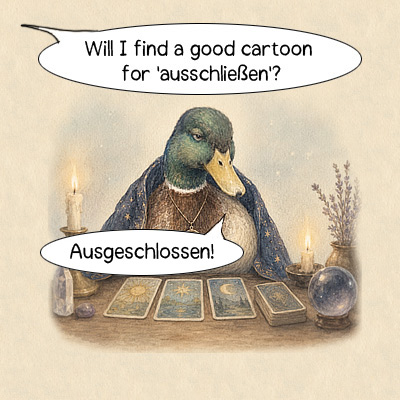
“Ausgeschlossen!” - “Can you see unicorns here?”
“Nah, impossible.” - Practice pronunciation – click once to start recording and again to stop
These examples would sound quite weird if we translated them with to exclude.
But when you think about it, the underlying idea is indeed the same. All three examples in essence talk about “excluding, removing” something from the set of possible options.
This use is actually quite common, so make sure to not just think of ausschließen as just plain to exclude.
Try to remember (and feel) the core idea and vibe that I tried to describe. Think of leaving something or someone outside and locking the door from the inside. Or at least saying “I’m sure X can’t come into our circle.”
That’s the vibe.
And in fact, there’s actually a third meaning that we can use as a mental hook: – to lock oneself out.
- Ich habe mich ausgeschlossen.
- I locked myself out.
- Practice pronunciation – click once to start recording and again to stop
You know… you hear the sweet luring chants of the Sirens (who live in a flatshare above you). You go out the door and boom. It’s shut and you forgot your key inside again. Another 150 Euro for Chad vom Schlüsseldienst (locksmith service). Good thing he’s one of the Siren’s boyfriend, so he’s probably around anyway.
But yeah, those are the three uses of ausschließen:
| to exclude | definite, strong |
| to rule out | exclude an option from reality |
| to lock oneself out | reflexive: sich ausschließen |
And now, to wrap this up, let’s take a quick look at the direct offspring of ausschließen.
Words based on “ausschließen”
We already had ausgeschlossen in examples, but I want to mention it again here. Technically, it’s “just” the ge-form of the verb itself, but it’s fairly common as an adjective, and it can be about exclusion but also about “being ruled out”.
- “Ich fühle mich grad von dir ausgeschlossen!”
“Ich bin auf Klo, Thomas. Mit Durchfall!” - “I feel excluded by you right now!”
“I’m on the toilet, Thomas. With diarrhea!” - Practice pronunciation – click once to start recording and again to stop
- “Was, wenn das Einhorn ins Haus kommt?”
“Das ist ausgeschlossen. Wir haben alkoholfreies Bier vor alle Türen gegossen!” - “What if the unicorn comes into the house?”
“That’s impossible. We poured around alcohol-free beer in front of all doors.” - Practice pronunciation – click once to start recording and again to stop
Then, we have the adverb ausschließlich, which is basically a more formal or fancy version of nur, that has the focus a bit more on the idea of being exclusive.
- Wir verwenden ausschließlich Bio-Zutaten für unser Eis.
- We only/exclusively use organic ingredients for our ice cream.
- Practice pronunciation – click once to start recording and again to stop
And what’s worth noting here is that ausschließlich pretty much comes BEFORE whatever it is referring to. So it cannot be at the end the way exclusively can.
It’s not a word you to use, but you’ll definitely see it here and there, and if you do a B2 or C1 exam, it’s a nice one to drop in.
Cool.
Next, up, we have the noun der Ausschluss. By itself, it refers to the act of excluding or ruling out.
- Die Verhandlung findet unter Ausschluss der Öffentlichkeit statt.
- The trial is taking place with the pubic excluded. (“under exclusion of the public”)
- Practice pronunciation – click once to start recording and again to stop
And there are a couple of nice compounds that are not super common, but they’re really handy in a particular context: das Ausschlussprinzip and das Ausschlussverfahren, which literally translate to exclusion principle and exclusion process, respectively.
The translations are a bit misleading though, because in German, both words are about the process of selecting or finding a solution by excluding one option after another until only one is left.
Think for instance you want to decide what movie to watch with your date and you have a list of 10, and instead of picking one, you exclude one option after another based on some criteria until you’re left with “The Notebook”. I think the better translation is process of elimination or something.
- “Wie habt ihr euch für Schottland als Urlaubsziel entschieden?”
“Nach dem Ausschlussverfahren.” - “How did you decide on Scotland as your holiday destination?”
“By process of elimination.” - Practice pronunciation – click once to start recording and again to stop
And that’s it for today.
Hooray.
This was our look at the verb ausschließen and its little family.
I didn’t have time to prepare a quiz for this one yet, but you can still recap and practice the words we’ve learned with my Text Comprehension tool below.
Basically, it’ll create a short text for you on your level and it’ll work in all (or most of) the words we discussed and then quiz you on the text.
It’s quite a nice recap, that also trains you in this exam type reading comprehension, so give it a try.
And of course, if you have any questions or suggestions just leave me a comment.
I hope you enjoyed this one, have a great week and I’ll see you next time.
Want to read more Prefix Verb episodes?
Here’s the archive:
Prefix Verbs Explained – Series Page
And here’s the link to ausschließen in my Prefix Verb Dictionary, where you can click through the family in a new and easy way.
“ausschließen” – Prefix Verb Dictionary
Text Comprehension Practice – “ausschließen”
***
What's your level?
***

The comprehension practice is fantastic! I generated a short B2 text with multiple choice questions and found it very helpful. The article itself was also great. Thanks again and congrats on Fatherhood!
Thanks and glad you enjoy the tool. I’ll add it to more and more lessons over time.
The Comprehension Practice isn’t working. It’s stuck at ‚generate text‘. Good article!
Hi, it’s working for me and I’m not out of AI credits, which is usually why it would stop. Could you tell me what browser you’re using?
Moin! Das Quiz hat diesmal richtig funktioniert. Ich habe das B1 Quiz ausgesucht und alle Fragen richtig ausgewählt. Dank dir habe ich auch ein paar neue Worte gelernt…wie immer! Ich liebe dieses Format!
Hello,
Some typos:
“the two word have more in common that it seems” (the two words have more in common that it seems)
“there is still verbs aplenty” (there are still verbs aplenty)
“barr or block” (bar or block)
“picked up an s somewhere and no we have” (picked up an “s” somewhere and now we have)
“It just sounds way to definite” (It just sounds way too definite)
“this super strict “exclusion” work perfectly fine” (this super strict “exclusion” works perfectly fine)
locksmith – just one word
alcohol-free beer – you need the hyphen
“It’s not a word you to use, but you’ll definitely see it here and see, and if you do a B2 or C1 exam, it’s a nice on to drop in” (It’s not a word you’ll use, but you’ll definitely see it here, and if you do a B2 or C1 exam, it’s a nice one to drop in)
Thanks for yet another very informative article :)))
Bis bald!
Ooph, more than usual this time :).
Danke wie immer!!
Hi Emanuel, thank you for the sponsored membership — I really appreciate it. You have a way of making German grammar easy to understand. Thanks as well to the members who make these sponsorships possible — it’s a generous thing to do. Vielen Dank und viele Grüße!
“Wir müssen ausschließen, dass das noch mal passiert.”
“We have to make sure that this happens again.”
I think this should translate as, “We have to make sure that this doesn’t happen again.”
Oh terrific, it happened again!! Another example with a wrong translation.
Thank goodness a reader caught it early this time, so not too many people saw it.
Thank you!!
Or:
Wir muessen uns sichern, dass sowas nicht wieder [mehr] passiert!
This is not idiomatic German to my ears. With “absichern” it works, but it means something slightly different.
Certainly.
Once again, I oughtn’t text or e-mail when I’m driving. Was simply distracted!
Thanks,
yeah, you also shouldn’t read comments probably :)
Neuaussiedler aus Somalien in der Bundesrepublik fuehlen sich oft wegen der Sprachbarriere ausgeschlossen.