Hello everyone,
And welcome to a new episode of Learning Quiz.
Hooray, everyone’s new favorite series. Netflix wanted it. Disney+ wanted it, Apple+ wanted it.
They don’t have it! You have!
For those of you who are new here:
In this series, we explore words and grammar concepts, but instead of me just info-dumping on you, we’ll work through the topic together and explore it in a question-answer format.
I ask a question, you can think about it and pick an answer, and then I’ll explain what and why and your brain will be super duper eager to know in that moment, especially if you got it WRONG.
Our brains don’t like being wrong. So they’ll make sure they won’t be wrong again. You don’t even have to do anything :).
And the whole quiz builds and I am leaving some clues and foreshadowing here and there, so if you pay attention, you’ll might know the answer to things you didn’t even know you knew the answer to.
So yeah… that’s a learning quiz in a nutshell and today, we’ll learn
The Meanings and use of “ankommen”
That’s definitely one of the more important prefix verbs, so if you’re ready, let’s jump right in.
***

 Audio Speed
 Dark Mode
6/10 — thought it was a good difficulty level. So interesting about “-kunft”!
I know, right? I had a little wow-moment myself when I found it out.
In Q3 why is ‘ Ich kam um sechs Uhr an ‘ incorrect?
Good question.
It’s not technically incorrect, but I was going for the spoken past here because that’s what you’d use and hear in most German speaking regions. “Ich kam um 6 an.” sounds like it’s part of you telling a longer story.
“Ich kam um sechs Uhr an.” would be completely right if you either were narrating an event or expressing same in writing.
Apart from that, “Ich bin um sechs Uhr angekommen.” is perfectly correct spoken German anywhere in the German-speaking countries.
I just wanted to say Danke schön to all of the members who sponsored my membership this year by paying a little extra for their own subscriptions. Your generosity truly means a lot to me, and I’m very grateful to be able to learn from this community because of it.
I am a student, and I will be traveling to Germany this summer. German is important for my studies and research, and having access to this site will help me continue improving my language skills. It’s really inspiring to see such kindness and team spirit in a learning community.
Vielen Dank für eure Unterstützung! Ich freue mich sehr, hier zu lernen!
Willkommen!
Good lesson! and thanks for all the work and tweeks you’ve put in lately.
Much more coming!
5 out of 10 first time. Then 100% correct! I’m delighted.
I am blown away!Wow that was the most interesting way to learn something . I did really bad on the test but wow it I will try again. Thank you very much!
Freut mich, dass es dir gefällt. Guck dir auch die anderen Quizzes an, die in dieser Kategorie sind :)
Really hard the first time through, but I learned a lot from it, which I guess is the point. :) Danke!
Huge Thank you guys
Tolles Quiz. Das habe ich genossen, obwohl ich nur die Hälfte richtig ausgewählt hatte.
Freut mich.
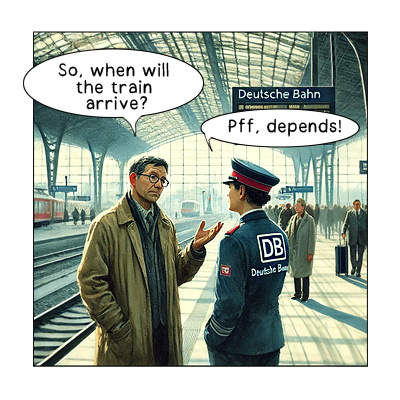
I made a major mess of the quiz first time through (about half marks, from memory), mainly because the “depends” usage was completely new to me, but second time was nice and easy, and I have confidence that that alternative meaning has sunk in. ’twas nice that a couple of the later questions in the quiz had their solution mentioned (or hinted at) in the discussions following earlier questions: a welcome reward for slow, careful reading ;-)
“because the “depends” usage was completely new to me”
Wow, that’s such a common word in everyday conversation. I’m almost sure you’ll hear it now, if you listen to podcasts or some stuff like that.
And yeah, I’m playing around with this foreshadowing-recall stuff. I think it’s important for stuff that you can’t really deduce and that you either know or don’t know. By mentioning it a few questions earlier, everyone has the chance to get it, even if they didn’t know. For a normal quiz that doesn’t matter but for a “learning quiz” it definitely does.
It *is* a little weird, so thinking about that absence a bit more leads me to suspect that I had an idiom or two graffitied somewhere in the shabby old brain (notably “Es kommt d(a)rauf an”), but had pigeonholed them *as* idioms, and didn’t connect them with a more general meaning. Should be fun to hear all the new instances ringing bells in my noggin now!
Great quiz! If the point is not to ace it, I scored really well ;-). Going to check out the “ankommen” article now!
“If the point is not to ace it, I scored really well.”
Haha, congratulations :)
Great job. I never knew about the depends on definition. But I still got eight out of 10 right, I’m a good guesser and you did give us some nice hints along the way as you said.
Ich würde besser lernen, wenn in jeder Antwort ein Beispiel dafür enthalten wäre, wie das Wort oder die Phrase in einem Satz verwendet wird. Danke.
Gute Idee, mache ich ab jetzt wenn’s passt.
Sehr spaß ~ natürlich!
Viel Spaß, nicht sehr :)
Great quiz!
Du hast ein Buch bestellt? Na, wann kommt’s an?
Nach meinem Papa, kommt’s auf die Wirtschaft an.
Dasselbe Wort mit zweierlei Bedeutungen!
That was really interesting. I only got half of the questions right and I learned a lot!
I think it was difficult if you are A1, which I am.
Yeah, A1 is early for sure. Did you learn something though?
I was A1 when I found YDG. Many articles were over my head. I read what I could and moved on. I am now B1/2 area and things are sticking in my mind better now. Having read #above# my level was hard, but opened up thinking that would come in handy later. This quiz is hard for many reasons.
Oh, I didn’t know you started here at A1 :). Glückwunsch zu deinem Fortschritt!!
Es freut mich, wie immer. Meine Punktzahl kommt darauf an, wie man es sieht…
Hallo,
here are two typos I found:
“the prefix splits of” (the prefix splits off)
Q5: “This is general patterns” (These are general patterns)
I got 8 out of 10, so not bad!!!
Thanks, I like this quiz format, I learn a lot more when I actually practice :)
Bis bald!