Hello everyone
And welcome back to a new episode of
Learning Quiz.
Yes, it’s a series now, I guess.
A learning quiz is a basically like a little German lesson about a topic, but instead of me just feeding you the facts, we’ll build up and explore the knowledge together through a series of questions.
I ask a question, you can think about it and pick an answer, and then you’ll get the correct answer along with an explanation why and what the key takeaway is. If you got it right, great.
You know.
If you got it wrong, great.
You learned.
I started doing these types of quizzes last year and I think they’re a lot more effective than a simple recap quiz and possibly even a longer article, because in this quiz, each piece of information presents as a problem for you to solve. So your brain is extra primed to “find out”.
Like… imagine I tell you “The pink unicorn has a food allergy because of childhood trauma.”. Okay, that’s a piece of information you can process or ignore.
And now imagine I instead ask you “WHY does the pink unicorn have a food allergy?”
You’re automatically more involved or at least engaged. Even if you’re like “Wait, which pink unicorn, why are you asking that?”
The fact you got presented a challenge automatically gets you involved and a bit on edge.
And that’s a much better state for learning than just passively consuming information.
Anyway, long story short, I really like this format as a means of teaching, and since many of my lessons and articles don’t have a quiz yet anyway, I’ll do a lot more of these.
And today, we’ll do a learning quiz for:
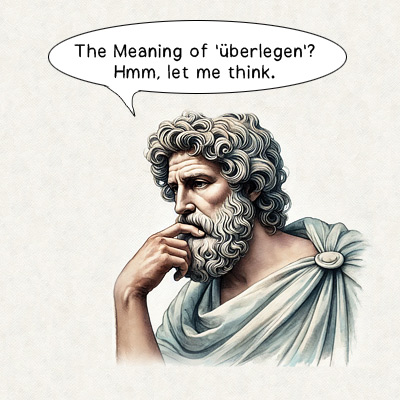
The Prefix Verb “überlegen”
überlegen and sich überlegen are both very common verbs in daily conversation, and in the quiz, we’ll learn, what they mean, how and when to use them, we’ll find out whether the sich is Dative or Accusative and why, and we’ll also address the rüberlegen, because thou shalt never ignore the r-versions.
This Learning Quiz complements the article about the topic, which I have recently given a substantial make-over.
If you want to check that out first, you can find it here:
The meaning and use of “sich überlegen”
But I actually recommend doing the quiz first.
Like I said… the quiz is meant to teach, not test.
You can then go to the article after if you want to review or see more examples for the various uses.
Anyway, without further ado, let’s jump right into the quiz. It’s eleven questions in total – so a bit on the long side, but I hope not too much.
Viel Spaß!
***
***
So, how was it? How’d you do?
Let me know in the comments how you did and if this was difficult. If you did poorly, please don’t worry. Instead, do it again and focus on the explanations. And then come back in a couple of days and retake the quiz. I’m pretty sure you’ll improve.
If you have any questions about anything in the quiz or things I haven’t addressed, just leave me a comment and I’ll clear it up.
And if you want to dig deeper and see practical examples for the verb, just check out the lesson I have linked above.
By the way… I’m restructuring the archives at the moment and I’ll also add a few more dedicated Courses you can complete (right now, most articles just belong to “Vocabulary”).
But I’ll let you know more about this when I’ve gone a bit further along.
Anyway, I really hope you enjoyed this one and learned a thing or two.
Have a great day, and I’ll see you soon in the next one.
Bis dann.

 Audio Speed
 Dark Mode
For the surprise question/answer “I thought about it too long, Ich habe zu lange überlegt.” Could this be written also as “Ich habe es (or a da-Wort) zu lange überlegt.”?
No, “überlegen” can only take a direct object if you include “mir”.
– Ich überlege etwas… NOPE, sounds quite wrong
– Ich überlege mir etwas.. YES
Apologies, my German learning side of the brain is a little fried today so forgive the follow-up question:
Ich habe zu lange überlegt = I thought about it too long. Is the “it” in this translation a filler word for ease of translation? If I had a concrete “it/something”, this is best emphasized in: Ich überlege mir etwas….. I hope this makes sense
I felt like “I thought too long” sounds too much like you’re in a quiz show with a strict timer, so I added the “about it”.
In actual spoken German, this sentence will usually have a context, so there WILL be an established “it” that the person was thinking about and the listener knows it.
The thing here is that “zu lange” implies that you never concluded the thinking because something changed. The opportunity went away for example.
“ich habe es mir zu lange überlegt” would work too, but it does sound a bit like you reached a conclusion, while the first one is really just you pondering.
Does that help?
Ah yes, that makes total sense. For some reason, I don’t always connect example sentences with (assumed) context. I read them as is and then have a billion ‘why’ questions like a toddler. Ugh, I am trying to break this bad habit! Thank you for the explanation – very helpful!
“I read them as is and then have a billion ‘why’ questions like a toddler.”
Oh, that’s perfectly fair! On Reddit, people would scream “context?” for some of my examples.
I’m just kind of in “writer mode” when I make them, and I do have a back story or angle in my mind. Not super fleshed out of course, but it’s there for a second. I sometimes notice that when I read a really old article. Then I’ll run into an example where I’m like wait, what was I thinking.
:)
Love the quizzes. I learn so much better that way.
I agree!
I’m really happy to hear that, because I think it’s a better way as well and it’s a nice variation for me to create these, especially because it gives me the chance to review and edit older articles and bring them up to date along the way.
I think the learning quiz would be more helpful to the brain and getting the new information into the brain if the color red for wrong guesses/answers was a more neutral color, like blue, instead. To make it visually feel like you are raising your hand in class rather than be tested on something already learned. I also think the word “Incorrect” could be something like “Here’s the Answer”.
I’m a total beginner so there is no way I would even be able to make good guesses for a while. Thanks!
Nice ideas, thank you!! I have changed the colors and display of the wrong marking for the answers.
I can’t easily change the “incorrect” wording because it comes from somewhere deep down inside the software I am using and I can not easily change it without having to change it again with every update. I thought about removing them, but many of the older quizzes don’t have an explanation but just this message, so removing them would mean no more feedback there.
But yeah, at least the colors are a bit less aggressive and chiding.
Oh, that’s amazing! I know that some things are just “out of the box of change” like that when it come to software. Thank you for inviting comments!
I like the INCORRECT. IT IS a frying pan upside head! Keep it!
I like this quiz format a lot.
SAME!!!!!! IT REALLY HELPS!
six out of eleven, not having read the article. But you learn more from mistakes, no? Time to read the article
Well the quiz certainly helped me to have a sharper focus throughout the lesson. So thumbs up from me!
Dieses Format gefällt mir.
Sehr interessant! 11/12
I’m hoping I won’t get blocked anymore with that aggravating- ’You’ve reached your 2 week for free limit.’ —Now that has been discontinued;) Grrr
Uhm… you’re even more likely to get blocked actually, since there won’t be a free option anymore for some of the content. I don’t know yet how to strike a balance but I cannot keep every newsletter free as things currently go.
The newsletter and new article are part of the work I do per week, sometimes 60% sometimes 30%.
The idea was always that the newsletter is free but I create an article which will then show up in search and give me new traffic over time, some of which translates into new members.
But that latter part is not not working well anymore, so I can’t have all new articles be free for 80% of the readers anymore who are following the newsletter. Either, I make some of them member exclusive or I stop writing, and work something else in that time. I’m trying to make the former work. The better it goes, the more I can do for free :).
“sich überlegen” can mean the same as “überlegen”, but the reflexive pronoun makes it sound more personal and there’s an added notion of “getting a decision” or plan out of the thinking you’re doing.” but “Thomas hat sich das lange überlegt.
Thomas thought about that a long time.” it seems that sometimes the nuance of thinking about something for practical purposes does not necessarily imply that a decision was made but rather that it was for the purposes of coming to a decision. Ist das richitig?
“Thomas hat sich das lange überlegt.”
Yes, it does include a notion that Thomas needed to make a decision or choice and he has thought about it for quite a while, but maybe he hasn’t made the decision yet.
The sentence would not work if Thomas spent an hour trying to remember something, for example. Then you could use “Er hat lange überlegt”, but not “sich überlegt”.
Does that help?
sehr hilfreich
danke
“Das muss ich [mir] gerade ueberlegen!” would mean something like “I’d really have to think about that?”, also “THAT I’d really have to think about!”, somewhere in between both ideas.
Does this help?
Unrelated to the topic, aber ich habe es überlegt;. :) I want to put in a good word for the time stamps on comments. These are useful, both for context with much older conversations, but also for keeping track of where you are in active conversations. Will those be coming back?
“ich habe es MIR überlegt.” is what you’d say in this context :).
So far, my observation is that I have gotten a few comments already on posts that had been quiet for a long time, so I think I’ll leave them off for now.
Bro goes full Socrates on us.
Da ich Niederländisch spreche, kann ich viel richtig erraten, aber der Unterschied zwischen überlegen und nachdenken war neu, interessant!
Niederlaendisch kann ich auch und zwar wimmelt’s praktisch von falschen Freunden!
Du hast mich etwas beigebracht. Aber, ich ueberlege, das es nicht möglich ist, Frage 1 mit sicherheit zu kennen.
Ich bin nicht sicher, was du genau meinst :).
Kleine Korrektur:
Du hast MIR was beigebracht.
i got 100%, surprised myself there tbh. Übrigens: Eisbaden ist ein Thema, über das ich gern reden könnte…
Thanks, a really useful lesson. I’d come across this quite a bit in Duolingo and had always got those exercises correct, but you’ve taught that there are many different things to think about when using it for ourselves
Ah, then don’t start overthinking it :).
Go with your gut, intuition beats analysis when it comes to actually speaking. Analysis is more like a tool to “harden the floor” if the intuitions feels lost and wobbly.
I got 7 out of 11, so at least thing about überlegen that I need to learn.
Hallo
Let’s get typos out of the way first:
“in this quiz, you each piece of information” (in this quiz, each piece of information)
“image I tell you “The pink unicorn…” (imagine I tell you “The pink unicorn…)
“you can then go the article” (you can then go to the article)
Q3 – “it’s a synonyms” (it’s a synonym)
I got 9 out of 11, the first one really surprised me, can you give an example of a separate ueberlegen?
All in all, I do agree we do learn a lot more and a lot quicker with this format, danke :)))
Bis bald!
In the linked article Emanuel mentions that the separable überlegen is pretty much only used for “covering with a blanket”, or something very similar to that. The example he gives there is
Ich lege mir eine Decke über.
(I am putting a blanket over myself)
thanks Emanuel – fun quiz, and a good way to learn. I got 9 of the 11 correct, so not bad, but I‘ll do it again to tighten the other 2.
Great article, thank you! I love the quiz format.
And for what it’s worth, Claude thinks that you’re overemphasizing the small-bore usages of the verb. Query to Claude: “Is it correct to say that “überlegen” is used for small scale, everyday things, like thinking what’s for dinner or thinking where you parked your car?” Claude’s reply: “Not exactly. Überlegen is quite versatile and can be used for both trivial, everyday matters and significant decisions. It’s a neutral verb that doesn’t inherently signal the scale or importance of the deliberation.
Small-scale examples:
Ich überlege, was ich zum Abendessen koche = “I’m thinking about what to make for dinner”
Wo habe ich geparkt? Lass mich mal überlegen… = “Where did I park? Let me think…”
Larger-scale examples:
Ich überlege, ob ich den Job annehmen soll = “I’m considering whether to accept the job”
Er überlegt sich eine neue Geschäftsstrategie = “He’s thinking through a new business strategy”
However:
For very deep, philosophical reflection or prolonged contemplation, German might prefer other verbs:
nachdenken (über) = to reflect deeply, ponder
grübeln = to brood, ponder anxiously
sinnen = to muse, meditate (more poetic/elevated)
erwägen = to weigh, consider (more formal)
So überlegen occupies a middle ground—it’s the go-to verb for considering or thinking something through, whether you’re deciding on dinner or deliberating a major life choice. It’s perhaps the most common, everyday word for “to think about/consider” in German.”
I mean sure, the examples I gave were extra mundane, it doesn’t always have to be this basic. And I go into more detail in the article.
But “überlegen” DOES have a certain casual vibe, that “nachdenken” doesn’t have.
– Ich überlege, ob ich den Job annehme.
– Ich denke darüber nach, ob ich den Job annehmen soll.
The latter sounds more serious and pondering, while the former is more the “normal” thinking about you’d usually use.
Claude is wrong in saying it occupies the middle ground. The middle ground is where they overlap. And claude is also wrong in linking “überlegen” to “deliberating major life choices” because that just isn’t the vibe it has.
Interesting to have to argue against AI, but keep it coming. I’m a native speaker and I pay a lot of a attention to who a word “feels”. Something that the AI cannot do.
AI is far from reliable, particularly for translation. Basic everyday vocab., not a problem. Idiomatic usage? Forget it!