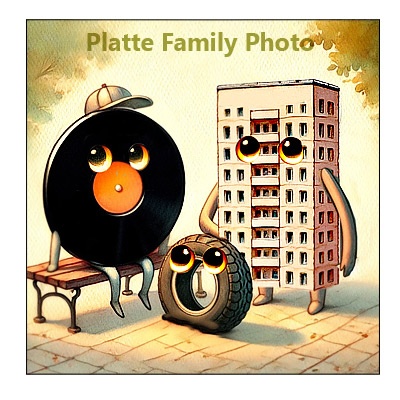
Hello everyone
And welcome to our German Word of the Day, this time with a look at the various meanings of
die Platte
Which looks like plate and doesn’t seem to be overly interesting, but die Platte itself as well as its relatives have some really nice “hidden gem” meanings that you’ll not want to… uh… to unknow once you know them.
“Uh… Emanuel, you mean to forget, right?”
Yeah, sorry. I’m a bit k.o. today, not sure why. One of those days, I guess.
Anyway, are y’all ready to sip some of that sweet, sweet colloquial vocabulary pollen from the flowery meadow that is the German dictionary?
Then let’s buzz right over and dig in.

 Audio Speed
 Dark Mode
does flach also refer to someone who is shallow?
The better choice there is “oberflächlig”.
Your articles are always appreciated. I’m always amazed at your detailed explanations, and I love the humor you sprinkle in.
Danke für das schöne Feedback!!
Im English; could someone explain what k.o. means please?
I think it’s short for “knocked out” and comes from boxing.
It’s a slangy synonym for “fertig” in the sense of “fix u. fertig”, voellig mitgenommen”, “hundemuede”, meaning “tired”!
“Platte” is of course also a German family name, e.g. the once well known stage and film actor “Rudolf Platte”, famous for his wonderfully authentic portrayal of the character Wilhelm Voigt, the humble shoemaker, in Carl Zuckmayer’s “Der Hauptmann von Koepenick”!
Nice bit of trivia :)! This is the stuff that wins someone a lot of money in some quiz show.
I take it Plattdeutsch is deflated German.
It originally meant “basic, simple, easy German”. The logic was “flat, basic”, I guess.
Or it might probably have been a reference to the “platte Land” or “Low country” from which the dialect originated.
How about eine Reifenpanne? Why “Panne” and not “einen Platten”? What’s the difference? Thanks!
No big difference.
“Panne” is more general, and can also refer to an engine failure. “Reifenpanne” means “a failure relating to the tire”. I think it might be used more for the moment you get the flat tire, and it sounds a bit more formal and stiff. And it can technically also refer to the rim breaking or something else related to the tire.
That was a smorgasbord, thanks. My question relates to something less visually stimulating. When I first encountered “einer” as a stand-alone nominative, I thought it strange as I didn’t expect the -er on an ein-word. But I have accepted it. In my Handelsblatt article, it reads:
I’m only citing the first sentence as an example. I just gave the rest, so as not to keep you in suspense. So there’s “Einer”. Now later in the same article, I read:
By my take, this “eines” isn’t just a gender neutral cousin of the stand-alone “einer”, right? Is the “eines” a genitive form, as in “eines Tages”? My mind’s translation of the above is:
The “eines” is just a fancy version of the more colloquial (standard) “eins” and means “one thing”. It’s in Nominative.
You can add a specification if you want.
– Eines der Biere ist warm!
“einer der Lichtblicke”… this is also Nominative with “der Lichtblicke” being in Genitive. It’s “einer” because “Lichtblick” is masculine. The “eins” is generic and hence neuter.
Let me know if that helps.
Of all your responses, this could be the most helpful, as I was somewhat off the mark there.
Really thankful I was able to be sponsored to have a membership here!
Just to say that your use of panel is occasionally a little “unEnglish”. “She grew up in a panel district” would not make sense to a British person. You would usually say something like “She grew up in an area of high-rise flats”.
true, I meant to mention this but forgot. Never heard of a panel district before.
But you can live in a flat (but not in the US where I’m from). Plattenbau seems to be a very specific Berlin phenomenon and I probably wouldn’t actually translate it. It is kind of like a housing project but with better outcomes.
I think you might be right about tending towards not translating. It might belong to a list of words that I wouldn’t translate when speaking with other english speakers here (like Altbau, Späti, Pfand, Hof, Anmeldung usw. )
What’s wrong with Pfand? Deposit is a pretty common word and used in the same contexts.
The ones I gave up on are Gymnasium and Realschule and, in the opposite direction, Highschool.
dunno, good question – habit i guess? “Deposit” is 3 syllables so maybe Pfand is more linguistically efficient?
“Deposit bottle” doesn’t quiet have the alliterative appeal as Pfandflasche?
Edit: I guess where i’m from there is no deposit scheme for bottles so it feels like its something specifically local to germany (even if it isn’t). ITs like Hof – yeah you can translate it as yard but there seems to be something specific to Berlin that gets lost if you translate it..
Yeah, “Hinterhof” and “backyard” do not evoke the same image in my mind. It’s quite funny to google both words on image search back to back.
had to do it :)
Glad you did this
In america when i hear backyard the bottom row of pictures is definitely what i think of when i hear ‘backyard,’ just learned the word hinterhof recently and imagined ‘backyard’ and yeahhh that’s definitely not what that is
Yup, here translating really makes no sense! It’s just different concepts, though they’re all “schools”.
I’ll give it a shot.
– Plattenbau – concrete high-rise, apartment block, Soviet/communist-era apartment block, commie block.
– Altbau – old building, older building, maybe “historical building”, depending on context.
– Späti – convenience store
– Pfand – deposit (“bottle deposit” is too much work to say)
– Hof – yard, lot, farm, court, courtyard, probably more depending on context.
– Anmeldung – I lost interest here, sorry :)
yeah, I mean, good attempts but I’d maintain in all of the cases i mentioned there is something specially local or german that gets lost in translation. Like, there is something specific and historical to the Hofs or to the culture of the Späti in Berlin that i would say, and just gets erased by translating it to yard or cornerstore . Soviet/communist-era apartment block works i’d say because it doesn’t remove the politcal-historical context…
Ah I grew up with bottle deposits so they feel totally normal. I see what you mean though, most of these words lose a bit in translation. I tend to use Pfand with my son too, just because there’s no need to add that layer, even though we’d also understand the English just fine.
Just FYI… you cannot just lose interest willy-nilly like that. You have to make an appointment and show up with a certificate of interest and file for it to be revoked.. Wait time for appointments is 3 months.
Oh shoot, thanks for the info. How do I go about getting a certificate of interest for next time?
That’d be a bit too long to explain for a comment section.
Bummer :( Would have been fun to read xD
I think that’s a good choice. For people who do not know Plattenbau, saying “high rise” will make them think “Manhatten”, which is not what this is :)
Plattenbau seems to be a very specific Berlin phenomenon
Nah, this is Germany wide and also Austria.
And in Bulgaria (which has the same type of buildings from the former communist blueprint), they call it “panelka” or something like that.
Yeah, I wasn’t sure about how idiomatic it is.
I just wanted to make sure that I am not just saying “high rise” and every American then thinks “New York” because Manhatten high rises are NOT the type I am talking about.
Same for these Queens-style projects which are high rises but they’re brick and not panel.
Coming in late on this topic, but it seems to me that Plattenbau appears to be a prefabricated type of construction. In the US we’d say prefab housing.
What’s important is that it’s a high rise. Or at least multi story. Prefab houses are closer to what we call “das Fertighaus”, which is a funny word actually.
Guten Tag, every one. I am very happy to be part of this german-learning community. Thanks to you all for sponsoring my membership. Hope to make the most of your generosity, and improve my knowledge of German. Thank you, Emanuel.
It is idiomatic to say “I have a flat” in English (at least in my part of the world), dropping the noun like in German. So that will be very easy for me to remember.
Yep, same in mine (Australia), though we might say “I’ve got a flatty/flattie” instead. It’s an expression I’ve used much more often with regards to tyres on bikes than on cars, thankfully!
Is platt the same as seicht, for shallow, in the context of shallow water?
“platt” is not used for shallow water. “flach” is.
“seicht” seems to mean the same as “flach” for water, but I NEVER use it that way and me personally, I’d think it’s something about being muddy.
I think “seicht” is mainly used for “shallow content”.
The Plattduetsche Altenheim Gesellschaft von Brooklyn und Umgegend turned 100 not so long ago.. may they always backup their Festplatten.
Hallo,
Here are a few typos:
“noone” (no one)
“just to be save” (just to be safe)
“All those pretty self explanatory and intuitive” (All those are pretty self–explanatory and intuitive)
“I think their might be something to it” (I think there might be something to it)
Very useful, I was familiar with the vinyl record and flat tire meanings, but there are quite a few uses I didn’t know about, I especially liked the “sich eine Platte machen”!
One question: how would you express the notion of “shallow” when referring to a person?
What about flat abs (and flat-chested, now that we’re talking about physiques)?
Bis bald!
My abs & entire chest are on vacation, but I think (völlig) oberflächlich might otherwise work.
Great questions!
“shallow” for a person is usually “oberflächlich”.
And abs and chest are definitely “flach”!
auch y’all statt ya’ll
Ugh, I keep making this mistake!
I‘m really excited to get started with this website after the good things I’ve heard! I’m in school and don’t have the opportunity to learn German. So I’m self learning, and couldn’t figure out how to get enough money for a subscription but these guys really came through and helped me out! I really appreciate it.
Großes Dankeschön!
It’s really firstly the other members that came through by pitching in extra, so all credit to them :).
Also, it’s pretty much just me running this here, no team.
Fun and interesting read :)
Do you use the word “Arbeitsplatte” for the kitchen counter at home, or do you call it something different?
And in the bathroom, what would you call the flat space around the sink? Example here. I see some shopping sites that call it a “Waschtisch”. You’ll see them advertised as a “bathroom vanity” here, but I think “bathroom counter/sink” is a lot more common in normal life.
“Arbeitsplatte”… oh, yes, I think “Arbeitsplatte” is a common word for it. Another one is “die Anrichte”, though I think I may be using it wrong :)
With “Waschtisch”, I would associate a separate Tisch in my mind, but I guess it makes sense to call the whole thing Waschtisch.
I would just call it “Fläche um das Waschbecken” or just … “das Waschbecken”
Interesting. So it sounds like maybe there isn’t really a separate word for a bathroom counter. Which is kind of a funny word, now that I think about it, because it’s not like you count stuff there.
What would be wrong about “die Anrichte” for the kitchen counter?
I feel like some people use it exclusively for a furniture kitchen aisle table, but honestly, when you enter Anrichte into image search you get a wild mix of furniture including TV sideboards, which makes no sense to me.
Maybe stay with “Arbeitsplatte” just to be save :)
…nor should we forget “das Plaetteisen”:-)
Where’s bro getting those images
They are, without doubt, some of the many, varied, and storied joys of the AI revolution/revolt/revoicing. Prompt, and ye shall receive…
Just to swat away any potential low-key associations of me being lazy… there’s quite some Photoshop stitching involved. Here for instance, I stitched in the high rise, added the eyes to it from another version, added the eyes to the tire and used the liquify filter to make the tire flat.
I used to puzzle my cartoons together before but now with AI, I can do much nicer looking things.
It does take longer actually though, as I’m usually prompting and refining 15 times till I have enough to work with.
But yeah… this image generation really unlocked new potential of expression for me as someone who can’t draw and can’t pay an artist every week.
No such associations intended whatsoever, of course! Good to see my *sloppy framing™* coming through loud and strong :-( Heck, generating any sort of accompanying image is above and beyond the call of duty in my book, and it’s actually the thought/joke/references behind the images that I enjoy the most, even if I don’t mention it as often, or as vociferously as I should. The images are just presented much more prettily and evocatively when they are sliced and diced from the output of the image generators.
Lange Rede, kurzer Sinn… gut gemacht, wie immer!
I think it’s more my own association that I wanted to front-run there, because I happen to HATE AI created content. It spams the web and hurts my business.
And I think if only people who actually have something to say about a topic produce content about the topic the world would be a much better place. The web is dominated by SEO hawks though, who will write about ANYTHING just to rank and sell. And now they can do that with even less soul.
I also hate Grammarly and other advanced “style-checkers”. Everyone sounds the same, it’s so boring.
So yeah, I tend to look down on AI content so I have to justify myself in front of myself for using it for images.
Interesting topic, and while I’ll hold back on a bit (‘cos it’s certainly not really the right place), the current intrusion of AI-generated dross into pretty much all forms of media strikes me as one of the final pieces of the *global blanding* begun by Amazon back in the 1990s(#). Warum setze ich dort “den Ursprungs” ein? Because all of a sudden there was little to no barrier to getting your hands on anything. No more ordering from obscure sources that either did the ordering for you, or accepted emails and charged exorbitant postage rates, no more waiting months, wondering if something would actually arrive, and whether it would be worth the special consideration and attentions that had been ladled upon it. In short, no real option for success/failure in such ventures that actually *meant something*: instead, a veritable homogenization of the whole process. Moving further along the timeline we have Spotify and friends/enemies rendering the whole process of discovery, retrieval and revelation practically non-existent, at least for music-related content. Once everything’s immediately at hand then nothing’s really worth a damn.
Regarding LLMs and the like, it’s just a sort of end-game of the above: information more generally is merely grist for the mill of banality, and it’s homogenised, pasteurized, repackaged, *de*vitalised, and pushed back out into the world, largely in a parastic attempt to dilute the impact of the original source. Distinguishing a real font of insight and novelty becomes a near impossibility in such a marketplace, which is why it’s so vital to use and maintain the power of word-of-mouth. The algorithms know little to nothing of such distinctions.
Finally, back to the subject at hand (somewhat!): in reading your spiel about image generation I was reminded of one of my favourite quotes, from Roland Barthes: when quizzed in 1971 about the dangers of the intrusion of a strong kind of formalism into literary analysis he opined that “We don’t need to maintain our *distance* from formalism, merely our ease”. I think that’s the right attitude to take with AI/LLM generated content. Enjoy the ride, milk it where it makes sense to do so, but regard a healthy humor and/or skepticism with the overarching claims and aims, and keep a close eye out for what it actually *maims*.
Errrm, aaah, lucky I “held back a bit”… :-) Sorry ’bout that…
(#) I thought that “emblandishment” was a real word, and may have used it once or twice, but seems it’s just some sort of peculiar admixture of “bland” and “embellishment” that my mind created and/or borrowed, so I guess I need to either double down on it and try to make it a *thing*, or hunt for a better alternative. Hmm…
I think I mostly agree about Spotify. It makes it easier to listen to music, but discovering music is another story. The algorithm showed me a few good things, years ago. But you hit sand pretty quick, and the sound quality is “meh” to boot.
I think it’s fantastic to have almost the whole world at your fingertips. But “personalization” is a curse. No risk, no reward, just Einheitsbrei. I get way better and more interesting recommendations by talking to people, browsing last.fm or Wikipedia, or firing up an ever-uselesser search engine.
I used to think life was too short to listen to things I don’t like, but the boring algorithms have made me rethink that. It can actually be interesting. Worst case you hate it, maybe it wins you over, and usually you can learn something.
Eh, now there’s a new word that I instantly like: Einheitsbrei. I think your last paragraph is nice and close to what I’m trying to get at: partly restriction acting as a *productive* concept, but also something more active than that. The process of seeking out, having to put the work in, skirting the possibility of abject failure, (usw) as all contributing to the value. But that’s all feeding into a bigger rant, and I’d end up uncomfortably close to the dreaded, “Zen and the Art of Motorcycle Maintenance”, which is not at all where I want to be! Hmm… let me focus a little!
It’s just that when the barrier to entry is so low, consuming and/or discarding without sufficient mastication quickly becomes the default. That is, the investment in the process is that much less, the *commitment* to the product is diluted, so it doesn’t really stand a chance. Heck, there’s always an(other) infinity of content hovering nearby. The pornification of everything, perhaps, for those who’ve ever ended up mired in that domain.
It’s not really the oft-used “paradox of (too much) choice” at work here as much as the recognition that the *worth* of something can be bound to the process of discovery, that need for a non-trivial commitment to a largely unknown object. In short, the level of risk used to be inextricably intertwined with and reflected in the (potential) payoff, and the opportunity/space for that payoff to happen was considerably greater when it wasn’t crowded out by other, neighbouring content, a la Spotify and the like.
I think both of you might enjoy the book “Enshittification” by Cory Doctorow once it comes out.
He has a bunch of essays/articles about it, too.
https://www.wired.com/story/tiktok-platforms-cory-doctorow/
“Chokepoint Capitalism” (this book is out) is also probably good.
Of course I have not read it (I’m GenZ like that), but I’ve read a good bunch of his essays.
As for music… I am pretty much ONLY listening to Mixcloud.com and have been doing that for 10 years. It’s a site almost exclusively for mixes or music radio show style formats. There are all kinds of genres on there and I have discovered so much new music in the mixes. Once you find creators you like, you can be sure they’ll always dig up the good new and old stuff.
Ah yeah, thanks for the recommendation: I’ll keep an eye out for the book (and do remember that linked essay from a couple of years ago, and how it hit that particular nail hard on the head). I do think the “enshittification” he mentions there happens as a parallel process to what I’m rambling on about above, which is more about disconnection and homogenization on an individual level. A loss of *affect*, perhaps.
Moving back to “die Platte” and friends in the actual article(!), which was a fun romp. Interestingly “flat” in English works as “apartment”, particularly for a more *prosaic* sort of dwelling, and I feel like it’s much more in BE rather than AE, but it’s typically credited as emerging via Scottish. It’s also used for a piece of land that’s particularly, aah, flat. Hmm, let’s go with “level”. Most notably you see it within “mudflat”, which is just what it sounds like, and a favourite of various kinds of water birds.
When you say you’re “a bit k.o. today”, I know what you mean, but that usage rings a little strangely(#) for me in English (other opinions warmly welcomed, of course). Evidently it functions as ugs for “exhausted/erschöpft” in German? For what it’s worth, which ain’t a lot, I’d tend to say “I’m a bit knocked around today” instead rather than “knocked out”!
In any case, I’ve got a big backlog of articles that seem to have accumulated during my recently-ended Summer hibernation, so more than enough said here ;-)
(#) Insert standard “old person” caveat here, so if it’s a gaming term or suchlike in English I’ve got no chance!
Oh yes…
– Ich bin k.o.
… is pretty standard in colloquial German.
Oh, sounds like you missed out on all the pre-election German politics binge we had here in February :D!
I did read a number of those on the sly, but not in sufficient depth. Instead I was following along via various German news outlets (mainly Tagesschau) and other podcasts (der Tag, Lage der Nation). I can imagine you danced a jig or two in celebration as Christian Lindner not only lost, but his party sank into oblivion as a result of the fünf Prozent Welle/Hürde. Fun times. Can’t say I was too sad at seeing that BSW also ending up with a big mouthful of dust!
Post that period, I do have to say that the much-maligned Merz appears to be a pretty canny operator. Slipping through die Lockerung der Schuldenbremse before the dissolution of the current electoral period, even at astonishingly great expense, was quite the move. Heck, even the departing, much maligned Greens came out of it feel relatively good for having finally achieved *something* of worth, even if the impressive sounding sum has to be smeared over a ludicrously long timespan.
I wouldn’t call it canny, I would call it “machthungrig”, because I am pretty sure this idea of passing certain things with the old parliament has been floated before and his party said “NO!” up until election day. They also said they’d NEVER reform the Schuldenbremse (they now did), they would REPEAL a heating law (they won’t) and they will START strict border controls (they can’t).
If lying is canny then yeah… CDU and CSU are very canny people. Like when they didn’t like the 2045 carbon neutral goal for Germany and agitate against it, while at the same time having a 2040 (!!!) carbon neutral goal in Bavaria where CSU reins with way above 45%. There it’s great and ambitious of course because THEY did it.
They’re just super disingenuous. Also, they tried to smuggle the infrastructure portion of the big spending package through without conditions and were planning to pay all kinds of goodies from it, and only because the Greens said “NO”, they had to insert the word “additional” to the laws, so the funding can NOT be used for random goodies.
By the way… the BSW complained that their votes were miscounted (some recounts did happen bringing them even closer to 5% but not beyond) and they complained that the ballot paper had a fold right on their line so people who wanted to vote for them got confused.
The high parliament-kindergarden horseshoe is real.
OK, maybe “sly/slimy” would work about as well as “canny” here ;-) My apologies for lacking the capacity for indignation, I think it’s been bled dry, desensitized, and wholly recalibrated as a result the first couple of months of someone else being in power somewhere else.
Die Schuldenbremse always make me think back to German supermarkets, where a local shopper races through the checkout at record speed, each carefully arranged item being quickly scanned, emerging in the optimal order for packing into pre-prepared bags. And then… and then… and *then* the customer insists on spending 2 full minutes getting out their fucking Portemonnaie and going on an archeological dig to find the *exact* notes and coins required to pay the 39.78 Euros. Yet, weirdly, this doesn’t seem to cause consternation among those waiting in line, because –I suppose?– “Bares ist Wahres!”.
In any case, good riddance Schuldenbremse, and welcome into the late twentieth century economic party, Deutschland: enjoy the ride…
The BSW fun and games sounds a lot like the wonderful saga of “(hanging) chads” from the 2000 Presidential election (Bush/Gore) in Florida, or even moreso the “butterfly ballots” from the same contest. Desperate times call for desperate measures!
“… where a local shopper races through the checkout at record speed, each carefully arranged item being quickly scanned, emerging in the optimal order for packing into pre-prepared bags.”
LOL, I do that!!
For a long time, the closest supermarket to where I used to live was Aldi. The discounters at some point removed virtually ALL space from behind the goods’ scanner, and the cashier scans at a relentless pace (because they’re tracked down to the second), so they’ll just pile up things there pressuring you to put them into your cart and then f off away from the cashier desk.
I wanted to beat them, so I preplanned my packing the stuff into bags so as to be FASTER than they could scan. And I do that to this day. They trained me well.
A good trick is to put the loose vegetables on last. They’ll have to type in all those numbers and that gives you time to clear everything and be done packing when it’s time to pay.
“Yet, weirdly, this doesn’t seem to cause consternation among those waiting in line, because –I suppose?– “Bares ist Wahres!”. ”
It does cause consternation with the cashier, because it lowers their “scans per minute” rate significantly. By doing that, you’re degrading their score, is what I heard. At the supermarkets (REWE, EDEKA, etc) it’s okay, but at Aldi and the other discounters, you can see it in their face sometimes.
Farewell Schuldenbremse.
By the way… I have a weird feeling that Australia has a lot of talent on marco-economics and social economics and finances. Whatever I watch on the topic, the stuff coming from Australians sounds the most lucid and well explained. Doesn’t mean that it’s right, but it’s feels like high quality arguments.
Steve Keen in particular.
You must have extra special local powers of discrimination, as regards the cashiers in Berlin. For me, the best I could manage would be assigning them into one of the three (exhaustive) classes: sauer, sauerer or am sauersten(#). I guess the exact-change-seeking customer could induce a class transition, in the rightwards direction ;-)
I imagine you’d probably freak out at just how friendly the vast majority of checkout operators are over here, though there are strong indications that the level of tracking/efficiency_management is starting to go through the roof at the major supermarkets, and that seems to be generating a growing fog of angst amongst the employees.
(#) I swear that some of them are employed based on their soaring level of Unhöflichkeit. My father used to berate my older brother for having “the dog poop look” on his face (ie, the facial expression that occurs after stepping in that substance), and I think it’s a good description of your average Berlin supermarket cashier’s face while at work. Yeah, it ain’t a great job, and it’s true, dreams of being the manager of your local Rewe aren’t going to sustain you for long, but FFS people!
Funny thing is, here it’s actually getting better, especially at REWE, EDEKA and Kaufland. At Kaufland, they were hyper friendly 10 years ago, because they were highly paid and … *gasp … overstaffed. There would be NO line EVER and the cashiers were just hanging out and chatting.
And generally, there are more young people now, bringing that party flavor with them.
But I also grew up in this environment, so I’m used to them being grumpy. I think I would get very sad seeing it in Australian and seeing how wonderful life could be, where the goods get scanned by a person, not a function in a body.
is there a reason you went for mixcloud over soundcloud?
Many!
– Mixcloud doesn’t have as many single songs, just mixed
– Mixcloud doesn’t have as many stupid podcast or interviews
– Mixcloud has WAY better mixes because all the mainstream shit djs don’t know about it and are on Soundcloud
– It was the niche site no one knew back 12 years ago and I am a bit of a snob, LOL. Like “Pshhh, soundcloud?! Yeah, okay. whatever.”
– I also like that you can follow a creator directly and pay THEM instead of just the platform
Here’s my list of favorites:
https://www.mixcloud.com/Honigmilch/favorites/
There’s some REALLY dope detroit house mixes down there.
I can pick some of my favorite mixes if you’re interested. There are so many good ones on Mixcloud and I never found this level of quality on Soundcloud. You have to wade through too much garbage.
Oh and I highly recommend this creator:
https://www.mixcloud.com/LeFtOoO/
He doesn’t give a shit about genre and mixes rap, rnb, drum and base, grime, Latin, house and techno… whatever he wants basically. I have found so many banger songs while listening to his mixes and I want to go to Brussels one day just to go to his party.
I might have to check that book out. I have to be in the right mood to read it, but his stuff is interesting.
Mixcloud is pretty fun so far. I clicked on a couple things that looked interesting and got some good stuff from a Polish guy and a Greek guy.
It’s instant gratification, and having an almost infinite amount of content does make that easier. Maybe part of it has to do with how our (monkey) brains work, but I have to wonder if a lot of it has to do with the circumstances we live in. When you’re stuck in a loop of work-sleep-survive, there isn’t really much time or energy (or money) to do things that are really gratifying.
I know that sitting down at the keyboard and trying to learn a song feels way better than swiping through a bunch of memes. And hearing live music is infinitely better than hours of Spotify. But when I’m exhausted after a long day of work, too tired to focus on anything, I end up staring at my phone and clicking on too much of everything. It doesn’t feel good, but sometimes it feels like all I can manage.
Then there are algorithms that are willing to take advantage, and if you don’t have a lot of friends or family around, that seems to feed into the negative loop. I think community and third places are some of the biggest things we’ve lost. The internet can help with that, and also hurt.
I gotta go tinker on the keyboard now because writing that made me a little sad….
I think community and third places are some of the biggest things we’ve lost.
This! 100%
The best way to discover music was downloading something on Napster, it being not what you wanted but ending up being a total banger
I keep getting ads for grammarly’s AI prompts for writing emails in podcasts and ughgghhhh how do people not know how to write basic simple emails.
Granted if you’re in an environment to need it (probably an office) the emails are already probably already bland and boring
I just wanted to say a huge thank you to the sponsors who made my membership possible. Didn’t think I’d get this lucky, but here we are. This site has already changed the way I look at German, feels less like cramming vocab and more like slowly unlocking how the language actually works. Funny thing is, I wrote this before checking today’s post, and of course, it turned out to be another one of those “why did no one explain it like this before?” moments. Really grateful to be here and excited to keep learning.
never thought of it in relation to the german word Platte but in english there is “dubplate” – a specific type of record cut onto acetate that found its way from the dub scene into various uk dance music scenes – dubplate culture was a huge part of the jungle / drum and bass scene for example. According to wikipedia records have been refered to as “platters” but I’m pretty sure I’ve never heard this…
Ach, your age is showing! At least in the US, the rock n roll records to which bobbysoxers of the 50s and their steady beaux would dance were referred to as “platters” by the hip, jive guys spinning the tunes…or so I’ve been told, and seen in old movies. In fact there was a rock n roll/doo wop group (or groups, the personnel changed many times) named The Platters. But the term did not survive the British Invasion of the early 60s, as far as I recall.
yeah definitely getting old here…can’t hide that anymore. I’ll be in the retirement home remininicing about the rave years. Never heard of bobbysoxers before though, not quiet that old,yet..
while we wait for the quiz I wanted to express my heartfelt gratitude to the generous sponsors who made my membership possible. To me, this… almanach is already proving itself as a very valuable tool for more precise polishing rather than broad strokes sculpting of my learning process. I’m both sad that I hadn’t discovered it sooner, and glad that I have now, at a point when German is not a scary terra incognita but a fun region to explore. Really looking forward to catching up on the workout blocks and getting myself better prepared for the advanced test