her

Based on: *ko-, *hi-,
Goethe A2 Adverb
  1. to here
  2. from
1.

to here

Opposite: hin
(toward the speaker)
Examples
  • Komm her!
  • Come here!
  • Practice pronunciation - click once to start recording and again to stop
2.

from

(in combination with "wo" when talking about origin)
Examples
  • Wo kommst du her?
  • Where do you come from?
  • Practice pronunciation - click once to start recording and again to stop

Word Family

Knowing relations between words can help understand their meanings and build a more connected vocabulary network. Here, you can explore parents and offspring and discover the whole family.

  • shows how many children or parents the word has
  • get the translations and a link
Loading word family…
Sources for Etymology:

My Articles

The meaning of German “her”

A thorough look at the confusing German word "her". We'll see what it means and why and learn how to use it properly with lots of examples.

Read article →

The meaning of “von … her…”

The combination "von.... her" is super common in everyday German. Today, we'll find out what it means and how to use it. Of course that includes "von daher".

Vocab: von X her, von daher, was X angeht

Read article →

German is Easy – QAS -1

Hello everyone, and welcome to the very very firstest episode of our new series… and you are the stars. Or better,your questions are. You guys ask a lot of questions and many of them are really interesting. But so far,they have been kind of buried in the comment section. And I don’t have a search function on the page…. because… in your face. But seriously, I figured it would be a pity to just have all those cool questions sit there at random places and so I decided to just collect the ones that are not related to the topic of a certain post, give them a headlines and make a nice bundle for all of you to read … or ignore :). So.. willkommen zu German is Easy – Q A S The S stands for stuff, by the way. And stuff stands for questions I have, polls, random learning tips, analyses of idioms, cool links, tons of ads in disguise and of course lots of fun selfies of me and my team…. meh… I guess that doesn’t quite qualify as a selfie but anyway.. without further ado, let’s just get the first question… 0 0 votes Article Rating <a href="https://yourdailygerman.com/meaning/her/">Dive in <span class="meta-nav">→</span></a>

Read article →

The meaning of “hin”

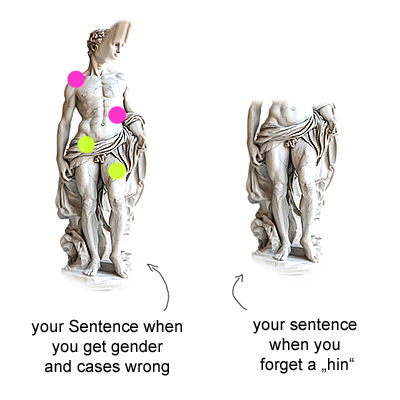
The German word "hin" means "there", but it's better to think of it as a generic marker - like #destination. And it sounds really wrong if you forget it.

Read article →

rauf, herauf, drauf, hinauf – A Deeper Look at Versions

rauf, herauf, hinauf, drauf - These types of words are very common. Today, we'll find out where they come from and how they're ACTUALLY used with German verbs.

Read article →

Questions and Comments

Do you have questions about the usage or meaning of “her”? Just ask here and I’ll try to clear it up.

guest

0 Comments
Newest
Oldest

How many meanings does the German word 'her' have?

her has 2 distinct meanings: 1. to here , 2. from .

What is 'her' related to?

The word 'her' is related to *ko-, *hi-,.

Where can I learn more about 'her'?

Here are some articles where you can learn more about 'her':

The meaning of German “her”
A thorough look at the confusing German word "her". We'll see what it means and why and learn how to use it properly with lots of examples.
Read article

The meaning of “von … her…”
The combination "von.... her" is super common in everyday German. Today, we'll find out what it means and how to use it. Of course that includes "von daher".
Vocab: von X her, von daher, was X angeht
Read article

German is Easy – QAS -1
Read article

The meaning of “hin”
The German word "hin" means "there", but it's better to think of it as a generic marker - like #destination. And it sounds really wrong if you forget it.
Read article

rauf, herauf, drauf, hinauf – A Deeper Look at Versions
rauf, herauf, hinauf, drauf - These types of words are very common. Today, we'll find out where they come from and how they're ACTUALLY used with German verbs.
Read article