Hello everyone,
And welcome to your German Word of the Day. And this time, we’ll take a look at the meaning of the verb
greifen
Which of course also means that we’ll take a look at the entire family with the various prefix versions like angreifen or begreifen or zugreifen. And also the corresponing nouns with der Griff and other related words.
So in essence, it’ll be a bit of a vocabulary dump and probably too much to remember in one go. I’ll throw in a few images probably, to loosen things up a bit, but whenever you feel like “I think, I’m full.” just stop reading :).
There’s no real narrative or arc here, so you can read it piecemeal and jump around as well.
Anyway, enough with the intro. Let’s jump right in.
***
“greifen” and “der Griff”
So the core idea of greifen is really easy to grasp – it’s the act of grabbing. The two words actually look like they could be related, but as far as I could find, there is no proof for a connection.
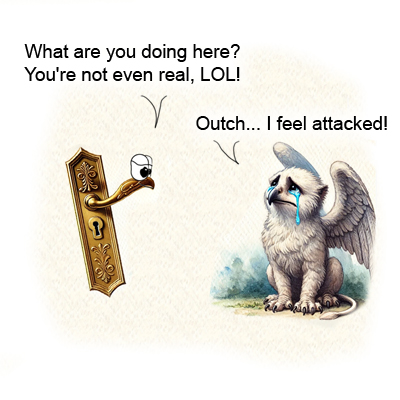
And while we’re at “non-connections”… I was super duper convinced that that fantasy bird Griffon was related to greifen. I mean… in German it’s literally called der Greif. But turns out that the name comes from a Greek word grȳpós, which was about the “curved beak”. And the name Griffin, which also looks like it has to be kin, comes from Irish and/or Welsh and has nothing to do with any of that.
But then there’s the German word der Greifvogel, which is the general term for birds of prey, like vulture, eagle or hawk. And that DOES come directly from greifen. Because these birds swoop down and grab their prey. Greifvogel – grip bird.
The only notable English relatives that greifen does have are grip and to gripe and also grope.
Not sure, why I am telling you this. Probably because I was kind of disappointed that all these words didn’t neatly tie into one family and I couldn’t let it go, but I also didn’t want to spread false information.
At the end of the day though, we’re not here to do research. We’re here to learn new words, and for that purpose, I think it’s best to associate greifen with grabbing and throw in the mental image of a griffin for good measure. And a fridge handle, because why not.

Actually, the most iconic word of the family is probably the noun der Griff. Which is the German word for handle in the sense of door handle or something like that.
- Der Griff am Kühlschrank ist abgebrochen.
- The handle of the fridge broke off.
- Practice pronunciation – click once to start recording and again to stop
- Die Polizei hat am Türgriff Greifenabdrücke gefunden.
- The police found gryphon prints on the door handle.
- Practice pronunciation – click once to start recording and again to stop
And der Griff can also be the way you “grab” something, be it an opponent in judo or a chord on the guitar.
- Ich habe heute beim Gitarrenunterricht drei neue Griffe gelernt.
- I learned three new fingerings in guitar class today.
- Practice pronunciation – click once to start recording and again to stop
Is fingerings the proper term here? Like… I mean, if it’s really just guitar class? I got the translation from DeepL, which calls itself the “world’s most accurate translator”, so it has to be correct, but it still sounds a bit … adult to me.
Anyway, now what about the verb greifen?
Well, it’s fairly common in combination with a prefix, as we’ll see in a bit, but it’s actually not so common by itself, because in everyday life, German uses the words fassen and anfassen for a lot of the grabbing (We’ll talk about that in a separate article soon).
greifen is used here and there, but then it’s more about reaching to grab or some fairly figurative use.
- Der Greif greift nach dem Griff des Schwertes.
- The griffin reaches for the hilt of the sword.
- Practice pronunciation – click once to start recording and again to stop
- Wie reagierst du, wenn dir im Kino von hinten jemand in deine Popcorntüte greift?
- How do you react if someone reaches into your bag of popcorn from behind at the movies?
- Practice pronunciation – click once to start recording and again to stop
- Früher hat Maria zum Joint gegriffen, wenn sie entspannen wollte.
Heute auch noch. - Back in the day, Maria would turn to /”grabbed” a joint if she wanted to relax.
Today, she still does it. - Practice pronunciation – click once to start recording and again to stop
- Es ist unklar, ob die Maßnahmen der Zentralbank greifen.
- It’s unclear whether the measures of the central bank will work/be effective.
(lit: “grip”) - Practice pronunciation – click once to start recording and again to stop
- Ich kann das Kernthema des Buches nicht wirklich greifen. Es geht um alles und nichts gleichzeitig.
- I can’t really grasp/pin down the topic of the book. It’s about all and nothing at the same time.
- Practice pronunciation – click once to start recording and again to stop
And the last one kind of brings us right over to our first prefix verb, which is also one of the most important versions of greifen.
“begreifen” and “der Begriff”
(and the difference to “verstehen”)
The core meaning of begreifen is to understand and while many learners might be a bit taken aback at first, but it actually makes a lot of sense. First of, we already saw in the last example in the previous section how greifen was used in the sense of “getting” an intellectual concept. And this connection of grabbing and understanding is not foreign to English either, where we have the exact same thing going on with the word to grasp. You can grasp an object but you can also grasp a concept.
But maybe the most visceral way to understand the logic is to think… of a baby. A big part of how babies explore the world is by touching things. Having them in their hand, turning them. They literally “inflict greifen onto” things to understand them.
I’m not sure this is how the meaning came about, but I really like the metaphor.
But anyway, time for some examples.
- Ich begreife nicht, warum Maria immer wieder mit Thomas zusammen kommt.
- I don’t understand/can’t fathom why Maria is always getting back together with Thomas.
- Practice pronunciation – click once to start recording and again to stop
- Es hat echt lange gedauert bis ich begriffen habe, dass es niemanden interessiert, ob ich die richtigen Artikel benutze, wenn ich Deutsch spreche.
- It took a really long time until I understood/grasped that no one cares, whether or not I use the proper articles when I am speaking German.
- Practice pronunciation – click once to start recording and again to stop
- Quantenphysik ist schwer zu begreifen.
- Quantum mechanics is hard to grasp/understand.
- Practice pronunciation – click once to start recording and again to stop
Now the big question is of course how begreifen relates to verstehen.
Well, first off, verstehen is far more common and also broader. You could use it in all three of the examples above and nothing would change, so you can think of it as the “default” and begreifen as a less common option with smaller scope.
Why smaller scope? Because begreifen implies some depth or some probing or researching or soul searching. It’s for stuff you’re REALLY puzzled about. Like… think of that baby again, exploring a sponge for the first time. It’s a really weird object if you don’t know what it is already.
So yeah, begreifen has some vibe of depth to it that verstehen doesn’t inherently have and you’ll see that people tend to use begreifen for stuff that is either deep understanding or there’s some struggle involved.
That also shows in the words unverständlich and unbegreiflich. The first one can simply be unintelligible but unbegreiflich is unfathomable.
- “Es ist mir unbegreiflich, wie man ohne Butter so eine leckere Soße machen kann.”
“Ich sage nur… Einhorn, 3 Bier und 1 Stunde warten.”
“Ihhhhh!!!” - “It’s unfathomable to me, how one can make such a tasty sauce without butter.”
“All I’m gonna say is … unicorn, 3 beers and waiting for an hour.”
“Ewwwww!!!” - Practice pronunciation – click once to start recording and again to stop
Yeah, that one might take a second ;).
But yeah, in daily life, the best piece of advice is probably to stick with verstehen and only use begreifen once you have a feel for it.
Now, what about the noun der Begriff.
And the meaning of that one seems like it has gone a little astray, der Begriff is actually the German word for the term. Like… in the sense of terminology.
- Der Begriff “Gerechtigkeit” ist einfach zu verstehen, aber schwer zu definieren.
- The term “justice” is easy to understand but hard to define.
- Practice pronunciation – click once to start recording and again to stop
- Die Präsentation war voll mit Fachbegriffen, die ich nicht kenne.
- The presentation was full of technical terms/jargon that I do not know.
- Practice pronunciation – click once to start recording and again to stop
And I think the best way to think of this is as a “frame”. Like… a certain term “captures” or “grasps” a concept and puts it into one word.
Besides this, you’ll likely also see Begriff in the two following phrasings:
- Bist du schwer von Begriff, oder was?
- Are you dense?
- Practice pronunciation – click once to start recording and again to stop
- Ich war gerade im Begriff zu gehen.
- I was just about to go.
- Practice pronunciation – click once to start recording and again to stop
But those are pretty much fixed, so learn them “wholesale”. Or just ignore them. That’s also totally fine.
Cool.
Next.
“angreifen” and “der Angriff”
angreifen and der Angriff might be the most common ones of the versions because they’re the German words for to attack. Or the attack, respectively.
- “Echt?! Auf dem Waldparkplatz??”
“Ja!! Das Einhorn hat mich nach Alkohol gefragt, und mich dann plötzlich angegriffen.” - “Really?! On the parking lot of the forest??”
“Yeah!! The unicorn asked me for alcohol and then suddenly attacked me.” - Practice pronunciation – click once to start recording and again to stop
- Das Medikament greift die Darmflora an.
- The medication attacks the intestinal flora.
- Practice pronunciation – click once to start recording and again to stop
- Spirituelle Leute so: Ich habe einfach nur gesagt, dass ich höher schwinge als du. Wenn du dich davon angegriffen fühlst, ist das dein Trigger.
- Spiritual people be like: I simply said that I am on a higher vibration than you. If you feel attacked/insulted/triggered by that, than that’s your trigger.
- Practice pronunciation – click once to start recording and again to stop
- Ist es ein Angriff auf die Meinungsfreiheit, Falschinformationen zu löschen?
- Is it an attack on free speech to delete false information?
- Practice pronunciation – click once to start recording and again to stop
And I think the meaning makes a lot of sense. First of, grabbing is a key part of a lot of fighting. Just think of two sumo wrestlers for example. And the “an” adds its usual flavor of initial, starting.
I mean, I’m not trying to say that angreifen is like THE logical choice for the idea of attacking. But thinking of two sumo wrestlers grabbing each others belts is a good mental image to show why it is A logical choice.
All right.
Next.
“eingreifen” and “der Eingriff”
If we take these at face value, they should mean something like “grabbing/reaching into“. But if you’ve been learning German for a while, you’ll have a hunch that it’s probably not going to be this straightforward. And if you’ve read some of my articles about prefix verbs, you might also be like “That would be the r-version, right?”
And yes, that’s spot on.
- Hier ist die Keksdose, aber vielleicht ist eine giftige Spinne drin. Willst du wirklich reingreifen?
- Here’s the cookie jar, but maybe there’s a poisonous spider inside. Do you really want to reach in?
- Practice pronunciation – click once to start recording and again to stop
If you don’t know what r-version is… don’t worry. I have an article about that and I’ll link it below. It’s a REALLY useful concept if you want to speak idiomatic German. The very condensed key learning is that the most literal, logical sense of a prefix verb is covered by its r-version. While the prefix version itself… well, it’s a got a little twist going on. Like… a tinge of abstract.
And that’s also the case for eingreifen, because the best translation is actually to intervene.
- Die Demonstration war friedlich und die Polizei musste nicht eingreifen.
- The protest march was peaceful and the police didn’t have to intervene.
- Practice pronunciation – click once to start recording and again to stop
- Thomas und Maria haben sich beim Meeting fast geschlagen, aber mein Chef hat dann eingegriffen.
- Thomas and Maria almost threw fists at the meeting, but my boss intervened.
- Practice pronunciation – click once to start recording and again to stop
Think of it as a metaphorical hand reaching “into” a scene – to intervene.
Oh wow, that rhymed :)

As for the noun der Eingriff – the translation depends on a bit on the context, but the core idea is essentially the same, and it can actually be used in the context of surgery, so there we have a fairly literal “reaching inside”.
- Mein Mitbewohner nennt meine Kamera im Bad einen Eingriff in seine Privatsphäre. Ich nenne es Entertainment.
- My flatmate calls the camera in the bathroom an infringement of privacy. I call it entertainment.
- Practice pronunciation – click once to start recording and again to stop
- Brasilian Horn Lift – bei dem Eingriff wird dem Einhorn mit Fettgewebe aus der Kruppe ein größeres, runderes Horn modelliert.
- Brasilian Horn Lift – at this surgery, fat tissue from the croup is used to model a bigger, rounder horn for the unicorn.
- Practice pronunciation – click once to start recording and again to stop
And I think that’s all for eingreifen, so let’s move on.
“zugreifen” and “der Zugriff”
zugreifen is a bit hard to pin to one translation, because it heavily depends on the context. In this example, the focus is more on really closing your hand firmly:
- “Ist deine gebrochene Hand verheilt?”
“Fast. Die Knochen sind okay, aber ich kann noch nicht richtig zugreifen.” - “Is your broken hand okay again?”
“Almost. The bones are okay, but I still can’t grasp things firmly.”
(Not sure this is idiomatic. The core idea of “zugreifen” is the moment of grabbing something firmly. Not so much the holding after.)
- Practice pronunciation – click once to start recording and again to stop
But in the example like the following, it’s maybe more about “reaching out to get”.
- Frische Tomaten, 5 Euro pro Kilo. Jetzt zugreifen.
- Fresh tomatoes, 5 dollars per pound. Get some!/Dig in./ “Grab some”.
- Practice pronunciation – click once to start recording and again to stop
- “Wow, das Büffet sieht super gut aus.”
“Greif zu, es gibt mehr als genug.” - “Wow, the buffet looks amazing.”
“Dig in, there’s more than enough.” - Practice pronunciation – click once to start recording and again to stop
And then, there’s the slightly more figurative and more technical sounding sense of accessing.
- Ich kann über mein neues Handy nicht auf mein Konto zugreifen.
- I can’t access my bank account from my new phone.
- Practice pronunciation – click once to start recording and again to stop
Which is also the main sense of the noun der Zugriff.
- “Die Hacker hatten Zugriff auf alle meine Fotos.”
“Alle?! Auch auf … DAS Foto?”
“Ja. Auf alle. Auch auf DAS Foto.” - “The hackers had access/could access all my pictures.”
“All of them? Also to…. THAT photo?”
“Yes. To all of them. Also to THAT photo.”
(Sounds more like a sense of “seizing” than “Zutritt” or “Zugang”, which are more about “going there”)
- Practice pronunciation – click once to start recording and again to stop
So I’m really not sure what the core is. It’s basically just “grabbing, seizing” and the zu maybe adds an extra notion of “targeting”. Or “going for it”.
It’s not really all that important though, so I think it’s enough if you understand it passively and let some sprachgefühl build up over time.
All right!
Next!
“übergreifen” et. al.
The two main things to know about übergreifen are a) it’s separable and b) it’s boring. At least as a verb itself, because I think the only context I see it in is for fire spreading to a neighboring building. It “grabs over”.
- Das Feuer hat auf die benachbarten Häuser übergegriffen.
- The fire spread over to the neighboring houses.
(Lit.: “grabbed over”) - Practice pronunciation – click once to start recording and again to stop
There might be some other niche uses for the verb, but what’s more useful here are is the adjective übergriffig. It’s essentially about someone crossing your boundaries. And that doesn’t have to be physical. It can also be invading your private space or your right of self determination… like in this very personal example.
- “Ich finde es übergriffig, wenn mir der Barista erklärt, wie ich meinen Kaffee trinken soll.”
“Das ist ein Cold Roasted 110% Arrabica Ethiopian Highland Single Malt Blend und nicht für Zucker gedacht.”
“Sagt wer?! Gott?? Ich bin der Kunde. Wenn ich Pisse in meinen Kaffee machen will, dann mach ich das. Macht geschmacklich eh keinen Unterschied bei dieser Plörre.” - “I find it intrusive/encroaching if the Barista is explaining to me how I am to drink my coffee.”
“This is a Cold Roasted 110% Arrabica Ethiopian highland Single Malt Blend and not meant for sugar.”
“Says who?! God?? I am the customer. If I want to add piss to my coffee, I’ll do that. Doesn’t make a difference in taste anyway, with this dishwater.” - Practice pronunciation – click once to start recording and again to stop
Okay, most people probably won’t find that übergriffig, but I kind of do.
Anyway, moving on.
“ergreifen”
If you’ve read my article on the prefix er-, you might remember that the core idea is “getting something, attaining”. Which is kind of part of the sense of grabbing. And so the main thing that the er- adds here is its “grandeur”. This epic vibe that it has.
ergreifen basically means to seize and it’s mainly used for abstract things like opportunities or “the
initiative”.
- Thomas hat die Chance ergriffen und Maria geküsst.
- Thomas seized the chance and kissed Maria.
- Practice pronunciation – click once to start recording and again to stop
Oh, and sometimes, you can also find it in a sense of “emotionally touched”, though that’s mainly the adjectives ergreifend and ergriffen.
- Ich war von der Szene total ergriffen.
- I was completely touched/moved by the scene.
- Practice pronunciation – click once to start recording and again to stop
And then there’s the noun. Which is NOT something with Griff this time, but rather die Ergreifung. Which is basically the act of seizing or capturing.
- Was viele nicht wirklich wissen, ist, dass die Machtergreifung durch die Nazis mit einer demokratischen Wahl begann.
- What many people don’t really know/realize, is that the seizure of power by the Nazis started with a democratic election.
- Practice pronunciation – click once to start recording and again to stop
Cool.
Next!
“sich vergreifen”
Good old ver-. What would be the world of prefix verbs without it. A lot smaller, that’s for sure, considering ver-verbs account for like 70% precent of all prefix verbs. That’s like… quite high on the “Bruuh!!”-o-meter.
In my article on ver- (link below), we found that all this lush variety stems from one core idea, which then split up into four themes.
I’m totally not gonna tell you what the core idea is but the four themes are as follows: wrong, change, away and for.
And once you see the example, you’ll immediately know which one we’re dealing with in vergreifen.
- “Ihhhh, das ist kein Zucker sondern Salz.”
“Oh sorry, da habe ich mich vergriffen.” - “Ewww, this is not sugar, but salt.”
“Oh, sorry. I must have “mispicked”.
(picked the wrong jar, for example)
- Practice pronunciation – click once to start recording and again to stop
- Wenn mein Chef gestresst ist, vergreift er sich im Ton.
- When my boss is stressed, he sometimes picks the wrong tone.
- Practice pronunciation – click once to start recording and again to stop
I’m sure you figured it out. It’s the idea of wrong that we’re seeing and that’s also why we have this self reference in Accusative – sich vergreifen. Meanings with the wrong-ver typically have that.
And then there’s the phrasing sich (Acc) vergreifen an which is used in a sense of taking and abusing, particularly in the sense of sexually assaulting, but there are several more common options for that, particularly sich vergehen an.
So overall, vergreifen it’s not a common verb and definitely one for the passive pile.
All right.
Next.
*buiiiiiiiiiiiiiuuuuuuuuiiiiiiiiiiiiiuuuuuuuuuu
Wow, what’s that? Is that… is that… yeah… that’s the speed run siren.
Heck yeah, let’s go!!!
“greifen” verbs – Speed round
durchgreifen – it can work in the literally sense of reaching “through” an opening to grab something, but where you’ll actually find it is in the more abstract sense of … well… kind of the opposite of laissez-faire. Like… think of a new manager coming in and taking tough measures.
- “Der neue Manager hat gesagt, er will jetzt durchgreifen, was die vielen Kaffeepausen angeht, die wir machen.”
“Er ist so dumm! Da kommen die besten Ideen.” - “The new manager said he’ll get serious/he’ll take measures with regards to the many coffee breaks we do.”
“He’s so dumb. That’s when we have the best ideas.” - Practice pronunciation – click once to start recording and again to stop
abgreifen – this one can be found in a technical sense of tapping a cable somewhere to get voltage or something.
But the use that you’re likely to come across is the sense of to snatch. Like… think of a pile of offers somewhere and you figuratively “grab” one “off” .
- Wenn man früh auf dem Flohmarkt ist, kann man krasse Deals abgreifen.
- If you’re on the thrift market early, you can snatch/get crazy deals.
- Practice pronunciation – click once to start recording and again to stop
aufgreifen – it’s used for picking up a topic or thought or comment to work with it or talk about it. Nuff said.
- Ich will zum Start dieser Stunde gerne nochmal das Thema von letzter Woche aufgreifen.
- For the beginning of this lecture, I would like to pick up that topic of last week again.
- Practice pronunciation – click once to start recording and again to stop
And last but not least – zurückgreifen. Or zurückgreifen auf (+Acc), we should say, because the full phrasing matters. And the meaning of this verb is … to resort. In the sense of falling back onto some tested method or some reserve or something.
- Moderne Filme greifen immer öfter auf CGI zurück, weil es einfacher ist, als vor Ort zu drehen.
- Modern movies resort to CGI more and more often, because it’s easier than filming on location.
- Practice pronunciation – click once to start recording and again to stop
And I think that’s it for today :).
Our epic and way too long look at greifen and its family.
There are a few more “versions” and words and expressions out there that we didn’t cover, but you can always zurückgreifen auf the comments here if you need me to clear something up.
And I think with all we learned, you can understand anything with greifen that you see, just based on context.
As always, if you want to check how much you remember, you can take the little quiz I have prepared for you.
And if you have any questions or suggestions, just leave me a comment.
I hope you liked it, and see you next time.
further reading:

 Audio Speed
 Dark Mode
Yey!! I finally have the opportunity to ask someone this question:
Would you say Türgriff or Türklinke? is it the same? or is some of those more coloquial?
Thank you in advance!! Loved the article!!
I’d say that “Klinke” is more specific. It is the handle that you push down with your hand.
A “Türgriff” and be of any shape and can just be a bar mounted to the door for you to pull it.
Interestingly, you get a LOT of images of “Türklinke” when you do a Google image search for “Türgriff”, so I guess people also a Klinge a Griff, but I would never do that, and it might just be marketing SEO.
I dind´t know that difference, thank you!!
Spotted this just now: „Im Momentum, in denen es kein Haushaltsgesetz gibt, greift die vorläufige Haushaltsführung“
I was a bit confused at first glance but this is the „to take effect „ sense right? Would you say you could effectively swap „greift“ here for „gilt“ and the sense be the same?
Nice example!
I always think of this “greifen” as a gear wheel “gripping”, but the idea is of course “apply”.
“gelten” is not necessarily a good swap-in, because “vorläufige Haushaltsführung” is a process, not a law. So the process kicks in whenever there is no “Haushalt”.
By the way… was “Momentum” a typo? Because that really doesn’t make sense.
Thanks. Was reading the newspaper in the library so don’t have the text to hand any more but i must have meant to type “In Momenten”..
This was an incredibly comprehensive and engaging look at the various meanings and contexts of “greifen” and its related verbs in German! I particularly appreciated the examples you provided, as they really helped clarify the nuances of each term. It’s fascinating how one root can branch out into so many different meanings depending on the context.
I spotted a use of greifen this morning like this:
Firma X greift nach Berliner Firma Y.
Its about Firma X becoming a shareholder in firma Y.
how would you translate this?
I think it’s about a takeover, but could be about becoming a shareholder as well. But yeah, sounds a bit “comprehensive”.
DEpending on the exact context, I would say “is looking to takeover” or something like that. Would “reaching for” be idiomatic at all?
Its about becoming a shareholder or wanting to become a shareholder. Its defnitely not about a takeover.
Reaching is not at all idiomatic and would actually make no sense to me if i heard it. Maybe i could hazard a guess if a non-english speaker used it but i wouldn’t be sure
But it has to be about getting a substantial share, right? Like, not just a random small investment. Otherwise, “greifen” would sound a bit too drastic for the occasion.
“looking to take a stake in” is maybe a good translation, but also feels less “aggressive” than “greifen”.
yeah its about taking a large share. Could zugreifen also work in this context??
No, “zugreifen” is about having access to resources to use them for something.
Ooh, fun translation exercise. How about “Company A is making a grab for company B”? It’s a bit colloquial in English, but widely used, and would suggest a pretty bold/brash/brazen attempt by one company to take control of the other (perhaps through the means of stocks, or by outright purchase). Hmm, I guess that’s a bit too large scale if it’s just about taking a less signifcant share of the other company, but it’s got a nice tang to it!
“Makes a grab” sounds kinda rash and like an attempted takeover rather than “taking a stake “ which feels more sober. I’m not sure how idiomatic”making a grab” feels to me either but perhaps I’ve just not come across it.”cash grab” I’ve definitely heard in a business context, which also sounds negative.
Aah, fair enough: then I suspect that usage is either quite regionally dependent, or perhaps an echo from another era ;-) It definitely is much more *brazen*, and maybe *surprising/unexpected* than rash in my mind. Yeah, “cash grab” is another kettle of fish altogether, and is pretty much wholly negative.
Hey, fun for all the family, in a freakin’ family-sized package! Before beginning with comments on the current article, let me just note that an article on fassen and its, aah, Feste/Fass/Fast-Freunde would be great: I’m sure there’s lots of fun to be found therein.
[General nonsense]
(1) I think one nice possibility to keep in mind with “begreifen” in particular is “get a handle on”. So, for example, “Quantum Mechanics is (ziemlich!) hard to get a handle on”. I guess it differs from “grasp” in that the latter is a sort of “grab the whole thing”, while “get a handle on” is slightly more focused about finding a way in, a point of (mental) attachment that allows the understanding to occur.
(2) One place I’ve heard a relative of our word of the day quite frequently (with regard to the situation East-South-East of Germany) is in “Angriffskrieg”, which seems to translate as “war of aggression”. Hey, who knows, it might also be useful in respect of the recent explosion of *die Ampel*. Was für eine Shitshow! (Hey, if German can have “Shitstorm”, then “Shitshow” can’t be far behind, oder?).
(3) Interesting that you chose to ignore the “, oder was”, in the translation of “Bist du schwer von Begriff, oder was”. I’d habitually add a “, or what?”, or even a “, or something?” at the end of such statements in English –so, “Are you thick, or what?” where the piece after the comma acts as a (very slight) softener to the rather brusque first clause!
(4) It was definitely a relief to know that “im Begriff zu gehen” should just be learnt as a “lump”, rather than a straightforward consequence of the core meaning of “Begriff”: this expression appeared from nowhere in an App-that-shall-remain-nameless, and was quite the headscratcher at the time.
(5) Random speculation time: there’s m-a-y-b-e something going on with “die Grippe” (which comes from French, and also gives “grip/grippe” for “flu” in Englisch). So what’s the tie-in with angreifen? Well, it seems there’s an element of “seizure” in the French word. As promised, not much to see here, but maybe someone can get a grip on this paragraph?
Finally, a handful of itty-bitty corrections:
[In the “beige box” at the top of the page…]
“greifen” is one of German words for “grabbing”. => “greifen” is one of *the* German words for “grabbing”.
[In the main body of the article]
handle of the sword. => *hilt* of the sword (or, more specifically, the *grip* of the sword, but not “handle”: ugh, that’s definitely a bit nerdy for me, but hey, why not…?)
“getting” an intelectual concept. => “getting” an intel*l*ectual concept.
one can simply be unintelligeble => one can simply be unintellig*i*ble (This was the site of a Zweifache Korrektur in Elsa’s post, but only the first part has been implemented)
do a firm grasp. => This doesn’t work (ie, you don’t “do” a grasp), but both “grasp firmly” and “*get* a firm grasp” get close. To be honest, both feel like they want a generic “thing” to grasp onto. So both “get a firm grasp on anything/things” or “grasp things firmly” work, but they’re a long way short of elegant!
Well, first of, verstehen => Well, first of*f*, verstehen (One of your very favourite omissions, methinks)
Arrabica => Arabica (a couple of times) Coffee nerds’ll be all, like, you know, kinda, sorta, maybe apoplectic at the pirate-spelling)
2) Angriffskrieg – this is a weird phrase and I didn’t think I have heard it before Russias attack. I now googled and found hits for the phrasing “Angriffskrief im Irak” from 20+ years ago.
It’s still a weird phrase to me, because what else could it be. If no one attacks, there is no war.
As for the Ampel… I hate the FDP, Lindner is cringe AF and I liked the speech Scholz gave when he kicked him out. I would even consider voting the FDP if they weren’t just a bunch of rich bros who want privileges.
I’d say we have “Shitshow”, although it’s not as widely accepted as “shitstorm”.
The real shitshow here was the dance around the date for elections. CDU threw a tantrum about Scholz’s idea of March, then the person overseeing the organizing said January is VERY unrealistic, then the CDU started discrediting her, then someone from CDU suggested 19th of January, and then they found out it’s unrealistically early and wanted end of February.
I hate CDU even more than FDP.
3) I felt like adding “or what” kind of takes away the punch. “or something” does work for me though. “oder was” in german does not tone it down. Ending on “bescheuert” just feels truncated.
5) Oh, I wanted to mention that but forgot. Yes, “die Grippe” comes from the French branch of the family and it’s indeed based on the idea that the disease “grips” you.
re: arrabica … it’s “rrobusta”, so I prefer to be consistent with my spelling values and say “arrabica” instead of catering to the coffee establishment.
==================
(2) Angriffskrieg – this is a weird phrase and I didn’t think I have heard it before Russias attack. I now googled and found hits for the phrasing “Angriffskrief im Irak” from 20+ years ago.
==================
If I’m reading correctly, the expression looks be present in both *des Statuts des Nürnberger* and the German constitution (Grundgesetz), the latter essentially saying that “if you attack Germany unprovoked, well get yourselves ready to be at war with us”. But yeah, it does seem to have a semi-formal definition, where it’s making it clear that one side was “simply attacked”, rather than retaliated against for provocative actions: in the news it’s pretty much used to mark the asymmetry of the conflict. “Der Angriffskrieg gegen die Ukraine” versus “Der Krieg zwischen Russland und der Ukraine”.
==================
As for the Ampel… I hate the FDP, Lindner is cringe AF and I liked the speech Scholz gave when he kicked him out. I would even consider voting the FDP if they weren’t just a bunch of rich bros who want privileges.
==================
Yep, the impression I have of the FDP is that they’ve drifted more and more from “liberal” toward “libertarian”, but in all the most loathsome senses of that word, to the extent that they are probably toasting Musk’s “musk” as I type: they’ve been predictably *anti* pretty much anything proposed by the Ampel that has even looked like costing money (let alone the fundamental problem of finding a more sensible solution regarding *debt*), to the extent that calling the loose assembly of the three parties a “coalition” has long seemed like quite the reach. So I guess at least that’s better reflected in the current minority government, but oh boy, what a mess. Oh, and, yeah, Lindner does seem like a total turd. One that took way too many flushes to be rid of… fear not, I’ll not be mentioning those skidmarks. No sir, not now, not ever…
Fair to say that the coming elections are going to be a lot more interesting than usual, and the bloated omnipresence of the AfD, the ugliest stepchild of German politics, may end up requiring some extraordinarily constricted-yet-convoluted mash-ups. So. Wenig. Spielraum.
Aaaaah, Die guten Zeiten bringen mich um.
We don’t have real libertarians over here. The ones that we do have, have long moved outside the country. You can meet them in Thailand or Bali and other places where they’ll talk to you about Bitcoin and taxes.
As for AfD… even if all the obvious problems were gone and they could rid themselves of their nazi wing (which they want to but they can’t because Höcke is too popular in some areas), there’s still the issue that Weidel, is actually living in… Switzerland. WTF!! And I am sure she has a LOT of rich friends who give her ideas.
I also find it interesting that the far right wing element in her party seems to have no issue with her being a lesbian, who lives together with an immigrant in a registered partnership raising two kids.
Which is a good sign, I guess. Back 30 years ago, this would not have been accepted by that kind of people, so there is progress, even if it doesn’t look like it.
Anyways, here’s a little clip of young Christian Lindner when he was still in school.
https://www.youtube.com/watch?v=w0rL6Ju9H2Q
We don’t mind *those* sort of foreigners, or those nice, respectable sort of gay folk! They’re not the problem, it’s those, those, those *others*. But, cheap cynicism aside, yeah, the lesbian thing being a non-issue is definitely a good sign: not sure what the rank and file members would think, but the *progress* is that it’s not really negotiable any longer.
As for the Lindner video, the less said the better! Even after filtering out the considerable horror of 90s fashion, the “jung, reich und erfolgreich” Lindner already reeks of the older, Berufspolitiker version, or vice versa. And that’s not a nice thing to say about either of them ;-)
An excellent article. Noticed a typo in the Quiz, in answer 3 – durchgeifen.
Yep, ‘fingering’ is the term. “How would you finger that passage?”
I will be honest, in practically 50 years I never thought of a sexual connotation …until now. Maybe I just dismissed it. Maybe I was missing out on the best that life has to offer. Googling “Finger Bang” now…
Ha ha yes “fingering”, always fun in guitar classes as a teenager! It is however the correct term. It is also the correct term for the more adult implication … Wasn’t there a Southpark Episode “Finger Bang”
Instead of “fingerings” I’d say “finger positions”.
One can learn a chord, which would refer to the three notes that comprise its sound. It is also possible to refer to the fingering of the chord, which would mean which fingers are being used to play the specific chord.
Yeah, with the example, I meant the finger placement on the guitar. The chord as a musical entity is “der Akkord” in German or “der Dreiklang”
At least with guitar, you can also talk about “chord shapes.” But it’s usually just “chords” colloquially, and “fingerings” is totally correct for “where to put your fingers.”
Do you know what’s used in German on piano for “which fingers to use for which notes”?
Musician here– yes, “fingerings” is actually the correct term. Which leads me to an old jokey story I heard years ago when I was at Juilliard about these two very old, dignified Russian pianists, Rosina and Josef Lhevinne (a husband and wife team), who, when asked in an interview if they ever got nervous before an important concert, the wife said “Oh, yes! We lie awake in bed all night, fingering our passages!”
LOL, comedy gold!!
Hallo,
Let’s grab some typos first:
“greifen” is one of German word for “grabbing”(“greifen” is one of the German words for “grabbing”)
“getting” and intelectual concept (“getting” an intelectual concept)
simply be intelligeble but (simply be unintelligible but)
wrestlers grabbing each others belt (wrestlers grabbing each other‘s belts)
several more common options wordings for that (you have to choose option or wordings – both work)
Quiz question 1 – Don’t listen to the waring (warning)
Quiz question 2 – bulk of everdy grabbing and touching (everyday)
Quiz question 5 – deeper and sound a bit emotionally involved (sounds)
Quiz question 6 – durchgeifen (durchgreifen)
This is the kind of article I find EXTREMELY useful for prefix verbs (my Achilles heel when it comes to German), thanks, I think I finally understand the nuanced meanings of all forms of greifen :)
PS – Regarding the guitar class, I think you mean learning chords ;)
Bis bald!
Achilles’ heel… So next time, just don’t.
Emanuel here!! Please don’t say that, Jonathan. Elsa has been helping me for a long time cleaning up the articles for everyone’s benefit!
No one is perfect and I wouldn’t expect a comment about typos to be typo-free. I do appreciate you defending me, but the comment was probably a misunderstanding and wasn’t fair.
(I’m logged out, so commenting with my alias)
Liebe Grüße an euch beide!
The “tone” here is what’s keeping me coming back here to learn about German, languages, and people. Thank you! With warm regards
You need a “share” button. This is super interesting way of learning German words.
I had one back a few years ago, but it was barely used and it slowed down the site a lot. Maybe I should give it another try.
In Persian “to take, seize” is giriftan. Might be related, might not
Oh, I bet it is! Persian belongs to the Indo-European family so it would make sense.
crazy, i was thinking today “when is Emanuel gonna do an article on greifen”. I almost wrote this in a comment. Refreshed the main page and lo and behold…
lol