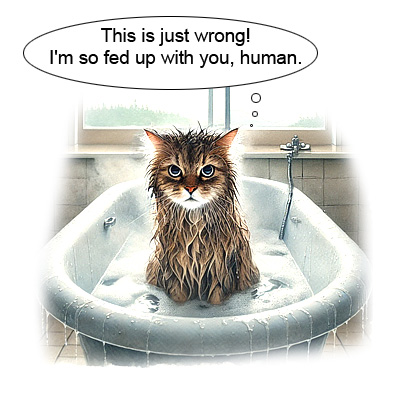
Katzenwäsche, Welpenschutz, Nase voll - today, we'll learn these three and 2 more expressions Germans use in daily life in an interactive learning quiz.
In each episode, we’re learning a few useful German expressions and idioms that are actually used in daily life. And instead of me just listing them, we’ll make it a little more interactive in form of a little learning quiz. So you can test if you already know the idiom, and if not, maybe you’re able to guess it based on context. If you want to check other episodes in this series, I’ll leave the links below. But now, let’s jump right in.
As usual, I’ll give you the idiom or expression along with a literal translation and an example and then you get to pick from a few options as to what it could mean.
Now, I don’t want this to be too easy, so the initial example I am giving is super generic and devoid of pretty much any context, and I tried to make all the options sound somewhat plausible. Like… they all have some sort of logic to them that could work with the expression.
But I also don’t want it to be just a matter of wild guessing, so for each question, you can find a more clear example when you press the “hint” button. That example then DOES have context that’ll help you figure out the meaning.
And then, I’m of course giving you the correct answer as well as some information about the idiom and why it means what it means, and some usage advice as well.
Today, I have 5 idioms for you, that don’t have a particular theme, but you can find them all in daily life. So if you’re ready, I’d say… viel Erfolg :)
***
Time limit: 0
Quiz Summary
0 of 6 Questions completed
Questions:
Information
You have already completed the quiz before. Hence you can not start it again.
Our first expression is “die Nase voll haben”. If you take it literally, it means “having the nose full”, but what could it mean in practice?
Generic example:
Ich habe die Nase voll davon.
Correct
Incorrect
Hint
Specific example:
Ich habe die Nase voll davon, dass Thomas nie die Küche putzt.
I _______________, that Thomas never cleans the kitchen.
Question 2 of 6
2. Question
“die Katzenwäsche”
Taken literally, “Katzenwäsche” means “cat wash”. But what’s the actual meaning?
Generic example:
“Ich mach Katzenwäsche, dann geh ich los.”
Correct
Incorrect
Hint
Specific Example:
“Duschst du vor der Date?” “Ich mach nur Katzenwäsche.” “Ihh, du warst beim Sport!”
“Will you take a shower before the party?” “I’ll just _________ . ” “Ewww, you did sports!”
Question 3 of 6
3. Question
“sturmfrei haben”
If you take it literally, “sturmfrei haben” means “having storm free”. It’s a really common expression especially when you’re not living alone. But what could it mean?
Generic example:
Ich habe morgen sturmfrei.
Correct
Incorrect
Hint
Specific example:
“Ich hab’ morgen sturmfrei, Maria ist nicht da.” “Also Strip-Poker-Boys-Night?” “Genau!”
“I _________ . Maria is not home.” “So strip poker boys night?” “Exactly.”
Question 4 of 6
4. Question
“der Welpenschutz”
“Welpe” is the German word for a puppy (formerly: whelp). Like… the literal baby dog. So taken literally, “Welpenschutz” is “puppy protection“. But what does it actually mean?
Generic example:
Thomas hat noch Welpenschutz.
Correct
Incorrect
Hint
Specific example:
“War dein Chef böse, dass du den Termin verpasst hast?” “Nee, ich habe glaube ich noch Welpenschutz.”
“Was your boss mad that you missed the appointment?” “No, I _________________ .”
Question 5 of 6
5. Question
“sich etwas abschminken”
“Die Schminke” is an old school German word for make-up and “sich abschminken” is the standard word for removing make-up. But it has an idiomatic meaning as well. Which one?
Generic example:
Das kann ich mir abschminken.
Correct
Incorrect
Hint
Specific Example:
Unser Chef hat heute gesagt, dass die Firma Geldprobleme hat. Die Gehaltserhöhung (salary raise) kann ich mir abschminken.
Our boss said today that the company is struggling financially. I ___________ .
Question 6 of 6
6. Question
And now let’s do a little recap. Match the idioms with the fitting situation.
(just drag and drop. You can readjust as much as you want to)
Sort elements
sturmfrei haben
die Nase voll haben von
Katzenwäsche machen
sich etwas abschminken
Inviting friends over for a party because your partner is away
Telling your friend that you've had enough of them being late.
Using dry shampoo and deodorant instead of taking a shower.
Your boss telling you that she needs you to work that weekend where you had that camping trip planned.
Correct
Incorrect
***
So, how did it go? With the contextual examples it shouldn’t be too hard, I think, but I know them all of course, so I can’t really tell how it feels to not know them. So yeah, let me know how you did in the comments and also which one was your favorite. Oh and do tell me know if you have some good English equivalents. And of course if you have any questions about any of them let me know and I’ll clear it all up in the comments.
I really hope you enjoyed this one and that you’ll add at least one of them to your active vocabulary. Have a great week and I’ll see you next time.
Oh, and here are the other episodes, if you want more (they open in a new tab):
Yes, I really did enjoy the exercise. I’m quite fond of the quizzes on idiomatic expressions. Someone has probably given you an English equivalent of “sturmfrei sein,” but for me, it’s “to ha r the house to oneself,” By the way, I did know ” die Nase voll haben,” and had seen “sich abschminken.”
Quick correction: it’s “sturmfrei HABEN”. The phrasing is about what you “have”, not how the apartment “is”. :)
Katja
Love this! I really love getting these in my mailbox. This is my favorite German website ever!! Commenting in hopes other newbies come across some posts and see that this place is active!! Thanks for all that you do!! So grateful as I am learning German. Xx
Wow, if you didn’t know the expressions and you got 5 without using the hint, that’s some really great intuition/Sprachgefühl then!!
Adrian Wiliams
These idioms are colorful. I have another question regarding a sentence from the newspaper. It is..
Mit dem standardisierten Prozess werden Fehler vermieden und die Effizienz der Radiologen gesteigert.
My thought is, “werden” couldn’t apply to “Effizienz” as it lies beyond “und” and so would need its only auxiliary verb. So I thought the sentence should read:
Mit dem standardisierten Prozess werden Fehler vermieden und wird die Effizienz der Radiologen gesteigert.
Could it legitimately be left out because it would be fair to assume. That does happen here and there in German I see.
The sentence did feel a tiny bit awkward to me when I read it. The “und” is not the point, the point is the “frame”-jumping that occurs.
“werden” is for plural and it can span an “und” without problems
– In der Bar werden Cocktails getrunken und Erdnüsse gegessen.
In your sentence, the second element is singular, so the “werden” does NOT cover it. And that’s why it feels weird. You can justify it by saying that “Fehler vermeiden” and “Effizient steigern” are in fact a plural together. Like “things that get done”. And maybe using werden – wird sounds clunky, so there might be no good option here.
Interestingly, it sounds less weird in past tense.
– Auf der Party wurden Lieder gesungen und ein Kuchen gegessen.
And my very personal guess (like, I have zero research to back this up with) is that “wurden” and “wurde” just sound more similar than “werden” and “wird” and that makes it easier for the brain to just let it slide.
Ilonka215
“The coast is clear” is an old expression that could be an equivalent to sturmfrei haben. It means you can operate without interference or getting caught.
Is that specific to having the apartment to oneself or could I also use that in a context where, say, I’m a factory and I want to dump my sewage into the river so I’m bribing the city counsel?
The latter: it works for almost anything, so it’s a far more general expression than sturmfrei haben. (eg, I’m shoplifting, and my accomplice might whisper “the coast is clear”, or if you’re trying to usher someone out of your bedroom and out of the front door without your housemate/parents/etc knowing about it).
Allan
Thank you so much for the sponsorship, Emanuel! I am really enjoying the member features! Keep up the good work :D
Bob
What I liked best were the multiple choice options. You did a great job of suggesting more than one that might work. I went back and forth a few times before making my best guess and then checking the hint. In each case, the hint would either confirm my guess or would be enough to settle on the correct one. I finished 100% but each of them created more than a moment or two of thinking about what worked best. Excellent quiz.
Thanks a lot, glad to hear you enjoy it. I really do try to make all options sound plausible, so I’m happy that it’s appreciated.
CathyL
Ich habe den Begriff “Welpenschutz” hier zum ersten Mal gesehen/gehört. Danke dafür. Ich schaue oft “Bares für Rares” im ZDF Mediathek: da hört man oft idiomatische Begriffe und Wendungen (und übrigens Akzenten aus ganzen Deutschland). Viel Glück mit Überleben trotz KI – schade, dass die Anfragen weniger geworden sind. Du bist aber einmalig, Emanuel.
Anonymous
Wenn du die Katzenwaesche tust, da kriegste ‘nen Katzenjammer, wenn du die Katze aus dem Saeckchen laesst!
I laughed at Katzenwäsche because here in Puerto Rico we literally use that exact same phrase for the same purpose. In Spanish (at least how we say it) it would be “baño de gato”. I’m not sure if it’s a colloquialism unique to us or if it’s actually common throughout many Spanish speaking/Latin American countries. I do think though, it’s not as widely used anymore here by younger generations but was very common when I was growing up during the 80’s-and 90’s.
Nice, I hope other Spanish speakers read this and share how it’s in their version of Spanish. If Spain-Spanish has it, I’d start thinking it might come from Latin.
Maddy
Emmanuel your post highlights something that has been bothering me about the AI ‘snippets’ – the beauty (and also the nightmare) of Google searches is that you can pick the site that seems most relevant/interesting, and compare a few results etc. Now that AI makes that choice for you, I guess many people don’t bother with the comparison, they just take it as ‘the answer’. It saves time, but ultimately I think it might kill the idea of searches altogether – as you said, it already seems to be diverting traffic from websites. And, as a friend pointed out, it’s currently a free-to-use service but once they’ve got us all hooked, will they start charging for information?…
I think Google is currently not sure what exactly to do with this feature and how to integrate it long-term. All I’m saying now is pure speculation, I have no data or info to back it up but:
I believe that Google HAD to act when ChatGPT came out. They had to ship something “AI” so people don’t start thinking of “google” as “the old thing” and of ChatGPT as the new thing. Now, they’re doing these AI snippets so people who use ChatGPT for search feel like “Oh, I don’t have to open ChatGPT anymore”. But when and how the snippets appear is absolutely ill adjusted. Just today, I wanted to check some idiomatic examples for a niche use of a German word. Then I usually do “hat * angeführt”, so I basically enter a part of the phrase I am looking to see with the * indicating variable words in between.
And instead of giving me a bunch of websites on which this pattern appears, Google serves me a rather lengthy AI snippet about what the word means, including a bunch of usage examples which were NOT idiomatic.
This can not be in their interest. I think they don’t know yet, when and how to serve the AI snippet and when it’s better to just not do it because it’ll not be what the user is looking for.
Also, the AI snippet eats up prime real estate on the search result page. And it’s followed by a “normal” snippet AND A “users also asked” box. And I think this might actually push paid ads further down, which can not be in the interest of any advertiser. It’s bad for business and hence also bad for Google’s business because ads are their main income.
I think that midterm Google will either have AI search as a separate option, so users can switch between “search with Gemini” and “search the old way”. Me personally, I hate these snippets, not least because I cannot trust them. They’re not reliable. Search results ARE reliable in so far as that the page they show does exist and I can then make an informed decision whether or not to trust the page or get a second and third “opinion”. With AI snippets, they make it sound like what the snippet says is the truth, and I’d have to check the sources the AI is listing, which might NOT be the pages I would have clicked on naturally. So the AI forces me to verify what it says. I hate them, not only because they hurt business for me, but they’re just annoying. But I 100% understand that Google had to do it.
Regarding this Google “feature”, I just received a great alternative in a weekly Recomendo newsletter: “By adding “udm=14″ to your Google search URL, you can strip away all the AI summaries, knowledge panels, and ads that clutter the results. This doesn’t improve the actual search results, but it provides a cleaner, distraction-free interface reminiscent of Google’s early days.” this link https://udm14.org/?utm_source=substack&utm_medium=email takes you to an AI overview free google prompt.
You can also get rid of the AI overview by forcing Google to only show [web results](https://www.theverge.com/2024/5/14/24074314/google-now-offers-web-search). Click on “web” near the top of the screen where it says “all,” “videos,” “images,” and so on. Sometimes it’s hidden under the option called “more.” That will give you ten blue text links per page. Unfortunately, you have to click this option again for every session. But if you use it a lot, it usually stops being hidden under “More.” Some of the results will not be good quality, like with pretty much all things Google these days. But it usually gets me what I’m looking for.
The thing I don’t like about adding “&udm=14” to the search is it usually limits the results a lot. Like 5-10 per search, and often not what I’m looking for. That only happens when you add it to the search yourself. If you use udm14.org, you get more results. It’s the same as when you do web-only results, except it also shows you video links (Youtube, Tiktok) and social media, and those seem to get up-ranked.
If Google lets me down, I’ll try DuckDuckGo. It will give you different and sometimes better results, but it can struggle with niche searches. Some other options if you want to get deep into it:
– [SearXNG](https://paulgo.io/search). It searches other search engines and strips out the ads. Also claims to strip out the tracking. – marginalia.nu. Designed to find smaller and older sites that Google and co. won’t turn up anymore. It works pretty well, but like many small search engines, it does better with some topics than others.
Edit to the comment I just posted: The links don’t show up right because I forgot I can’t use markdown here, and the edit button isn’t there. It’s been gone for a few weeks now.
It often talks complete rubbish, sometimes even dangerous or outdated advice – luckily I am old enough to recognise it as such, but how many people just accept it as the ‘best’ result?
I did that on the backend. I uploaded the image on my server and the copied the link here and it gets converted. This might also work for external image links, but I have disabled media upload directly to my database as I feel like it’s a potential security threat. Not sure if it’s justified, but my gut feels weird about it.
100% , of course they will. Many web services/apps we currently pay for started as either free or quite inexpensive services and once they reached critical mass then began the price hikes and the inevitable “enshitification”, ie. to make their product as cheap for them and as bad for us as far as we would allow and still pay for it. So yeah, seems pretty inevitable. ♂️♂️
“enshitification” … have you read Cory Doctorow, by any chance :)
Pete
Hello everyone,
This is my first course and very far beyond my learning. As I have disabilities which have left me without any money, Emanuel has been kind enough to give me a year’s subscription for free! I am absolutely stoked. I couldn’t be happier or more grateful. I am grateful to everyone who pays, so that people like me can learn German. I am grateful to Emanuel for being so kind. I am just really happy and really keen to begin learning.
I actually did the quiz and managed to get 5 out of 6 correct – some of these expressions appear in the Tim und Struppi comics which my Mum and I use to learn German. Kapitän Haddock, as he is called in the German versions of Tintin (Tim und Struppi) uses “I have die Nase voll!” frequently. Some of the others I just guessed, based on context, and the last one, abschminken I used the hint, but still got it wrong. I chose ‘to play something down’. Next I’ll return to the beginning of the course.
But again I wanted to introduce myself and to say thank you to everyone who pays for the course. Your payments allow me to learn, to participate, and hopefully one day to be able to read and speak fluently, to listen, to communicate in every way.
I am extraordinarily keen to read German books and to speak German with my Mum (who is from Flensburg). We live in a small town in Australia.
If anyone ever comes to Australia, we have 2 spare rooms here in our house, and we live on the South Coast of NSW. The best beaches in the world are a short distance away.
Anyone is welcome to stay here. I have a bit of trouble communicating verbally as I am very shy but, I like to make people happy.
My invitation will always stand. Just contact me here or email me at [email protected]
When I have enough money to drive, or take the bus, I sometimes go to the beaches and walk, usually during the evening when there are no people (I like being alone, but that is not because I dislike people, I love people, I a just have very intense social anxiety, and concerns about my appearance and so on. Plus I have to wear prescription glasses, and I even have prescription sunglasses).
But please, if you ever in Australia, I really do encourage you to come to the South Coast, especially Jervis Bay – this is a part of the world that is truly beautiful.
Some time ago, my Mum took some of her retirement money, because it was my Uncle’s 80th birthday. She and my brothers all contributed to allow me the chance to go to Germany. I will never forget that trip, and I have a photo on my wall just to my left of the Flensburg harbour.
I also had the opportunity to see the German Alps in spring, and the flatter German state of Schleswig-Holstein, as well as Berlin, and on a rainy day, Hamburg. It was immensely enjoyable.
The Alps stunned me, rising up, as they did, from the farmlands surrounding them. I had never seen anything like it. I haven’t since. I hope to again one day.
I hope the beaches near which I live, will have the same effect on people who have not yet seen them.
I am a ‘wannabe’ writer as well, I write historical pieces and feature articles and I am hoping soon to get them published. That would be a dream.
Thank you again everybody and thank you again Emanuel, your course is one of the best tools for learning German I have ever encountered.
I also recommend (for English speakers learning German) the book ‘Intuitive Vocabulary: German’ by Azzan Yadin-Israel, published in 2013 by Lingua Press. In fact, when Googling it I see that Emanuel has done a review on it, published right here on the website, the link to which is here: German Review of the Day – Intuitive vocabulary The author acknowledges that Emanuel helped him with the book and refers readers to this website. That’s how I found the website. The book says that there are further editions for learning other languages such as Portuguese, French, Dutch, Italian, Spanish and Yiddish. I don’t know if these are only for English speakers, but, it is an interesting book.
I’m sorry for the very long post, I don’t mean to spam you all. Only to introduce myself and to express my gratitude. Danke nochmal! I’ll speak to you in the comments section, but will aim to keep my remarks there much shorter! Cheers, Pete
a cat’s lick in English has the same meaning but probably a bit old fashioned…I haven’t heard it for some time…
Elsa
Hallo, Let’s correct a few typos:
“in an learning interactive quiz” (in a learning interactive quiz) Question 1: “It makes perfect sense of you think of a stuffy nose” (It makes perfect sense if you think of a stuffy nose) Question 5: “taking that of is returning to reality” (taking that off is returning to reality)
I love these articles, I got all 6 questions right :))))
I got four out of five correct. I guessed Welpenschutz correctly but forgot what abschminken meant even though i’d encountered it before (maybe on this blog even) …
coleussanctus
“Sturmfrei” would probably be
I have/I’ve got the place (all) to myself.
I have the run of the place.
Would it sound OK to say “eine Katzenwäsche machen” or “ne Katzenwäsche machen” or is it better without the article? I saw both versions on Google, and liked this example:
Menschen, die morgens immer nur eine Katzenwäsche machen, müssen aufpassen, dass sie nicht am Katzentisch landen.
I guess that means you’d have to sit away from everyone else, but I like the mental picture of a table that a cat could sit at.
I think I’d usually skip the article with “Katzenwäsche” but it doesn’t feel weird if it’s there, especially in writing.
“Katzentisch” is another nice one. It’s kind of a small table on the side, for people that are not the “A-league” of guests. Like kids or drivers or in some cases also the partners.
Oh, the scene that he’s laying out there for “having an empty” fits a lot of “sturmfrei” evenings :)
pmccann
4/5 without hints: nicht so übel ;-)
(“sich etwas abschminken” tripped me up: I chose the “authentic” route, but the correct answer also makes good sense after the fact).
Nice exercise, regardless! Always good to reinforce that certain idioms are actually fresh enough to still be heard in the wild, rather than wasting time memorising the fossilised versions that populate a lot of old German learning books, as well as the occasional website. Now I have to go back and repeat all the earlier versions linked above…
I’m indeed trying to only use the relevant ones that you can hear in daily life. Those books and blogs usually just rehash other content or in case of websites, they do SEO search term analysis and then build an article around the most “famous” ones which are not always the most used ones. But they don’t say that part out loud of course. I’ll have to cut myself off now, I feel The Ramble-Rant™ is starting :D
((aaaaand… Backpfeifengesicht has entered the chat…))
Please do save those ramble-rants somewhere, and dedicate a post to explicating some of the more blatant stupidities of the genre. My “favourite” are the posts –typically on youtube– where you’re exhorted to stop using something boring like “machen” (in brain-dead, tedious beginner style), but should instead master a veritable panoply of “alternatives”, each of which only works in a very limited sense and in very limited contexts. But of course the video helpfully labels them as “synomyms”.
Heck, stir in some of the toxic hell-stew that surrounds anything with the name “hyperpolyglot” and there’s surely a bunch of fun to be found for the whole family.
I know exactly what you mean about the machen thing. You’ll hear learners around the b2/c1 level constantly using “Prüfung ablegen” when I’ve only ever heard “Prüfung + machen” from native speakers.
Lol, yeah native speakers use “machen”. Maybe I should print that on a t-shirt, as merch. I think these particular videos get clicked because people really want to sound good.
I did a soft rant about it a while back in the Advent Calendar:
Actually I had the idea you could do a huge quiz / article on machen and its alternatives. Like where the reader has to guess what sounds more idiomatic. For example is machen better ? Is the alternative better ? Or are they both more or less as common as each other? Is one better for written and one for spoken?
Hmmm, my initial gut feeling is that this could be very frustrating for learners who don’t have the Sprachgefühl yet, because they’ll basically be guessing all the time, and then, if they get it wrong, they will want some logic or explanation, but in most cases, there isn’t any. It’s just about what’s idiomatic and what isn’t. I mean the quiz form that is. Article is a different story, but I have a hard time writing as soon as it gets into list style articles. The more narrative I can weave in, the more enjoyable the writing is. Like… some things are best represented by a list, and I feel like this could be one. But who knows, the seed is sown.
Totally, Emanuel! One can’t honestly learn a language instinct into which one wasn’t born. Fluency is all one can hope for if one is a non-native speaker.
I’m not saying its wrong, rather that learners – and i am a learner myself -are often encouraged to use german that isn’t really used in day-to-day life over more idiomatic alternatives. Classic example I see is learners introducing themselves with “ich heiße” rather than “ich bin”. Again, ich heiße isn’t wrong I just never hear native speakers introduce themselves with it. Often this “encouragment” means learners using high register german in all instances. Obviously its good to know high-register german but part of fluency is knowing where and when to use certain registers – for example Gentiv and Norminalisierung is great when you are writing an essay but when you are chatting with someone casually over a beer?
“Kaffee kochen” is something I’ll never get used to by the way : ) You migh know this alreaday but the phrase sounds very strange to an english speaker as “cooking” is only done to food..
I’ve heard teenagers in Bavaria, speaking to outsiders in High German, albeit slang German as opposed to their local “Boarisch”, say, “Hallo, ich bin der Daniel” instead of “..ich heisse Daniel”.
Just out of curiosity: Would you use “Kaffee kochen” also for using a Vollautomat or a Nespresso machine or a proper Italian coffee machine. I absolutely would not, but that might well be generational or regional.
I’ve never really watched any Polyglot content, as I am not one and don’t aspire to be. But I do check out the German “learnosphere” on Youtube every now and then and yes… these “Stop saying X” videos in particular are not exactly my favorite type of content.
For what it’s worth, here’s a bit of a rant about those synonym videos from a while back:
Oh God, I think I must have digested the content of the rant you’re pointing at there, and have simply regurgitated that particular furball here, 4 years later. The evidence is right there in the comments on the advent article…
Steering clear of the *hyper*polyglot (heck, let’s be real, even the “polyglot”) multiverse is very much recommended: it’s largely a pissing contest, but also includes a few folk dedicated to unmasking the very worst of the shysters… Those claiming, say, fluency in 25 languages at 25 years old. All of whom, strangely enough, have their own “secret system/sauce” that they’ll let you imbibe for a few thousand euros/dollars, after a massive discount on the “usual price”! Then you too will be ready to master a language in three months.
One of my favorite Polyglot stories is the one about Ikenna. He has a Youtube channel, and at some point thought, he has the plan to create the Duolingo killer because he knows how language learning really works. He took in over a million on Kickstarter and together with other funds, and after HUGE delays created an app that claims to be completely different.
He has a serious illness that had him not being able to even sit up while working on the app. Then, after beta launch, they raised money AGAIN, through crowd-investing this time.
He seems genuine when he talks about it, but the app is just soooooo f-ing lame, it’s a shame that they spent 1,5 million on this. The way he described it and the way it actually is (piss poor nonsensical gamification that just slows you down) are so far apart, they can barely see each other.
OK, so out of a profound sense of, let’s say, *science*, I actually downloaded this app (“Fluyo”) onto my home computer and played around with it for about 15 minutes (circa 3-4 levels). Typing out everything that’s wrong with it really isn’t worth the time investment: suffice to say that as far as I can tell it’s exclusively single word selection (or, hilariously, choose which of these two sentences is the correct one). The journey was a mishmash of very occasional, vastly underbaked grammar hints, sometimes outright *wrong* pronunciation hints, a tragically bad implementation of the most basic flashcards, and lots and lots of pastel dolphins and friends. As a language learning tool it really seems fatally, ie, unrescuably, bad. Whoever invested in this must be mightily pissed, even if they did receive a velour dolphin. I’ll be shocked if the whole venture doesn’t go belly-up sometime soon.
It’s an interesting case really because of a) how incredibly much they hyped up the whole thing, saying it’s something COMPLETELY REVOLUTIONARY™, b) how not special the outcome really is, c) the amount of money that went into this presumably and d) the fact that the founder does have a serious illness, which might make it harder for some people to voice their discontent or give some honest feedback on how the product really isn’t all that great. Jeremy from Seedlang and I have been tinkering with the idea of an open world language learning world where you have a little robot with you that you that grows as you learn and that can help you and explain things, but you have to charge its battery by doing exercises (or just buy power in our in game store).
So I was really excited by Fluyos idea of “open world” and an avatar, but the implementation is just so poor.
I think I could actually make a really good actual language learning game if I had 2 million to spend, at least a good prototype. But yeah, neither Jeremy nor I ever had time to seriously draft anything even remotely approaching a working prove of concept (though I did get as far as downloading roblox at some point).
But yeah… they had some nice ideas but went 1% of the way they need to go to REALLY be revolutionary.
Not to go back to dumping on Fluyo –there’s plenty of that already, and I’m 100% not their target audience– but the current talk from the founder is that it’s now managed to consume 3 million dollars to get to its somewhat pathetic current state.
I do like that idea of a small robot/creature/whatever that somehow takes your current state of language competency and throws material at you that’s just above your pay-grade. It’d certainly have to be something AI-based, and essentially keep track of a player’s vocab, strengths, weaknesses, interests, in order to offer relevant and engaging challenges. ((That stuff can probably fit inside of a context window these days!!)) I sort of envisage a cute (inter)face to a persistent personal-chatgpt for each user. It could suggest topics, evaluate sentences, hold chats, etc etc. That is, a sort of language coach in disguise, constantly nudging the edges of your abilities. At first blush that doesn’t sound like an enormous amount of development work, particularly if it was offered as a “pack” to someone with a chatgpt (or similar) subscription It’s obviously not going to be perfect, given the heavy reliance on AI for evaluation and generation, but for close to nothing it’d be a pretty nifty way to spend 15-30 minutes a day learning. Infinitely better than Duolingo currently offers, for example, at basically the same price., or even cheaper if you’ve already got a subscription somewhere.
3 million?! I don’t know what to say, that’s crazy.
I’m actually almost sure that there are apps or at least AI agents out there, that try to do what you described.There are several chat based apps for instance that let you chat with AI about every day stuff, you can highlight words and have an explanation, it’ll correct your mistakes (try to) and you can save words to your vocabulary deck. I’m not sure how well they do with “understanding” where the user is at or what they need though.
What I had in mind though was a more open world concept. So you can go anywhere you want. You can go to the conditional 2 past tense with modal verb dragon, if you want to. But you’ll fail miserably.
The bot or avatar you have is your little companion that can in theory help with ANY task and even give you the correct answer. But that costs battery. In the beginning, the bot doesn’t have much battery life and asking it for help with a conditional 2 question would drain it completely immediately. It grows along with you in a sense that it gets more battery life, more “stored knowledge” that you can check on for free and of course “skins”, depending on where your current learning focus is.
I envision it as a mix of Tamagochi, that you have to take care of by charging it through doing exercises or practice words, and a reference for words and grammar and of course an in game-buddy.
Yeah, such things undoubtedly exist at that level, but I think the one crucial aspect, indeed the part that would require an inordinate amount of care, is the persistence. Hmm… maybe what I’m going for here is something like the *inverse* of what you’re describing, and maybe the language learner would be “fed and watered” in terms of language learning by the personalised GPT. That is, it’s something like your language learning that’s the Tamagotchi, and the LLM’s job is to help you keep that alive and thriving…
((You feed it your preferences, it assesses your strengths and weaknesses, and prescribes appropriate strengtheners and reinforcers so that you’re getting better at what you’ve previously tripped up on. Again, all tempered by your areas of interest, usw…))
Ha, interesting. I would actually HATE for my app to decide what I learn when. Duolingo and most other apps try to do that with their learning path and that’s why I am not using them. I want to be in charge of what I learn when, so I can follow my interests and skip boring shit I don’t care about like learning 20 vegetables.
But I think that’s 100% a matter of personality. I’m very “particular” in that way, because when I explain something, I absolutely want the other person to let go and follow MY approach but when I am explained someone, I want the explainer to follow MY path and explain along MY questions.
I’m VERY self centered in that way XD.
So yeah, I would happily sacrifice comfort to charge up my little robot by doing an exercise about vegetable names, but I would absolute NOT do the same exercise if the bot were like “Hey, I think this is what you need right now.”
Aah, fair enough. The dreaded owl-based language learning app started turning the screws ever-tighter on free users, to the point where using the app for even circa 10 minutes a day would mean that you frequently ran out of “hearts” (ie, the number mistakes you could make before being locked out), and the only way to get them back was to undertake some designated practice exercises (Even that option was only available on the web-based version, so users on their phones were simply unable to do anything). Sounds OK, but the exercises were utterly generic, brain dead vocab, pick the gender and so on, and completely independent of both your level and the actual mistakes you’d made to end up at that point.
In short: infuriating. ((For me!)) Particularly when the reason that the hearts were lost is that Duolingo’s newer questions still, not infrequently, have basic errors (not recognising all genders, or formal *and* informal, or straightforward synonyms.
In any case, it’s ancient history for me now, having pretty much plucked that dreaded bird, and not missed it one bit. (Finally…!)
I’ll happily be told what to learn by “my app”, because everything is only ever supplementary: it’s supplements all the way down. And I can tell it to switch things up when necessary! FEED ME WHAT I WANT (as well as what I need)!
What do you like? Do you pick a topic that interests you (say maybe music, math, inconsiderate neighbors) or do you go more by things like grammar or pronunciation?
I don’t like being told what to learn. I get told what to do plenty as is, and I like the feeling of being free to pick any topic I happen to be interested in. Today, singing exercises, tomorrow making bread, then how to complain when your computer is on the fritz. The downside is I struggle more to understand it, but I don’t mind. It helps me remember better and it’s kind of fun.
It’s interesting to hear how other people go about it. The other day, someone suggested finding a bookstore and getting a book if you happen to be traveling. So if you’re in Italy and learning Italian, grab yourself a kid’s book and puzzle your way through it. Depending on where you live, that might even work in your own neighborhood.
Maths will do me fine ;-) I can talk about that for decades! But the more it knows, the more it can weave (and the less it would, theoretically, waft) by itself. Heck, let’s have a chat about the crazy history of psychoanalysis, and Freud’s lasting legacy. Couch as much as possible in Konjunktiv II. But now I’m feeling a bit tired: lets revise 30 of the words on the list of those that I’ve not yet mastered. Construct a goodnight story for me, and read it in a soft, slow, soothing voice.
The goal setting can be either higher level/longer term, or more immediate. “What do I need to brush up on?” / “Retest me on that grammar we were covering yesterday, but without any hints this time”. In any case, I’m obviously just making shit up as I go along, but do think there’ll be something occupying that sort of space before long: the ingredients pretty much exist, they just need some decidedly expert assembly!
Have you heard of Harald Lesch? He has some interesting videos on math and astrophysics, like this one here (has subtitles). Some of them kind of get into philosophy, but not like Freud, just about nature.
I like falling asleep to documentaries or audiobooks because the narrators tend to have those great, soothing voices.
Nope, hadn’t heard of him, but quite enjoyed the video you linked to, so I’ll also watch a bunch of others on his channel. Thanks for the pointer! Along the same lines I tried reading “Der Anfang aller Dinge” by Hans Küng, but was constantly repelled by the ponderous theological (di|per)versions/assertions(#), and gave up after about 100 pages. The content on Lesch’s channel looks/sounds/feels/tastes infinitely more palatable. I also attempted “Die Vermessung der Welt” by Daniel Kehlmann a year or so ago, which I thought would be good fodder (having already read the English translation) but the level of German in there was a little over my head. Or perhaps it was just the high percentage of unfamiliar vocab… Maybe in a year or two?
I work at a German company where everyone is supposed to speak English. Mostly it’s fine, but some coworkers just can’t stand saying things in normal ways and try to use fancier phrasings that are almost invariably wrong. Meanwhile I try to be mindful of my language and avoid using words most of them won’t know. I allow myself a few vocabulary building words a week.
Lol, I think that’s maybe a general human phenomenon, that as soon as we’re conversational in another language, we then think we need to be “extra” and of course we all fail, because using synonyms is not about knowledge but about “feeledge”.
I can see your point from my own experience in Dortmund. Here, international companies in particular insist on English only, both in the board room as well as even the break areas as well. As a native German speaker, although naturally I know English fluently, I can hardly bring myself to chat, resp. chatter, away in “normal” English with German co-workers. many from Turkey or Greece, whose first language isn’t English either!
Get full access
This feature is available with the YourDailyGerman membership.

 Audio Speed
 Dark Mode
I think i missed two. Katzenwäsche seemed too easy to be the right one, so I guessed otherwise. Silly me.
These are my favorite quizzes! “When the cats away the mice will play” sturmfrei haben?
Same core idea, for sure.
Yes, I really did enjoy the exercise. I’m quite fond of the quizzes on idiomatic expressions. Someone has probably given you an English equivalent of “sturmfrei sein,” but for me, it’s “to ha r the house to oneself,”
By the way, I did know ” die Nase voll haben,” and had seen “sich abschminken.”
Quick correction: it’s “sturmfrei HABEN”. The phrasing is about what you “have”, not how the apartment “is”. :)
Love this! I really love getting these in my mailbox. This is my favorite German website ever!! Commenting in hopes other newbies come across some posts and see that this place is active!! Thanks for all that you do!! So grateful as I am learning German. Xx
Thanks a lot for this great feedback :). Working on a new article right now, and this is perfect to hype me up!
Woo. 6/6 correct and I only needed the hint for one. Maybe I’m figuring out this German thing after all.
Wow, if you didn’t know the expressions and you got 5 without using the hint, that’s some really great intuition/Sprachgefühl then!!
These idioms are colorful.
I have another question regarding a sentence from the newspaper. It is..
My thought is, “werden” couldn’t apply to “Effizienz” as it lies beyond “und” and so would need its only auxiliary verb. So I thought the sentence should read:
Could it legitimately be left out because it would be fair to assume. That does happen here and there in German I see.
The sentence did feel a tiny bit awkward to me when I read it.
The “und” is not the point, the point is the “frame”-jumping that occurs.
“werden” is for plural and it can span an “und” without problems
– In der Bar werden Cocktails getrunken und Erdnüsse gegessen.
In your sentence, the second element is singular, so the “werden” does NOT cover it.
And that’s why it feels weird.
You can justify it by saying that “Fehler vermeiden” and “Effizient steigern” are in fact a plural together. Like “things that get done”.
And maybe using werden – wird sounds clunky, so there might be no good option here.
Interestingly, it sounds less weird in past tense.
– Auf der Party wurden Lieder gesungen und ein Kuchen gegessen.
And my very personal guess (like, I have zero research to back this up with) is that “wurden” and “wurde” just sound more similar than “werden” and “wird” and that makes it easier for the brain to just let it slide.
“The coast is clear” is an old expression that could be an equivalent to sturmfrei haben. It means you can operate without interference or getting caught.
Is that specific to having the apartment to oneself or could I also use that in a context where, say, I’m a factory and I want to dump my sewage into the river so I’m bribing the city counsel?
The latter: it works for almost anything, so it’s a far more general expression than sturmfrei haben. (eg, I’m shoplifting, and my accomplice might whisper “the coast is clear”, or if you’re trying to usher someone out of your bedroom and out of the front door without your housemate/parents/etc knowing about it).
Thank you so much for the sponsorship, Emanuel! I am really enjoying the member features! Keep up the good work :D
What I liked best were the multiple choice options. You did a great job of suggesting more than one that might work. I went back and forth a few times before making my best guess and then checking the hint. In each case, the hint would either confirm my guess or would be enough to settle on the correct one. I finished 100% but each of them created more than a moment or two of thinking about what worked best. Excellent quiz.
Thanks a lot, glad to hear you enjoy it. I really do try to make all options sound plausible, so I’m happy that it’s appreciated.
Ich habe den Begriff “Welpenschutz” hier zum ersten Mal gesehen/gehört. Danke dafür. Ich schaue oft “Bares für Rares” im ZDF Mediathek: da hört man oft idiomatische Begriffe und Wendungen (und übrigens Akzenten aus ganzen Deutschland).
Viel Glück mit Überleben trotz KI – schade, dass die Anfragen weniger geworden sind. Du bist aber einmalig, Emanuel.
Wenn du die Katzenwaesche tust, da kriegste ‘nen Katzenjammer, wenn du die Katze aus dem Saeckchen laesst!
Das kann doch eigentlich nur von einer Person kommen, dieser Kommentar ;)
Jawohl, der Herr! Hier Harald und ich tauche immer wieder an den konischsten Stellen auf LOL
Ha! Sofort erkannt!
:-)
I laughed at Katzenwäsche because here in Puerto Rico we literally use that exact same phrase for the same purpose. In Spanish (at least how we say it) it would be “baño de gato”. I’m not sure if it’s a colloquialism unique to us or if it’s actually common throughout many Spanish speaking/Latin American countries. I do think though, it’s not as widely used anymore here by younger generations but was very common when I was growing up during the 80’s-and 90’s.
Nice, I hope other Spanish speakers read this and share how it’s in their version of Spanish. If Spain-Spanish has it, I’d start thinking it might come from Latin.
Emmanuel your post highlights something that has been bothering me about the AI ‘snippets’ – the beauty (and also the nightmare) of Google searches is that you can pick the site that seems most relevant/interesting, and compare a few results etc. Now that AI makes that choice for you, I guess many people don’t bother with the comparison, they just take it as ‘the answer’. It saves time, but ultimately I think it might kill the idea of searches altogether – as you said, it already seems to be diverting traffic from websites. And, as a friend pointed out, it’s currently a free-to-use service but once they’ve got us all hooked, will they start charging for information?…
I think Google is currently not sure what exactly to do with this feature and how to integrate it long-term.
All I’m saying now is pure speculation, I have no data or info to back it up but:
I believe that Google HAD to act when ChatGPT came out. They had to ship something “AI” so people don’t start thinking of “google” as “the old thing” and of ChatGPT as the new thing.
Now, they’re doing these AI snippets so people who use ChatGPT for search feel like “Oh, I don’t have to open ChatGPT anymore”.
But when and how the snippets appear is absolutely ill adjusted.
Just today, I wanted to check some idiomatic examples for a niche use of a German word. Then I usually do “hat * angeführt”, so I basically enter a part of the phrase I am looking to see with the * indicating variable words in between.
And instead of giving me a bunch of websites on which this pattern appears, Google serves me a rather lengthy AI snippet about what the word means, including a bunch of usage examples which were NOT idiomatic.
This can not be in their interest. I think they don’t know yet, when and how to serve the AI snippet and when it’s better to just not do it because it’ll not be what the user is looking for.
Also, the AI snippet eats up prime real estate on the search result page. And it’s followed by a “normal” snippet AND A “users also asked” box.
And I think this might actually push paid ads further down, which can not be in the interest of any advertiser. It’s bad for business and hence also bad for Google’s business because ads are their main income.
I think that midterm Google will either have AI search as a separate option, so users can switch between “search with Gemini” and “search the old way”.
Me personally, I hate these snippets, not least because I cannot trust them. They’re not reliable. Search results ARE reliable in so far as that the page they show does exist and I can then make an informed decision whether or not to trust the page or get a second and third “opinion”. With AI snippets, they make it sound like what the snippet says is the truth, and I’d have to check the sources the AI is listing, which might NOT be the pages I would have clicked on naturally. So the AI forces me to verify what it says.
I hate them, not only because they hurt business for me, but they’re just annoying. But I 100% understand that Google had to do it.
Regarding this Google “feature”, I just received a great alternative in a weekly Recomendo newsletter:
“By adding “udm=14″ to your Google search URL, you can strip away all the AI summaries, knowledge panels, and ads that clutter the results. This doesn’t improve the actual search results, but it provides a cleaner, distraction-free interface reminiscent of Google’s early days.” this link https://udm14.org/?utm_source=substack&utm_medium=email takes you to an AI overview free google prompt.
Wow, this is AMAZING!!! Thanks so much, I’ll probably share that with everyone in a post soon!
You can also get rid of the AI overview by forcing Google to only show [web results](https://www.theverge.com/2024/5/14/24074314/google-now-offers-web-search). Click on “web” near the top of the screen where it says “all,” “videos,” “images,” and so on. Sometimes it’s hidden under the option called “more.” That will give you ten blue text links per page. Unfortunately, you have to click this option again for every session. But if you use it a lot, it usually stops being hidden under “More.” Some of the results will not be good quality, like with pretty much all things Google these days. But it usually gets me what I’m looking for.
The thing I don’t like about adding “&udm=14” to the search is it usually limits the results a lot. Like 5-10 per search, and often not what I’m looking for. That only happens when you add it to the search yourself. If you use udm14.org, you get more results. It’s the same as when you do web-only results, except it also shows you video links (Youtube, Tiktok) and social media, and those seem to get up-ranked.
If Google lets me down, I’ll try DuckDuckGo. It will give you different and sometimes better results, but it can struggle with niche searches. Some other options if you want to get deep into it:
– [SearXNG](https://paulgo.io/search). It searches other search engines and strips out the ads. Also claims to strip out the tracking.
– marginalia.nu. Designed to find smaller and older sites that Google and co. won’t turn up anymore. It works pretty well, but like many small search engines, it does better with some topics than others.
Edit to the comment I just posted: The links don’t show up right because I forgot I can’t use markdown here, and the edit button isn’t there. It’s been gone for a few weeks now.
Before posting, coleusssanctus’ reply to this has the best solution for Safari. Use the More -> Web option.
It will add the &udm=14 and that will “stick” for that tab/page for other searches.
I set DuckDuckGo as my search engine and my preferred browser, since I’m mostly now an Apple user. That helps reduce the noise.
It often talks complete rubbish, sometimes even dangerous or outdated advice – luckily I am old enough to recognise it as such, but how many people just accept it as the ‘best’ result?
Oh, here is an example for one of the snippets I got served today. It is so absolutely off topic and braindead that it’s almost satire:
Emanuel –
How did you add the image? When I try doing a drag&drop (MacOS screenshot) nothing happens.
Just being a curious cat.
Mike
Helps to own the site. :)
Lol, indeed :)!
I did that on the backend. I uploaded the image on my server and the copied the link here and it gets converted.
This might also work for external image links, but I have disabled media upload directly to my database as I feel like it’s a potential security threat. Not sure if it’s justified, but my gut feels weird about it.
100% , of course they will. Many web services/apps we currently pay for started as either free or quite inexpensive services and once they reached critical mass then began the price hikes and the inevitable “enshitification”, ie. to make their product as cheap for them and as bad for us as far as we would allow and still pay for it. So yeah, seems pretty inevitable. ♂️♂️
“enshitification” … have you read Cory Doctorow, by any chance :)
Hello everyone,
This is my first course and very far beyond my learning. As I have disabilities which have left me without any money, Emanuel has been kind enough to give me a year’s subscription for free! I am absolutely stoked. I couldn’t be happier or more grateful.
I am grateful to everyone who pays, so that people like me can learn German. I am grateful to Emanuel for being so kind. I am just really happy and really keen to begin learning.
I actually did the quiz and managed to get 5 out of 6 correct – some of these expressions appear in the Tim und Struppi comics which my Mum and I use to learn German. Kapitän Haddock, as he is called in the German versions of Tintin (Tim und Struppi) uses “I have die Nase voll!” frequently.
Some of the others I just guessed, based on context, and the last one, abschminken I used the hint, but still got it wrong. I chose ‘to play something down’.
Next I’ll return to the beginning of the course.
But again I wanted to introduce myself and to say thank you to everyone who pays for the course. Your payments allow me to learn, to participate, and hopefully one day to be able to read and speak fluently, to listen, to communicate in every way.
I am extraordinarily keen to read German books and to speak German with my Mum (who is from Flensburg). We live in a small town in Australia.
If anyone ever comes to Australia, we have 2 spare rooms here in our house, and we live on the South Coast of NSW. The best beaches in the world are a short distance away.
Anyone is welcome to stay here. I have a bit of trouble communicating verbally as I am very shy but, I like to make people happy.
My invitation will always stand. Just contact me here or email me at [email protected]
When I have enough money to drive, or take the bus, I sometimes go to the beaches and walk, usually during the evening when there are no people (I like being alone, but that is not because I dislike people, I love people, I a just have very intense social anxiety, and concerns about my appearance and so on. Plus I have to wear prescription glasses, and I even have prescription sunglasses).
But please, if you ever in Australia, I really do encourage you to come to the South Coast, especially Jervis Bay – this is a part of the world that is truly beautiful.
Some time ago, my Mum took some of her retirement money, because it was my Uncle’s 80th birthday. She and my brothers all contributed to allow me the chance to go to Germany. I will never forget that trip, and I have a photo on my wall just to my left of the Flensburg harbour.
I also had the opportunity to see the German Alps in spring, and the flatter German state of Schleswig-Holstein, as well as Berlin, and on a rainy day, Hamburg.
It was immensely enjoyable.
The Alps stunned me, rising up, as they did, from the farmlands surrounding them. I had never seen anything like it. I haven’t since.
I hope to again one day.
I hope the beaches near which I live, will have the same effect on people who have not yet seen them.
I am a ‘wannabe’ writer as well, I write historical pieces and feature articles and I am hoping soon to get them published. That would be a dream.
Thank you again everybody and thank you again Emanuel, your course is one of the best tools for learning German I have ever encountered.
I also recommend (for English speakers learning German) the book ‘Intuitive Vocabulary: German’ by Azzan Yadin-Israel, published in 2013 by Lingua Press. In fact, when Googling it I see that Emanuel has done a review on it, published right here on the website, the link to which is here:
German Review of the Day – Intuitive vocabulary
The author acknowledges that Emanuel helped him with the book and refers readers to this website. That’s how I found the website. The book says that there are further editions for learning other languages such as Portuguese, French, Dutch, Italian, Spanish and Yiddish. I don’t know if these are only for English speakers, but, it is an interesting book.
I’m sorry for the very long post, I don’t mean to spam you all. Only to introduce myself and to express my gratitude.
Danke nochmal!
I’ll speak to you in the comments section, but will aim to keep my remarks there much shorter!
Cheers,
Pete
For once I got % on the quiz!
You mean 100, I assume :)
a cat’s lick in English has the same meaning but probably a bit old fashioned…I haven’t heard it for some time…
Hallo,
Let’s correct a few typos:
“in an learning interactive quiz” (in a learning interactive quiz)
Question 1:
“It makes perfect sense of you think of a stuffy nose” (It makes perfect sense if you think of a stuffy nose)
Question 5:
“taking that of is returning to reality” (taking that off is returning to reality)
I love these articles, I got all 6 questions right :))))
Bis bald!
Wow, Glückwunsch. C1 incoming!
I got four out of five correct. I guessed Welpenschutz correctly but forgot what abschminken meant even though i’d encountered it before (maybe on this blog even) …
“Sturmfrei” would probably be
Would it sound OK to say “eine Katzenwäsche machen” or “ne Katzenwäsche machen” or is it better without the article? I saw both versions on Google, and liked this example:
I guess that means you’d have to sit away from everyone else, but I like the mental picture of a table that a cat could sit at.
I think I’d usually skip the article with “Katzenwäsche” but it doesn’t feel weird if it’s there, especially in writing.
“Katzentisch” is another nice one. It’s kind of a small table on the side, for people that are not the “A-league” of guests. Like kids or drivers or in some cases also the partners.
Sturmfrei reminded me of the Scottish comedian Kevin Bridge’s routine about parents being away or ‘having an empty’ https://www.tiktok.com/@standupcomedyshort/video/7275805237108149537
Oh, the scene that he’s laying out there for “having an empty” fits a lot of “sturmfrei” evenings :)
4/5 without hints: nicht so übel ;-)
(“sich etwas abschminken” tripped me up: I chose the “authentic” route, but the correct answer also makes good sense after the fact).
Nice exercise, regardless! Always good to reinforce that certain idioms are actually fresh enough to still be heard in the wild, rather than wasting time memorising the fossilised versions that populate a lot of old German learning books, as well as the occasional website. Now I have to go back and repeat all the earlier versions linked above…
Gut gemacht!!
I’m indeed trying to only use the relevant ones that you can hear in daily life. Those books and blogs usually just rehash other content or in case of websites, they do SEO search term analysis and then build an article around the most “famous” ones which are not always the most used ones. But they don’t say that part out loud of course.
I’ll have to cut myself off now, I feel The Ramble-Rant™ is starting :D
((aaaaand… Backpfeifengesicht has entered the chat…))
Please do save those ramble-rants somewhere, and dedicate a post to explicating some of the more blatant stupidities of the genre. My “favourite” are the posts –typically on youtube– where you’re exhorted to stop using something boring like “machen” (in brain-dead, tedious beginner style), but should instead master a veritable panoply of “alternatives”, each of which only works in a very limited sense and in very limited contexts. But of course the video helpfully labels them as “synomyms”.
Heck, stir in some of the toxic hell-stew that surrounds anything with the name “hyperpolyglot” and there’s surely a bunch of fun to be found for the whole family.
I know exactly what you mean about the machen thing. You’ll hear learners around the b2/c1 level constantly using “Prüfung ablegen” when I’ve only ever heard “Prüfung + machen” from native speakers.
Lol, yeah native speakers use “machen”. Maybe I should print that on a t-shirt, as merch.
I think these particular videos get clicked because people really want to sound good.
I did a soft rant about it a while back in the Advent Calendar:
https://yourdailygerman.com/using-synonyms-german/
Long and short for anyone reading this: STOP USING SYNONYMS.
Actually I had the idea you could do a huge quiz / article on machen and its alternatives. Like where the reader has to guess what sounds more idiomatic. For example is machen better ? Is the alternative better ? Or are they both more or less as common as each other? Is one better for written and one for spoken?
Hmmm, my initial gut feeling is that this could be very frustrating for learners who don’t have the Sprachgefühl yet, because they’ll basically be guessing all the time, and then, if they get it wrong, they will want some logic or explanation, but in most cases, there isn’t any. It’s just about what’s idiomatic and what isn’t.
I mean the quiz form that is. Article is a different story, but I have a hard time writing as soon as it gets into list style articles. The more narrative I can weave in, the more enjoyable the writing is. Like… some things are best represented by a list, and I feel like this could be one. But who knows, the seed is sown.
fair enough and yes i do see how that could be frustrating for some too…
Totally, Emanuel! One can’t honestly learn a language instinct into which one wasn’t born. Fluency is all one can hope for if one is a non-native speaker.
“Pruefung ablegen” is absolutely correct standard German! As a native speaker, I might use “Pruefung machen”, even though it’s casual or vernacular.
“Kaffee kochen” is the same as regards the proper collocation, however I will also say “Kaffee machen”, even though it’s not completely correct.
I’m not saying its wrong, rather that learners – and i am a learner myself -are often encouraged to use german that isn’t really used in day-to-day life over more idiomatic alternatives. Classic example I see is learners introducing themselves with “ich heiße” rather than “ich bin”. Again, ich heiße isn’t wrong I just never hear native speakers introduce themselves with it. Often this “encouragment” means learners using high register german in all instances. Obviously its good to know high-register german but part of fluency is knowing where and when to use certain registers – for example Gentiv and Norminalisierung is great when you are writing an essay but when you are chatting with someone casually over a beer?
Oh, I agree! In any language, it’s all about the social register (Stilebene) in a given situation:-)
“Kaffee kochen” is something I’ll never get used to by the way : ) You migh know this alreaday but the phrase sounds very strange to an english speaker as “cooking” is only done to food..
I’ve heard teenagers in Bavaria, speaking to outsiders in High German, albeit slang German as opposed to their local “Boarisch”, say, “Hallo, ich bin der Daniel” instead of “..ich heisse Daniel”.
Just out of curiosity: Would you use “Kaffee kochen” also for using a Vollautomat or a Nespresso machine or a proper Italian coffee machine. I absolutely would not, but that might well be generational or regional.
Admittedly in order to be completely accurate, “Wasser kochen” is more exact, this is true!
I’ve never really watched any Polyglot content, as I am not one and don’t aspire to be. But I do check out the German “learnosphere” on Youtube every now and then and yes… these “Stop saying X” videos in particular are not exactly my favorite type of content.
For what it’s worth, here’s a bit of a rant about those synonym videos from a while back:
https://yourdailygerman.com/using-synonyms-german/
Oh God, I think I must have digested the content of the rant you’re pointing at there, and have simply regurgitated that particular furball here, 4 years later. The evidence is right there in the comments on the advent article…
Steering clear of the *hyper*polyglot (heck, let’s be real, even the “polyglot”) multiverse is very much recommended: it’s largely a pissing contest, but also includes a few folk dedicated to unmasking the very worst of the shysters… Those claiming, say, fluency in 25 languages at 25 years old. All of whom, strangely enough, have their own “secret system/sauce” that they’ll let you imbibe for a few thousand euros/dollars, after a massive discount on the “usual price”! Then you too will be ready to master a language in three months.
One of my favorite Polyglot stories is the one about Ikenna. He has a Youtube channel, and at some point thought, he has the plan to create the Duolingo killer because he knows how language learning really works. He took in over a million on Kickstarter and together with other funds, and after HUGE delays created an app that claims to be completely different.
He has a serious illness that had him not being able to even sit up while working on the app. Then, after beta launch, they raised money AGAIN, through crowd-investing this time.
He seems genuine when he talks about it, but the app is just soooooo f-ing lame, it’s a shame that they spent 1,5 million on this. The way he described it and the way it actually is (piss poor nonsensical gamification that just slows you down) are so far apart, they can barely see each other.
OK, so out of a profound sense of, let’s say, *science*, I actually downloaded this app (“Fluyo”) onto my home computer and played around with it for about 15 minutes (circa 3-4 levels). Typing out everything that’s wrong with it really isn’t worth the time investment: suffice to say that as far as I can tell it’s exclusively single word selection (or, hilariously, choose which of these two sentences is the correct one). The journey was a mishmash of very occasional, vastly underbaked grammar hints, sometimes outright *wrong* pronunciation hints, a tragically bad implementation of the most basic flashcards, and lots and lots of pastel dolphins and friends. As a language learning tool it really seems fatally, ie, unrescuably, bad. Whoever invested in this must be mightily pissed, even if they did receive a velour dolphin. I’ll be shocked if the whole venture doesn’t go belly-up sometime soon.
It’s an interesting case really because of a) how incredibly much they hyped up the whole thing, saying it’s something COMPLETELY REVOLUTIONARY™, b) how not special the outcome really is, c) the amount of money that went into this presumably and d) the fact that the founder does have a serious illness, which might make it harder for some people to voice their discontent or give some honest feedback on how the product really isn’t all that great.
Jeremy from Seedlang and I have been tinkering with the idea of an open world language learning world where you have a little robot with you that you that grows as you learn and that can help you and explain things, but you have to charge its battery by doing exercises (or just buy power in our in game store).
So I was really excited by Fluyos idea of “open world” and an avatar, but the implementation is just so poor.
I think I could actually make a really good actual language learning game if I had 2 million to spend, at least a good prototype. But yeah, neither Jeremy nor I ever had time to seriously draft anything even remotely approaching a working prove of concept (though I did get as far as downloading roblox at some point).
But yeah… they had some nice ideas but went 1% of the way they need to go to REALLY be revolutionary.
Not to go back to dumping on Fluyo –there’s plenty of that already, and I’m 100% not their target audience– but the current talk from the founder is that it’s now managed to consume 3 million dollars to get to its somewhat pathetic current state.
I do like that idea of a small robot/creature/whatever that somehow takes your current state of language competency and throws material at you that’s just above your pay-grade. It’d certainly have to be something AI-based, and essentially keep track of a player’s vocab, strengths, weaknesses, interests, in order to offer relevant and engaging challenges. ((That stuff can probably fit inside of a context window these days!!)) I sort of envisage a cute (inter)face to a persistent personal-chatgpt for each user. It could suggest topics, evaluate sentences, hold chats, etc etc. That is, a sort of language coach in disguise, constantly nudging the edges of your abilities. At first blush that doesn’t sound like an enormous amount of development work, particularly if it was offered as a “pack” to someone with a chatgpt (or similar) subscription It’s obviously not going to be perfect, given the heavy reliance on AI for evaluation and generation, but for close to nothing it’d be a pretty nifty way to spend 15-30 minutes a day learning. Infinitely better than Duolingo currently offers, for example, at basically the same price., or even cheaper if you’ve already got a subscription somewhere.
Anyway, enough delirium for now…
3 million?! I don’t know what to say, that’s crazy.
I’m actually almost sure that there are apps or at least AI agents out there, that try to do what you described.There are several chat based apps for instance that let you chat with AI about every day stuff, you can highlight words and have an explanation, it’ll correct your mistakes (try to) and you can save words to your vocabulary deck.
I’m not sure how well they do with “understanding” where the user is at or what they need though.
What I had in mind though was a more open world concept. So you can go anywhere you want. You can go to the conditional 2 past tense with modal verb dragon, if you want to. But you’ll fail miserably.
The bot or avatar you have is your little companion that can in theory help with ANY task and even give you the correct answer. But that costs battery.
In the beginning, the bot doesn’t have much battery life and asking it for help with a conditional 2 question would drain it completely immediately.
It grows along with you in a sense that it gets more battery life, more “stored knowledge” that you can check on for free and of course “skins”, depending on where your current learning focus is.
I envision it as a mix of Tamagochi, that you have to take care of by charging it through doing exercises or practice words, and a reference for words and grammar and of course an in game-buddy.
Yeah, such things undoubtedly exist at that level, but I think the one crucial aspect, indeed the part that would require an inordinate amount of care, is the persistence. Hmm… maybe what I’m going for here is something like the *inverse* of what you’re describing, and maybe the language learner would be “fed and watered” in terms of language learning by the personalised GPT. That is, it’s something like your language learning that’s the Tamagotchi, and the LLM’s job is to help you keep that alive and thriving…
((You feed it your preferences, it assesses your strengths and weaknesses, and prescribes appropriate strengtheners and reinforcers so that you’re getting better at what you’ve previously tripped up on. Again, all tempered by your areas of interest, usw…))
Ha, interesting. I would actually HATE for my app to decide what I learn when. Duolingo and most other apps try to do that with their learning path and that’s why I am not using them.
I want to be in charge of what I learn when, so I can follow my interests and skip boring shit I don’t care about like learning 20 vegetables.
But I think that’s 100% a matter of personality. I’m very “particular” in that way, because when I explain something, I absolutely want the other person to let go and follow MY approach but when I am explained someone, I want the explainer to follow MY path and explain along MY questions.
I’m VERY self centered in that way XD.
So yeah, I would happily sacrifice comfort to charge up my little robot by doing an exercise about vegetable names, but I would absolute NOT do the same exercise if the bot were like “Hey, I think this is what you need right now.”
Aah, fair enough. The dreaded owl-based language learning app started turning the screws ever-tighter on free users, to the point where using the app for even circa 10 minutes a day would mean that you frequently ran out of “hearts” (ie, the number mistakes you could make before being locked out), and the only way to get them back was to undertake some designated practice exercises (Even that option was only available on the web-based version, so users on their phones were simply unable to do anything). Sounds OK, but the exercises were utterly generic, brain dead vocab, pick the gender and so on, and completely independent of both your level and the actual mistakes you’d made to end up at that point.
In short: infuriating. ((For me!)) Particularly when the reason that the hearts were lost is that Duolingo’s newer questions still, not infrequently, have basic errors (not recognising all genders, or formal *and* informal, or straightforward synonyms.
In any case, it’s ancient history for me now, having pretty much plucked that dreaded bird, and not missed it one bit. (Finally…!)
I’ll happily be told what to learn by “my app”, because everything is only ever supplementary: it’s supplements all the way down. And I can tell it to switch things up when necessary! FEED ME WHAT I WANT (as well as what I need)!
What do you like? Do you pick a topic that interests you (say maybe music, math, inconsiderate neighbors) or do you go more by things like grammar or pronunciation?
I don’t like being told what to learn. I get told what to do plenty as is, and I like the feeling of being free to pick any topic I happen to be interested in. Today, singing exercises, tomorrow making bread, then how to complain when your computer is on the fritz. The downside is I struggle more to understand it, but I don’t mind. It helps me remember better and it’s kind of fun.
It’s interesting to hear how other people go about it. The other day, someone suggested finding a bookstore and getting a book if you happen to be traveling. So if you’re in Italy and learning Italian, grab yourself a kid’s book and puzzle your way through it. Depending on where you live, that might even work in your own neighborhood.
Maths will do me fine ;-) I can talk about that for decades! But the more it knows, the more it can weave (and the less it would, theoretically, waft) by itself. Heck, let’s have a chat about the crazy history of psychoanalysis, and Freud’s lasting legacy. Couch as much as possible in Konjunktiv II. But now I’m feeling a bit tired: lets revise 30 of the words on the list of those that I’ve not yet mastered. Construct a goodnight story for me, and read it in a soft, slow, soothing voice.
The goal setting can be either higher level/longer term, or more immediate. “What do I need to brush up on?” / “Retest me on that grammar we were covering yesterday, but without any hints this time”. In any case, I’m obviously just making shit up as I go along, but do think there’ll be something occupying that sort of space before long: the ingredients pretty much exist, they just need some decidedly expert assembly!
Have you heard of Harald Lesch? He has some interesting videos on math and astrophysics, like this one here (has subtitles). Some of them kind of get into philosophy, but not like Freud, just about nature.
I like falling asleep to documentaries or audiobooks because the narrators tend to have those great, soothing voices.
Nope, hadn’t heard of him, but quite enjoyed the video you linked to, so I’ll also watch a bunch of others on his channel. Thanks for the pointer!
Along the same lines I tried reading “Der Anfang aller Dinge” by Hans Küng, but was constantly repelled by the ponderous theological (di|per)versions/assertions(#), and gave up after about 100 pages. The content on Lesch’s channel looks/sounds/feels/tastes infinitely more palatable. I also attempted “Die Vermessung der Welt” by Daniel Kehlmann a year or so ago, which I thought would be good fodder (having already read the English translation) but the level of German in there was a little over my head. Or perhaps it was just the high percentage of unfamiliar vocab… Maybe in a year or two?
(#) Can I say “nonsense” if it’s in a footnote?
I work at a German company where everyone is supposed to speak English. Mostly it’s fine, but some coworkers just can’t stand saying things in normal ways and try to use fancier phrasings that are almost invariably wrong. Meanwhile I try to be mindful of my language and avoid using words most of them won’t know. I allow myself a few vocabulary building words a week.
” that are almost invariably wrong.”
Lol, I think that’s maybe a general human phenomenon, that as soon as we’re conversational in another language, we then think we need to be “extra” and of course we all fail, because using synonyms is not about knowledge but about “feeledge”.
Once again, language instinct, just as Prof. Steven Pinker of Toronto U. has written.
I can see your point from my own experience in Dortmund. Here, international companies in particular insist on English only, both in the board room as well as even the break areas as well.
As a native German speaker, although naturally I know English fluently, I can hardly bring myself to chat, resp. chatter, away in “normal” English with German co-workers. many from Turkey or Greece, whose first language isn’t English either!