And welcome back to a new episode of the quiz series about
German Expressions
In the last episode, we learned a bunch of expressions that are related to food. And in the episode before that, we learned a mix of expressions that had no particular overarching topic. Wow. What a useless recap. For real though, if you want to check out the other episodes, it’s actually not so easy right now, because I don’t have a proper quiz archive. Yet. But the Epic Advent Calendar season is slowly but surely creeping near, so let’s see what happens. In the meantime, you can find links to all the other quizzes in this series below this one.
But yeah, today we’ll do another serving of useful expressions, so if you’re ready to jump in, let’s jump in.
Here’s what we’ll do:
As usual, I’ll give you the expression in German, along with a literal translation and a super generic example, that doesn’t really give you any context or hint. And then I’ll give you three or four options for what the expression could mean. I am trying to have all the options make sense, each with its own twisted German prezel logic. So common sense is NOT always the key. Oh and I’m also sometimes trying to confuse you with the question, because …that’s … that’s really top tier next gen didactics, developped with the help of AI. They don’t even do it on Harvard, as far as I know. Too advanced.
Seriously though, guessing is not really the best way to learn, so that’s why for each question, there is also a hint-button. And that’ll give you an extended example WITH context, and that makes it much easier to pick the right option. So… when you do the quiz the first time, I do recommend using the hint. And then, after a few days, try again without hint to see if you can visualize a context on your own.
And yes… unless you ace it, you should totally do the quiz at least twice, with a couple of days of a break. Because the goal is that you LEARN something, not just score some points. Or in other words:
You’re here to form, not perform.
And that’s also why, along with each answer, I’ll also give you a quick explanation WHY the expression means what it means, where it comes from and some usage advice.
Cool. I think everything is clear, so I’d say… viel Spaß :)
Time limit: 0
Quiz Summary
0 of 7 Questions completed
Questions:
Information
You have already completed the quiz before. Hence you can not start it again.
The literal translation is “getting oneself in the hair”. But does it really have to do with hair? Or is it a metaphor? Or is it something completely different? (Yup, I’m totally trying to mislead you. And yes… this section in parantheses is totally part of that attempt)
Generic Example:
Thomas und Maria kriegen sich oft in die Haare.
Correct
Incorrect
Hint
Contextual example:
Thomas und Maria kriegen sich bei Meetings oft in die Haare, weil sie ihre privaten Probleme mit auf Arbeit nehmen.
Thomas and Maria often ____________________ in meetings, because they bring their private issues to work with them.
Question 2 of 7
2. Question
“auf ex”
This is something you might hear at a bar or a party and taken literally, it would be “on ex”. But what does it really mean?
Example:
Komm Thomas, auf ex!!
Correct
Incorrect
Hint
“Komm Thomas, auf ex!” “Ein ganzes Bier?! Das kann ich nicht, das ist zu viel auf einmal.”
Question 3 of 7
3. Question
“ins Schwarze treffen”
Taken literally, it means “hitting into the black”. But what could it actually mean?
Generic Example:
Thomas hat mit seinem Kommentar ins Schwarze getroffen.
Correct
Incorrect
Hint
Contextual example:
Thomas hat mit seinem Kommentar voll ins Schwarze getroffen. Das ist genau das Problem in dieser Firma.
Thomas _________________________ with his comment. That is exactly the problem within this company.
Question 4 of 7
4. Question
“eine Extrawurst”
Germany is famous for its Wurst, so it makes sense that an “Extra-Wurst” would exist. But what does it actually mean as an expression?
Generic Example:
Thomas braucht eine Extrawurst.
Correct
Incorrect
Hint
Contextual example:
Gibt es irgendwo ungekühltes Bier? Thomas braucht mal wieder eine Extrawurst.
Is there non-cooled/room temperature beer somewhere? Thomas _______________ .
Question 5 of 7
5. Question
“die Nase voll haben”
Literally, it means “having the nose full”. Which really suggests a meaning, but is it really that obvious? Or is it an instance of German prezel logic? Or is it indeed straightforward and I am just trying to confuse you ;)?
Generic Example:
Ich habe die Nase voll.
Correct
Incorrect
Hint
Contextual example:
Drei Wochen nur Regen. Ich habe die Nase voll davon.
Three weeks only rain. ______________ .
Question 6 of 7
6. Question
“ein Wink mit dem Zaunpfahl”
A Wink is a bit of a false friend, because it’s NOT with the eye but actually means a subtle wave with the hand in German. And a Zaunpfahl is a fence post. So literally, the expression is a “wave with a fence post”. But what does it actually mean?
Generic Example:
Das war ein Wink mit dem Zaunpfahl.
Correct
Incorrect
Hint
Contextual Example:
“Hat dein Chef gesagt, dass du öfter ins Büro kommen sollst?” “Nicht direkt, aber es war schon ein Wink mit dem Zaunpfahl.”
“Did you boss say that you should come to the office more often?” “Not directly, but __________________________ .
Question 7 of 7
7. Question
And last but not least… one that could be tricky. Or not. I’m not sure ;).
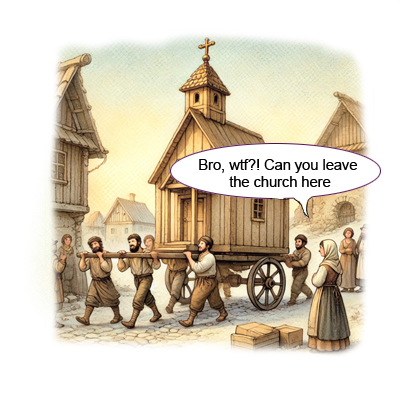
“die Kirche im Dorf lassen”
Literally, it means leaving the church in the village. Like… not taking it elsewhere. But what is the actual meaning of this? And be careful… it’s probably not be what you think ;).
Generic Example:
“Ich glaube, wir sollten die Kirche im Dorf lassen.”
Correct
Incorrect
Hint
Contextual Example:
“Wir machen ALLES neu. ALLES. Die ganze App.” “Ich glaube, wir sollten die Kirche im Dorf lassen und einfach erstmal mit dem arbeiten, was schon da ist.”
“We’ll redo everything. EVERYTHING. The entire App.” “I think ________________________ and first work with what’s already there.”
And? How did it go? Let me know in the comments, how you did and also, how many of those you already knew and if you maybe have them in your mother tongue, as well. And which one was your favorite, actually? Oh and of course you’re welcome to vent your frustration if I managed to throw you off with the questions and started overthinking ;).
Please, please do the quiz again in a couple of days, and try without the hint that time, to see how much has stuck in memory. I hope you had a fun time and found at least one expression that you want to add to your active vocabulary. Have a great week and I’ll see you next time with scary more grammar stuff :)
I have never heard that and I do not understand what it means without more context. I assume it’s something about being in a dangerous spot, but yeah… new expression for me.
Hmm, I went back and checked and it is “es schwebt ein bisschen wie die Wurst vor dem Hund”, It was their version of “a moving target”. I thought it was that you hold a sausage in front of a dog and they will stare at it as it moves, but you pull it away before the can bite it. I’ll be disappointed if this isn’t a thing I can use.
Wow, no, I would not understand what this means in this context without explanation. I would just ignore it, I think. This expression also never came up in lists or when I asked ChatGPT to give me some animal expressions are so.
Very true!! I’ll let you know if it crosses my path in daily life, so you know it’s making the rounds :)
Rextyler
I got 7/7 right! But I did did use the hints. The only one I had previously heard was „die Nase Voll haben“. And I think that is my favorite. I will try the quiz again in a few days without the hints and see if I can remember. Das hat Spaß gemacht! Vielen Dank!
It’s really hard without the hints because I tried finding options that all have some logic to them. So there’s no way to “reason” your way to the correct answer. The no hint option really is more for the recall run, where you already kind of know the meaning but the logical sounding options try to lure you away :)
Lisa
After living in Germany for many years, I am finding out today that “to ex a drink” is a German expression. The immigrants in Germany (including me) use it so often, I tought it was an English phrase.
Oh really?? I now asked ChatGPT and it said that “ex-ing a drink” was indeed a thing. So maybe it does exist in English after all. I wonder where it came from then.
Hajarfaried
I just finished the quiz, got 5\7. I found the hints really useful, I would have probably missed most of the questions if I hadn’t checked them out. My favorite expression is the Extrawurst one as I often “brauche Extrawurste” myself. The links for the quizes 2, 3 and 4 aren’t working though.
I enjoyed this quiz and learned a lot! I’ll be back to test myself and try some of the others – thank you! Alle waren sehr interessant! I like learning the explanation and though it doesn’t always make sense, I can see how trying to figure them out makes it easier to learn (and hopefully retain) new words.
My favorite is probaby, “eine Extrawurst,” mostly because it made me laugh as I am known to be picky or need something different at times.
Could one say to someone, “Du hast ins Schwarze getroffen?”
Sich in die Haare kriegen – in the US, an idiom using hair comes to mind… “Would you get out of my hair?” or, “He wouldn’t get out of my hair.” Meaning, leave me alone or quit being annoying. i have no idea the background on that – lol.
Yeah, you could say “Du hast ins Schwarze getroffen”, though as a direct reply, you’d probably just say a short “Voll ins Schwarze” :).
Frickster
In Amerika, ich habe “a nosefull von etwas” immer gesagt. Es ist ein Ein-Wort-Substantiv. Aber vielleicht habe ich es von meinen deutschen Großeltern, die ihre Redewendungen einfach wörtlich ins Englische übersetzt haben.
Like when you smell something you don’t like. You can also be “in a noseful of trouble,” but I think that one is pretty rare and probably old-fashioned.
“Ich hab die Nase voll” would be like “I’ve had it” or “I’ve had it up to here.”
Anonymous
The Extrawurst one for those of us living in Austria has a slightly different connotation. If I heard Thomas braucht eine Extrawurst the next word in my mind would be Semmel. As Extrawurst here is a beloved Austrian sausage type.
Yes its an actual sausage. Outside of Leberkäse its probably the second most popular. Im not sure if its used as an idiom though. The only wurst based saying or idiom I hear regularly is the popular ‘das ist mir Wurst’
michele
On the hint for ins Schwarze getroffen, it says that is what is wrong with the company. I don’t understand how hitting the nail on the head is a problem for a company. The phrase Nail on the Head to me is getting something exactly correct.
What I meant with the example is that Thomas said something that nailed what the problem is with the company. It’s a bit confusing, for sure, but I hope I could clear it up.
Bob
5/7 on the first pass. The hints were very instructive, otherwise I would have missed more than two. Will try again in a couple of days. This was fun.
ancaju
Cool, thank you Emanuel! I will definitely be using more of these expressions, at least 3 of them, now that I know what they stand for :)
Just one question since genitive makes me crazy lately: isn’t it “wegen des Kaffees” in the Explanation below Question 1? I know there is a tendency to use more and more dative instead of genitive but I think it’s still more on the informal level… ?
Wegen with dativ is standard in spoken german – even Duden agrees with this. In my experience there is a tendency amongst some teachers to encourage german learners too use too much genetiv in spoken german. I rarely if never hear my german native speaker collegues using genetiv when speaking and i’ve never heard a “wegen des”.
That ship has sailed long ago, and some etymologists/grammarians actually doubt it was ever there. Use Dative, unless you’re writing a thesis or a news report. Calling it informal is misleading. Calling it “normal” does it more justice.
pmccann
Cool list of expressions: not too obvious, not too obscure, but also nice and useful. 10/10, would recommend… Well, to be honest, I got about 4/7 first time, with a few sloppy errors. The one I totally stuffed up was “ins Schwarze treffen”, where I associated the “Schwarze” with “die Dunkelheit”, a misinterpretation that was probably reinforced by two sneaky options. In any case, second and third attempts of the quiz both went swimmingly, so I don’t think those phrases are in danger of divorcing themselves from their meanings any time soon.
For “Komm, wir trinken auf ex”, I think “Come on, down the hatch” works pretty well, or even “bottoms up!”. “Chug” sounds pretty (much exclusively) British to me, but it’s entirely possible that I’m simply out of touch with the vocab for such matters. My suggestions might sound completely foreign to others — in matters of drinking I tend to think that “regionality rules the roost” ;-)
ein paar kleinere Korrekturen: ================== developped => developed
(Within the quiz)
drinking on xyzw => (I think these should all be “drinking to”. “drinking on” doesn’t work, at least for me. To be honest “drinking to” isn’t really idiomatic either. I’d probably say “toasting your ex”, but maybe that has too positive a vibe…)
Great post. Funnily enough, I was 4 out of 7 first time through too and I wholeheartedly agree these are useful for my smaller vocabulary. As a midwesterner who then lived 20 years on each coast I’d include “chug” as pretty standard in my US experience. Curiously I see chug as more common and “down the hatch” and “bottoms up” as more upscale and less common.
Aah, thanks for the reply: very interesting (re “chug”, I mean, which I might have run into in American College towns, but simply forgotten about in the interim). The Australian equivalent –which I neglected to mention, but is very widespread– is pronounced “scull”, is very much “unrefined”, and is spelt in all sorts of revealing ways (scull/skull/skol/skoll/…). It seems have come to us via Scots, but there are obvious cognates in (at least) all the Scandy languages, usually meaning “cheers”, or similar.
Hi Emanuel Few days back I posted one comment, can you please take a moment and answer my query. I’ve completed the A1 level in German. For which entire credit goes to this place. So much I learned here – from the blog posts, AI tools, QnA sections all these resources helped me achieve “ein bisschen Deustch sprechen!” I’m stepping to learn ahead. My target is to complete the B1 level by April next year. Can you guide me on how I should approach this goal? I’m facing issue because syllabus is a lot. Grammar is complex and the institution from where I’m pursuing is not really good enough this time. How can I study on my own? I know the basics, but facing challenges in pronunciation, sentence formation, and translation. I’ve got time, but I don’t know how to utilize it for this language skill. Danke dir :)
My recommendation is to learn about 3.000 words, boring brute force learning.
And read a couple of books, and read them out loud to yourself.
This should take up 70% of your time. 15% for writing practice that you can have ChatGPT give you feedback on. You can also ask it to give you translation exercises. And then 15% for looking up grammar topics.
That’s how I would do this, but I never do actual grammar exercises. I just look up the theory and then I’ll see it in the book I am reading or formulate it in my head.
BUt yeah, if you can get yourself to be good at learning words, you’ll have no trouble taking the B1.
Are you familiar with Andre Klein’s “Learning German through German Storytelling” books? Available in Kindle, audible, and print editions, there are various series, including a young Sicilian’s (Dino Lernt Deutsche) life/relationships/employment in and around German-speaking countries, as well as a fantasy trilogy (Aschkalon) and at least five crime “thrillers” of the Baugartner & Momsen series. I’ve found all of them to be very helpful novellas.
Without having looked it up, my guess is that it’s based on a magician making a card appear from their sleeve. Something wasn’t there, and then boom it’s there without effort.
Yes, there is a similar saying in English. He pulled it out of his hat or sleeve. In this case, it referred to how well Martha Washington handled social functions.
Elsa
Hallo, Here are a few typos:
I we learned (we learned) three or four options what the expression could mean (three or four options for what the expression could mean) Explanation in question 4 extra saussage (extra sausage) Explanation in question 6: waiting till you’re seen it (waiting till you’ve seen it ) Explanation in question 7: The phrase a quite common (the phrase is quite common)
l love these quizzes!! Some of the expressions I knew quite well, others not at all… but I got question 6 right and the program marks it as incorrect…
Oh, and how are you getting these mega-cool cartoons? Is it AI?
Wait, question 6, you mean “Wink mit dem Zaunpfahl”? I just checked and it’s marked correctly. Are you sure your answer was “obvious hint” and not “threat”?
Yeah, the pics are AI. It sometimes take a while till it creates what I want, but I’m very happy with this new tool because I’m basically not limited anymore to composing elements I can find online, but can really do the thing I want. And in color. Glad you like them!!
 Hello everyone,
 Audio Speed
 Dark Mode
Just heard in a podcast: “es schwebt sich wie die Wurst vor dem Hund” :)
I have never heard that and I do not understand what it means without more context. I assume it’s something about being in a dangerous spot, but yeah… new expression for me.
Hmm, I went back and checked and it is “es schwebt ein bisschen wie die Wurst vor dem Hund”, It was their version of “a moving target”.
I thought it was that you hold a sausage in front of a dog and they will stare at it as it moves, but you pull it away before the can bite it. I’ll be disappointed if this isn’t a thing I can use.
It is at 9:30 here:
https://www.sueddeutsche.de/politik/podcast-nachrichten-klimakonferenz-baku-trump-klimaschutz-lux.3qdiLVzk9LaH8tURvrXEcU
Of course this is a South German news podcast, and the accent can get a bit thick at times.
Wow, no, I would not understand what this means in this context without explanation. I would just ignore it, I think. This expression also never came up in lists or when I asked ChatGPT to give me some animal expressions are so.
Ignore it?! Or, I could champion it! Redewendung have to come from somewhere.
Very true!! I’ll let you know if it crosses my path in daily life, so you know it’s making the rounds :)
I got 7/7 right! But I did did use the hints. The only one I had previously heard was „die Nase Voll haben“. And I think that is my favorite. I will try the quiz again in a few days without the hints and see if I can remember. Das hat Spaß gemacht! Vielen Dank!
It’s really hard without the hints because I tried finding options that all have some logic to them. So there’s no way to “reason” your way to the correct answer.
The no hint option really is more for the recall run, where you already kind of know the meaning but the logical sounding options try to lure you away :)
After living in Germany for many years, I am finding out today that “to ex a drink” is a German expression. The immigrants in Germany (including me) use it so often, I tought it was an English phrase.
Oh really?? I now asked ChatGPT and it said that “ex-ing a drink” was indeed a thing. So maybe it does exist in English after all. I wonder where it came from then.
I just finished the quiz, got 5\7. I found the hints really useful, I would have probably missed most of the questions if I hadn’t checked them out. My favorite expression is the Extrawurst one as I often “brauche Extrawurste” myself.
The links for the quizes 2, 3 and 4 aren’t working though.
Links are fixed, thank you :)
Found someone in the comments wishing you a happy birthday, so..
Herzlichen Glückwunsch zum Geburtstag, nachträglich! :)
Danke!!
Super fun. Makes one feel like a little bit of a German language insider
Super, freut mich zu hören. Happy to hear that :)
Great fun. I’ve always enjoyed idioms.
“You’re here to form, not perform.” Ich liebe es. Vielen Dank!
Lieber Emmanuel,
Ich wünsche dir einen schönen , glücklichen Geburstag.
Aller Beste .
War am 6. 11., aber merci beaucoup :)!!!
I enjoyed this quiz and learned a lot! I’ll be back to test myself and try some of the others – thank you! Alle waren sehr interessant! I like learning the explanation and though it doesn’t always make sense, I can see how trying to figure them out makes it easier to learn (and hopefully retain) new words.
My favorite is probaby, “eine Extrawurst,” mostly because it made me laugh as I am known to be picky or need something different at times.
Could one say to someone, “Du hast ins Schwarze getroffen?”
Sich in die Haare kriegen – in the US, an idiom using hair comes to mind…
“Would you get out of my hair?” or, “He wouldn’t get out of my hair.” Meaning, leave me alone or quit being annoying. i have no idea the background on that – lol.
Yeah, you could say “Du hast ins Schwarze getroffen”, though as a direct reply, you’d probably just say a short “Voll ins Schwarze” :).
In Amerika, ich habe “a nosefull von etwas” immer gesagt. Es ist ein Ein-Wort-Substantiv. Aber vielleicht habe ich es von meinen deutschen Großeltern, die ihre Redewendungen einfach wörtlich ins Englische übersetzt haben.
Wahrscheinlich :).
Ich habe diese Redewendung noch nie in Englisch gehört.
Ich auch!
I know it as something like this:
Like when you smell something you don’t like. You can also be “in a noseful of trouble,” but I think that one is pretty rare and probably old-fashioned.
“Ich hab die Nase voll” would be like “I’ve had it” or “I’ve had it up to here.”
The Extrawurst one for those of us living in Austria has a slightly different connotation. If I heard Thomas braucht eine Extrawurst the next word in my mind would be Semmel. As Extrawurst here is a beloved Austrian sausage type.
Oh really? Like an actual sausage? That’s interesting! Do you use it in as an idiom at all then?
Yes its an actual sausage. Outside of Leberkäse its probably the second most popular. Im not sure if its used as an idiom though. The only wurst based saying or idiom I hear regularly is the popular ‘das ist mir Wurst’
On the hint for ins Schwarze getroffen, it says that is what is wrong with the company. I don’t understand how hitting the nail on the head is a problem for a company. The phrase Nail on the Head to me is getting something exactly correct.
What I meant with the example is that Thomas said something that nailed what the problem is with the company.
It’s a bit confusing, for sure, but I hope I could clear it up.
5/7 on the first pass. The hints were very instructive, otherwise I would have missed more than two. Will try again in a couple of days. This was fun.
Cool, thank you Emanuel! I will definitely be using more of these expressions, at least 3 of them, now that I know what they stand for :)
Just one question since genitive makes me crazy lately: isn’t it “wegen des Kaffees” in the Explanation below Question 1? I know there is a tendency to use more and more dative instead of genitive but I think it’s still more on the informal level… ?
Wegen with dativ is standard in spoken german – even Duden agrees with this. In my experience there is a tendency amongst some teachers to encourage german learners too use too much genetiv in spoken german. I rarely if never hear my german native speaker collegues using genetiv when speaking and i’ve never heard a “wegen des”.
Spittin’ facts right here!
That ship has sailed long ago, and some etymologists/grammarians actually doubt it was ever there.
Use Dative, unless you’re writing a thesis or a news report. Calling it informal is misleading. Calling it “normal” does it more justice.
Cool list of expressions: not too obvious, not too obscure, but also nice and useful. 10/10, would recommend… Well, to be honest, I got about 4/7 first time, with a few sloppy errors. The one I totally stuffed up was “ins Schwarze treffen”, where I associated the “Schwarze” with “die Dunkelheit”, a misinterpretation that was probably reinforced by two sneaky options. In any case, second and third attempts of the quiz both went swimmingly, so I don’t think those phrases are in danger of divorcing themselves from their meanings any time soon.
For “Komm, wir trinken auf ex”, I think “Come on, down the hatch” works pretty well, or even “bottoms up!”. “Chug” sounds pretty (much exclusively) British to me, but it’s entirely possible that I’m simply out of touch with the vocab for such matters. My suggestions might sound completely foreign to others — in matters of drinking I tend to think that “regionality rules the roost” ;-)
ein paar kleinere Korrekturen:
==================
developped => developed
(Within the quiz)
drinking on xyzw => (I think these should all be “drinking to”. “drinking on” doesn’t work, at least for me. To be honest “drinking to” isn’t really idiomatic either. I’d probably say “toasting your ex”, but maybe that has too positive a vibe…)
prezel => pretzel
muccus => mucus
Great post. Funnily enough, I was 4 out of 7 first time through too and I wholeheartedly agree these are useful for my smaller vocabulary. As a midwesterner who then lived 20 years on each coast I’d include “chug” as pretty standard in my US experience. Curiously I see chug as more common and “down the hatch” and “bottoms up” as more upscale and less common.
Aah, thanks for the reply: very interesting (re “chug”, I mean, which I might have run into in American College towns, but simply forgotten about in the interim). The Australian equivalent –which I neglected to mention, but is very widespread– is pronounced “scull”, is very much “unrefined”, and is spelt in all sorts of revealing ways (scull/skull/skol/skoll/…). It seems have come to us via Scots, but there are obvious cognates in (at least) all the Scandy languages, usually meaning “cheers”, or similar.
That makes sense: Skol is Swedish for ‘Cheers’
I thought of ‘Down the hatch’ as well!
Hi Emanuel
Few days back I posted one comment, can you please take a moment and answer my query.
I’ve completed the A1 level in German. For which entire credit goes to this place. So much I learned here – from the blog posts, AI tools, QnA sections all these resources helped me achieve “ein bisschen Deustch sprechen!”
I’m stepping to learn ahead. My target is to complete the B1 level by April next year. Can you guide me on how I should approach this goal?
I’m facing issue because syllabus is a lot. Grammar is complex and the institution from where I’m pursuing is not really good enough this time.
How can I study on my own? I know the basics, but facing challenges in pronunciation, sentence formation, and translation. I’ve got time, but I don’t know how to utilize it for this language skill.
Danke dir :)
My recommendation is to learn about 3.000 words, boring brute force learning.
And read a couple of books, and read them out loud to yourself.
This should take up 70% of your time.
15% for writing practice that you can have ChatGPT give you feedback on. You can also ask it to give you translation exercises.
And then 15% for looking up grammar topics.
That’s how I would do this, but I never do actual grammar exercises. I just look up the theory and then I’ll see it in the book I am reading or formulate it in my head.
BUt yeah, if you can get yourself to be good at learning words, you’ll have no trouble taking the B1.
Got it. I will let you know how it goes :)
Can you recommend which books I should read, and which site or app is best for pronunciation practice?
Are you familiar with Andre Klein’s “Learning German through German Storytelling” books? Available in Kindle, audible, and print editions, there are various series, including a young Sicilian’s (Dino Lernt Deutsche) life/relationships/employment in and around German-speaking countries, as well as a fantasy trilogy (Aschkalon) and at least five crime “thrillers” of the Baugartner & Momsen series. I’ve found all of them to be very helpful novellas.
Viel Glück!
I’ve just checked online about all these books. Sounds ideal to start with!
Tausend Danke
Oh ich habe gerade ein Neues gehört,
“Sie schüttelt es aus dem Ärmel”
Was? Hattet sie eine Maus oder Laus dort?
(Ja ich weiß schon was es bedeutet)
Without having looked it up, my guess is that it’s based on a magician making a card appear from their sleeve. Something wasn’t there, and then boom it’s there without effort.
Yes, there is a similar saying in English. He pulled it out of his hat or sleeve. In this case, it referred to how well Martha Washington handled social functions.
Hallo,
Here are a few typos:
I we learned (we learned)
three or four options what the expression could mean (three or four options for what the expression could mean)
Explanation in question 4 extra saussage (extra sausage)
Explanation in question 6: waiting till you’re seen it (waiting till you’ve seen it )
Explanation in question 7: The phrase a quite common (the phrase is quite common)
l love these quizzes!! Some of the expressions I knew quite well, others not at all… but I got question 6 right and the program marks it as incorrect…
Oh, and how are you getting these mega-cool cartoons? Is it AI?
Bis bald!
Wait, question 6, you mean “Wink mit dem Zaunpfahl”? I just checked and it’s marked correctly. Are you sure your answer was “obvious hint” and not “threat”?
Yeah, the pics are AI. It sometimes take a while till it creates what I want, but I’m very happy with this new tool because I’m basically not limited anymore to composing elements I can find online, but can really do the thing I want. And in color.
Glad you like them!!
I’ve just redone the quiz and there was no problem… so it was either a glitch or I clicked the wrong button (most likely) :))
“auf ex” and “extra-wurst” are the two where I had to read the hint. Apparently I don’t hang out with enough people who slam their gluten free beers
LOL yeah, “auf ex” has been on a steady decline over the decades.