***
Hello everyone,
And welcome to your German Word of the Day.
This time, with a look at the meaning of
fremd
And of course we’ll not just look at the word itself but also explore its family a bit because there are some real vocabulary nuggets to be found.
But let’s start with fremd itself.
***
The core Idea of “fremd”
If you look up fremd in a dictionary, you’ll get foreign and alien as translations; and maybe also unknown or strange.
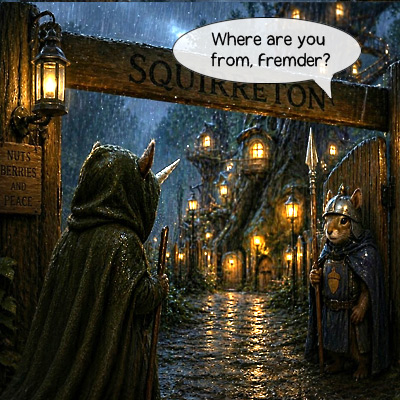
And they’re not wrong, but I think it’s worth understanding the actual “soul” of fremd, and the best way to do that is to think of a small town hundreds of years ago.
Imagine you’re having guard duty at the gate. All afternoon, just familiar faces, villagers from the valley, townspeople, a couple of merchants from the South who come through all the time.
But then, after nightfall, through heavy rain a person approaches that you’ve never seen before. This person is fremd.
In English, you’d call them a stranger, but not because they’re acting “so strange”. It’s the old sense of the word strange which is ultimately a relative of external and simply meant someone from outside, not “from here”.
That’s the core of fremd.
And guess which English word fremd is actually related to?
It’s from.
They both belong to same family as fahren and to fare so they’re about travelling or going places.
And German fremd has focused on the notion of “unfamiliar” mixed with a certain sense of “your” vs “other”.
And nationality or countries don’t really matter. A person from your country or city can still be a fremde person.
- Mit fremden Leuten nackt in der Sauna sitzen? Kein Problem in Deutschland.
- Sitting naked in Sauna with people you don’t know? No problem in Germany.
You wouldn’t use foreign or alien here.
The core point is that the people are not “from your figurative village”. There’s “mental distancing”. You and “the other”
This distance-notion is important to fremd.
Suppose a friend has a friend you don’t know. You wouldn’t call that person fremd. Yes, you don’t know them, but it’s kind of a person from your figurative village.
You don’t want to stress “distance” here. Or take this example:
- ein fremdes Bier
If you strictly go by the dictionary, you might think that this means foreign beer. Like… from a different country. But what it’s usually understood as is actually
- beer that’s not mine (and not my friends’)
You know what beer is, and if you just wanted to talk about a type you don’t know yet, you’d say unbekannt or neu.
The vibe of distance that fremd carries matches much better onto a “my beer” or “our beer” vs beer of the “other”.
Anyway, I feel like I’m starting to talk in circles without adding much clarity.
I hope these images opened up a kind of a “vibe space” for fremd.
But now let’s see it in action.
- Lass keine Fremden in die Wohnung okay?
- Don’t let people you do not know into the apartment, okay?
- Mein Hund hat Angst vor fremden Hunden.
- My dog is scared of dogs it doesn’t know.
What’s also useful is the phrase jemandem fremd sein which means that something is “foreign” to someone – be it in the sense that you legit don’t know it or in the sense that you do know the concept but it’s not part of “you”.
- Alle Lügner: “Lügen ist mir fremd.”
- All liars: “Lying is not who I am.”
You can also add fremd at the end of nouns, to create an adjective that expresses distance or “not belonging”. This usually sounds a bit formal, but you’ll definitely see it in written German.
- Betriebsfremden ist der Zutritt verboten.
- Entry is prohibited to people not affiliated with the business.
- Diese Politik ist weltfremd/lebensfremd.
- This policies are out of touch with the world/life.
And then, there are loads of nouns with Fremd- or Fremden- at the beginning:
- der Fremdkörper – the foreign object (in your body)
- das Fremdkapital – the outside capital (doesn’t need to be foreign)
- der Fremdenhass – the hatred of foreigners, the extreme xenophobia
- der Fremdenführer – the tourist guide (old fashioned)
and of course
- die Fremdsprache – the foreign language
You can see how broad he word actually is. Thinking of it as just foreign would be narrow. But I think with the core idea I tried to flesh out, you should be able to understand nouns like these when you see them in context.
But nouns are not the only relatives. There are also verbs, and those are really really cool.
Useful Words with “fremd”
Let’s start with the verb fremdgehen.
fremdgehen
Taken literally, it would be something like “go foreign” but the real meaning is hard to guess, even when you see it in a sentence.
- Thomas ist fremdgegangen.
Could be all kinds of things, right?
Well, let me add some more context.
- Maria hat Schluss gemacht, weil Thomas fremdgegangen ist.
- Maria ended the relationship because Thomas ____________ .
Do you have a guess yet :)?
I’ll solve it now.
fremdgehen means to cheat, specifically in the sense of cheating on your partner with another person.
- Ist Küssen schon Fremdgehen?
- Is kissing already cheating?
This is definitely a must-know term for you when you’re in a relationship with a German speaker. Because Germany is basically one big polycule dressed as a country.
Come on… don’t be so surprised. Naked Germans on the beach, naked Germans in the hotel spa, naked Germans everywhere. What did you expect.
Okay, I’m kidding of course. German speakers don’t cheat any more than other speakers, I guess. But it is a really good word to know. You can also use betrügen, which would be the more general to cheat, but fremdgehen is more common.
All right, next verb.
fremdschämen
sich schämen is the word that describes feeling embarrassed. When you audibly pass gas in an elevator for example.
And fremdschämen is if you feel that feeling just by watching someone else do something.
Like… imagine you’re at a bar with your friends, there’s a young waitress, and then on the table next to you, a 50 year old over-wheight guy is trying to “flirt” with her by trying to use some gen-Z slang but it’s all so unnatural that you feel physically uncomfortable.
The feeling is quite similar to what you feel when something is “cringe”, but the structure is totally different, and the better translation is “feel second hand embarrassment”.
- Ich habe mich unglaublich fremdgeschämt.
- I felt soooo much second hand embarrassment.
- Das war zum Fremdschämen.
- That was cringe.
Not super common but definitely nice to have and it’ll make you sound very native speaker like if you use it at the right moment.
And the same goes for the next one.
fremdeln
This is kind of a niche word but if you use this correctly, you’ll have a “native speaker moment”. Like… people do NOT expect learners to use this one pretty much EVER, so I’m almost certain you’d get a “Wow, why do you know this word.”
fremdeln, or fremdeln mit I should say because it almost always goes with mit… so fremdeln mit means that you do not vibe with something, or you feel estranged even though you don’t want to or try not to.
It’s hard for me to translate, so I might be off, but I hope the examples help make it clearer.
- Ich fremdele mit der Deutschen Küche.
- I’m feeling at odds/don’t vibe with the German cuisine.
- Seit ein paar Jahren fremdele ich mit meiner Kirche.
- For a few years, I’ve been starting to feel a little estranged by my congregation.
Maybe think of a cat walking around a piece of cheese that you smeared chili sauce on top of. The cat is like “I should like this, but what is this?! This is weird.”.
This is a visual that at least to me fits the vibe of fremdeln well.
Like I said, it’s not a super common word. Actually, I can’t even call it common. But if you drop it at the right moment, people will be legitimately impressed.
Cool.
Now, of course there are yet more related words in the family. Like zweckentfremden for instance which means using something for a different purpose than what it was made for. Like… using book as a door stopper for example.
But I think we’ve done enough for one session. Going on now would just be stuffing ourselves with info we can’t retain anyway, so instead, let’s just call it a day :)
So yeah, this was our look at fremd and its relatives, and the core sense that we could maybe sum up as “Not from my tribe”.
Now, usually this would be the place where I say that you can take my little quiz if you want to recap things a little bit. And I might add one later, but first, I want to introduce a new type of recap to you: Text Comprehension. I’ll explain is in a second :)
But yeah, if you have any questions or suggestions just leave me a comment.
***
And now, let’s get to my new feature!
New Practice Feature
Many of my articles go over a whole bunch of vocabulary, and together we explore what things mean and why and how they relate to each other and most importantly, how they’re used.
That’s nice, but it’s not very active. So far, actually learning vocabulary and studying it was up to you.
That’s about to change!
The most important addition probably will be flashcards for the lesson, which you can download OR just practice directly here. That’s a bit more work still though.
But the other tool is pretty much finished and it’ll premier today.
Like… right now.
Text Comprehension Based on The Vocab
This was actually a suggestion of one of you readers and it’s such an amazing idea!
Basically, I have made a tool that lets you create a text comprehension exercise based on the vocabulary we discussed in the article here.
You can select difficulty and lengths and you’ll get a little text along with a few comprehension questions for the text. Kind of like in a real exam, but the text uses specifically the vocab we learned today, so you get to see it in context.
You can also get an optional translation, add a timer if you want to make a more realistic exam simulation and you can get audio. You have to be a proper member to use all these features though.
Anyway, I’m planning to add this to all articles, but I want to try it out here first and make sure everything works properly.
So yeah, check it out and let me know what you think :).
Text Comprehension with “fremd” and its family
***
What's your level?
Sets how challenging the text and vocabulary will be. B2 and C1 are members-only levels.
***

 Audio Speed
 Dark Mode
The Text Comprehension Exercise at the end does not work
Give me some details please.
Nevermind it works now. It gave me an error before after generating. Thanks
Oh okay :)
Ich denke das Übungszeug hat fantastich Potenzial. Vielen Dank für die Erstellung.
Freut mich, dass es dir gefaellt!
Great article as usual :)
> der Fremdkörper – the foreign object (in your body)
This is a great example to have included because the use of the word “foreign” here in English is also different than the usual meaning. It communicates not-belonging-ness more than of-different-nationality.
Mir gefällt sehr das Übungszeug!
The text comprehension tool is fantastic! Thank you!
Your Text Comprehension tool is excellent! Thank you!!
I’ve been away from the site because of B2 exams. And this new upgrade is so useful. more of an active learning tool.
Hast du bestanden?
Das Ergebnis kommt im Juli… too much anticipation about it :)
Hast du ein Gefuehl?
Ja, ich denke, dass ich es gut gemacht habe. sehr höflich. Jetzt suche ich eine Stelle, wo ich meine Deutschkenntnisse anwenden kann.
Wish me luck and any advice that you can share, it always helps!!
Thanks for the new text comprehension tool, Ema! I particularly like the flexibility and ease of use of this tool. Very creative!
Glad you like it!!
Wow! Gut gemacht. Gute Ergänzung
Hello leute. Vieleeeeen danken. Thank you Emanuel and all people who helped us to join this awesome community by their support. I too joined for a year with your generous helps and I appreciate it. THANK YOU
Thank you Emanuel and members of the community. Thanks to your contributions I was signed up for a free membership for a year. I appreciate everyone here!
Ich mag es sehr. Danke für deine Arbeit!
Toll, perfekt and any other superlatives you can think of. Very useful and user friendly.
Any reading practice is welcome and especially if it is connected to learning or practicing new vocabulary.
Yeah, practicing the vocab you read about was a huge gap on my site, but I’ll close that now.
Text Comprehension is a super cool tool – really makes you engage with the language and text on a deeper level.
das Thema war toll. Es freut mich riesig. Vielen Dank. Die Prüfung gefällt mir. Du bist der Bester.
“der Beste”.. only one gender marker. If the article has it, the adjective is free.
Ahhhh, I think this was my suggestion?? I LOVE the new tool!! It’s exactly what I was thinking! I selected C1, which is what I technically am (according to the DSD-2, haha), but I will def kick it down to B2 because I feel that will be more conducive to learning new vocab. I hope people like and use the new tool, and that it’s not too much extra work for you??
Yeah, that was just such a great idea, it as a bit of work, but absolutely worth it.
The cool thing is that the texts themselves are made by AI so I can add that to every article on the site easily, so you’ll soon have this feature available all the time.
Thanks again for suggesting this, it’s a really really nice addition!!
‘fremd’ is a great choice for Word of the Day and the practice feature is very much appreciated.
Love the text generator… can questions in German be an option?
They should be in German for the higher levels. Which level did you try?
Hello, let’s correct a few typos:
“over wheight” (overweight)
“second hand” (second-hand; you have it twice)
“I’ll explain is in a second” (I’ll explain it in a second)
I knew the word “fremd” and its meaning, but the two last words were totally “fremd” to me :)
Bis bald!