Hello everyone,
And welcome to a new episode of Prefix Verbs Explained, today, with a look at the meaning of
aufhaben
Which at least in my opinion is an A1 verb.
So it’s a nice one to learn very early on, not only because it’s pretty easy to use and you can practice the whole prefix verb stuff. It’s also very useful and it’s one of those verbs that just sounds super natural and authentic but that you wouldn’t necessarily pick up if you follow a normal textbook or that Green Owl of Stagnation.
And because we always also talk about what I call The Versions™ in these episodes, we’ll also get to know draufhaben, which is a REALLY nice colloquial gem.
Anyway, if you’re ready to dive in, let’s go!
And I actually want to start with a quick look at the prefix itself.
The Prefix “auf” in a Nutshell
The prefix auf has two ideas that it can add to a verb. One is the “local” or “spatial” sense of upward, on top and the other is open.
Seems a bit random at first, but the words up, auf, open and offen actually are all related. And the connection makes a lot of sense if we look a little bit closer.
Imagine you’re in nature and there’s a cave. And now think of standing on top of the cave and standing inside of the cave. When you’re inside, you’re somewhat safe and separated from wind and weather. But when you’re on top of the cave, you’re in the open and you’re exposed to rain and wind and whatever. Can you see the connection of being “on top” and being “open”?
And if that is a bit too abstract, just think of our eyes. To open them, we move the upper eyelid upward. When it’s up, at the top, it’s open.
So yeah, the prefix auf has these two ideas upward/on top and open, and both of them are “expressed” in aufhaben and its meanings.
The meanings of “aufhaben”
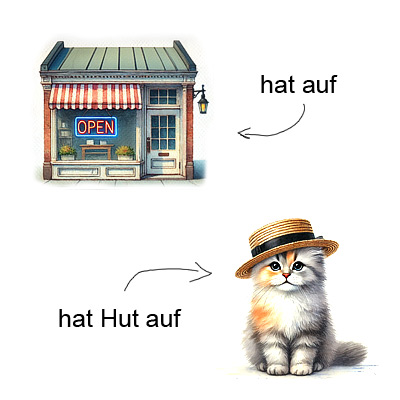
The first one is to wear but ONLY in the sense of having something ON TOP of you, on your head. Like a hat, a hood, a helmet, a pair of glasses or a headset.
- Ich habe Kopfhörer auf.
- I’m wearing headphones.
(NOT the best for earbuds, that would be “drinhaben”)
- Practice pronunciation – click once to start recording and again to stop
- Gut, dass ich einen Helm aufhatte.
- Good thing I had a helmet on/ was wearing a helmet.
- Practice pronunciation – click once to start recording and again to stop
“So, can we just think of aufhaben is like to have on basically?”
Well, no.
You can have on a pair of jeans, but that would be anhaben, not aufhaben in German.
And the same goes for having on some music in the background or having the heater on.
Those are anhaben as well.
For aufhaben, the focus is really on “on top” in a vertical sense.
Well, with the one exception being a backpack.
- Ich habe einen Rucksack auf.
- I’m wearing a backpack.
- Practice pronunciation – click once to start recording and again to stop
But if you think of a really heavy backpack that makes you bend forward, then it’s kind of actually “on top” of you again.
Cool.
So this meaning alone already makes aufhaben quite useful and I’d even say it’s a must have for beginners.
But the second one, the one based on the idea of open, might be even more useful in daily life.
You can use it like having open in English, for a window for example.
- “Ich habe einen Waschbär im Zimmer!”
“Ja, keine Wunder, wenn du den ganzen Tag das Fenster aufhast.” - “I have a raccoon in my room.”
“Yeah, no wonder if you have the window open all day.” - Practice pronunciation – click once to start recording and again to stop
But beyond that, German also uses it for to be open, in the context of stores being open.
- Bis wann habt ihr heute auf?
- Till what time are you open today?
- Practice pronunciation – click once to start recording and again to stop
- Der Supermarkt hat immer bis Mitternacht auf.
- The supermarket is always open till midnight.
- Practice pronunciation – click once to start recording and again to stop
- Was mich an dieser Stadt nervt, ist, dass nach um 10 nix aufhat.
- What annoys me about this town is that nothing is open after 10.
- Practice pronunciation – click once to start recording and again to stop
Could we also use auf sein? Yes, that works too. There’s no real difference, so it depends on the speaker. I use aufhaben way more, others might prefer auf sein.
But you’ll definitely hear aufhaben a lot, and I would recommend you add it to your active vocabulary because it sounds super natural and authentic.
Oh and you can add the opposite zuhaben as well.
- “Der Supermarkt hat zu.”
“Bless you! What’s with the supermarket?” - Practice pronunciation – click once to start recording and again to stop
Get it? I… I tried to do a pun but everyone is just looking at me confused. Is it because of the explanation?
I’m not sure, maybe it wasn’t clear.
“Explanation is fine. It’s the pun…”
I meant that hat zu sounds bit like the English atchoo.
“Yeah, yeah it’s just not funny. Let’s just move on, okay?”
Uhm… sure!
So wearing for stuff like hats, hoods or glasses and being open for stores. Those are the two main meanings of aufhaben.
There is a third use for having homework…
- “Mom, ich geh raus spielen.”
“Hast du keine Hausaufgaben auf?” - “Mom, I’ll go outside to play.”
“Don’t you have homework ?” - Practice pronunciation – click once to start recording and again to stop
but that really only applies to actual SCHOOL homework and the broader sense of it. And haben alone also works, so I’d say let’s put this to our passive vocabulary.
Cool.
So now we know the meanings of aufhaben itself.
But of course, with prefix verbs, that not the full story. Because there are also… The Versions™.
raufhaben and draufhaben
Often when we have both, a r-version (raufhaben) and a dr-version (draufhaben), they mean more or less the same thing. or at least similar things.
But sometimes, one of the versions has taken on a life of its own, and that is the case here.
Let’s start with raufhaben because that’s the less useful one.
This is pretty much a typical r-version. Prefix verb veterans will now be like “Yup, I know what that means.” but if that’s not you, don’t worry, it’s something that’ll come up again and again here, especially in my lessons on prefix verbs, so you’ll pick it up over time. I’ll also link my lessons about it below, if you really want to dig in.
Typical r-version means that it carries the most straight-forward, literal, directional meaning that you can create from the prefix and the verb.
That just sounded SUPER complicated, but it’s way more clear with an example.
- Kann ich Chili-Soße raufhaben?
- Can I have chili sauce on top of it?
- Practice pronunciation – click once to start recording and again to stop
Can you see what I mean?
I am asking if I can have chili sauce “go on top” of whatever I’m eating… like a burger or fries or whatever. It’s super literal, not abstract at all, and it’s about “location”.
So this is what I mean when I say “typical r-version”.
Do you need raufhaben in particular? Well, for this one particular context, getting some sort of topping, it’s one of the best options, but I wouldn’t really create a flashcard for it. You see, the cool thing with these r-versions is that once you understand the logic at play, you can pretty much just make them up as you go. No need to treat them as a real word.
What IS probably worth a flashcard is draufhaben. Usually, the dr-version is very similar to the r-version with the one big difference that the dr-version sounds stationary, while the r-version sounds has a sense of direction.
However, draufhaben has evolved into an actual colloquial verb that expresses the idea of being good at something.
The exact translation depends on the context, but this is the core idea.
- Thomas hat es echt drauf, Maria sauer zu machen.
- Thomas has a real knack for/is really good at making Maria angry.
- Practice pronunciation – click once to start recording and again to stop
- “Hast du Marias Zaubershow bei der Firmenparty gesehen?
“Ja, sie hat es echt drauf.” - “Have you seen Maria’s magica show at the company party?”
“Yeah, she’s really good.”
Now, some of you probably noticed that I used es and echt in both examples and are now wondering if we can skip them.
And the answer is:Not really, but!
The echt is just an intensifier, but the verb draufhaben is usually used in contexts where you talk about someone being REALLY good at something, so it just feels natural to have it there. But you can also find other intensifiers like voll or total or krass.
And the es… well, the thing is that draufhaben really likes to have a direct object along with it. And so whenever the thing you’re good at is a verb, you’ll have that little es there as a placeholder object.
- Ich habe es echt krass drauf, meinen Schlüssel zu verlieren.
- I‘m really really good at losing my keys.
- Practice pronunciation – click once to start recording and again to stop
You can also use draufhaben with nouns, but that’s less common and can sound weird.
- Ich habe Mathe drauf.
This sounds a bit odd to me and I would not use that if I want to say that I’m good at math. I’d just say “Ich bin gut in Mathe.”
Actually, I’d say draufhaben with a noun leans a lot more toward having fully “learned” a topic.
- “Hast du deinen Text drauf?”
“Nee, noch nicht ganz.” - “Do you know the text by heart?”
“No, not completely yet.”
(one actor asking another) - Practice pronunciation – click once to start recording and again to stop
You can think of this as having the text on your hard-drive, if you will. Which actually kind of gives the whole meaning of the verb some logic.
But of course the verb is way older than hard-drives. Maybe it evolved from a waiter or servant carrying a tray with stuff. Like… whatever you have on your tray is what you can offer. It’s not know for sure where it comes from, but that would at least make sense.
But anyway, I think I actually hyped draufhaben up quite a bit, so let me add a little disclaimer here, before we wrap it up for today. The verb is quite colloquial and I feel like it’s mainly used in contexts where you express some emotion. Either when you’re really impressed or you’re being sarcastic or ironic.
It is NOT the best choice if you just talk about what you’re good at. For those, either können or gut sein in are the better options.
So yeah… maybe wait till you’ve seen draufhaben a few times in daily life before you use it.
Anyway, I think that’s enough for today.
As always, if you want to check how much you remember, just take the little quiz I have prepared for you.
And of course, if you have any questions or suggestions, just leave me a comment.
I hope you liked it, have a great day and see you next time.
further reading:

 Audio Speed
 Dark Mode
One per week for free, is this true? But I just open the website this week for sure the first time, but I can’t read the content. Or did I understand this wrong? ;-)
It’s one per 7 days, so if you’ve opened it last week on Thursday and now it’s a new week Monday, it’s still blocked. I’m thinking to move the cap back to two per week.
In Bayern träumt man von einer Welt, in der irgendwas bis um 10 noch aufhat :(
Hahaha, ja, das dachte ich auch, als ich mal da war.
I agree with people below — it feels like draufhaben leans towards having +down+ a skill in English. Guitar player=„Man, that dude has that part/lick/phrase DOWN!“ Even leaning to the term „down pat“ — and of course one pats someone or something ON the head.
Hallo, big thanks to sponsors for supporting learners who can’t afford memberships. I’ll stay dedicated and keep learning german.
Hallo,
only one typo:
“It’s not know for sure” (It’s not known for sure)
Thanks, even more advanced learners need a recap every now and then ;)
Bis bald!
I love Your daily German. I am only a beginner but I need something with more personality than the green bird!
Thanks for the article. Does it work for museums, galleries and other places like that being open, or only stores?
All kinds of places that have opening hours :)
“Green Owl of Stagnation” this is so good.
The pun with “zu” was great as well. Always a pleasure to read you :)
Thanks a lot! And everyone reading this, please do check out Clement’s German practice webapp:
https://www.sieversstudyhall.com/
It’s free and it’s got loads of exercises for the usual suspect topics. Perfect to grind out some practice.
(Sorry to hijack your comment to plug your stuff, but I wanted to give it another shoutout for a while now)
I connect draufhaben with “on top of it” or “on the ball”. Like “Maria is new here, but her work is top notch, she’s really on the ball”. “Did you finish that project” “not yet but I’m on top of it”.
So, successfully doing something challenging, like walking on a ball.
Just to make sure: the second example (Finish the project) would NOT work with “draufhaben” at all. It’s not about success or how well you’re doing with a task. It’s a statement about your skill.
You can be not very good at something and still do well with a task.
I know it doesn’t work grammatically, it is more of a spiritual connection.
But how can you do something well if you can’t do the thing well? If it is just luck, that’s not being on top of it, that’s lucking out.
You can get far with diligent work without having a special talent for it or having hone the skill. For instance, you don’t have to be a super skilled wall painter to do a really good paint job, if you put the work in.
If you then do that multiple times in a row, people would to consider it one of your skills and then say that “Du hast das drauf.”
Sometimes we even use the idiom “Am Ball bleiben”, probably a calque from English. Then again, there’s always “Auf Draht sein”
I don’t know if my previous comment posted because I realized I wasn’t logged in! I just wanted to quickly say thank you to everyone who sponsors language learners that can’t afford this site themselves. I’ve been really having a lot of fun on here and I find the information very valuable, so thank you so much.
Side note: If anyone has a recommended study plan, I’d be so grateful! I’m about two weeks in on my language journey, and I’m hitting a wall. I’m not used to self-studying, so all this new information feels like a lot, and I don’t know where to go from here. I study two hours a day, and I simply don’t know what topics to approach anymore. I hope that makes sense!
My advice for you is to stop learning more grammar and instead just study vocabulary for an hour or two a day for a few weeks. Continuously mix in new words.
And then start reading and writing. Write a few sentences, then read them the next day as if it’s an “find the error” style of task. I think you’ve got enough grammar for now.
I will try this advice too! It’s true, vocab is really needed… I also like the idea of turning yesterday’s writing into more material to work with.
Grammar’s an abstraction anyhow! Most important is vocabulary acquisition. Grammar or structure is the house,
vocabulary/words are the furniture. Tough to live in a house without furniture:-)
Hmm, interesting analogy :). I would argue that you can live in a house without furniture quite well, but it’s not so nice to have a bunch of furniture but be outside without a roof.
Maybe we could modify this a bit and say that grammar is like the schematics of the house, the building plan. And the vocabulary is the material – timber and brick.
If you have the perfect plan, but no material, you have no house. But if you have all the material, and just a vague idea of the plan, you can at least put up some sort of shelter with a roof and then slowly improve it.
What do you think?
I only meant that a house bereft of furnishings is a lonely one indeed, no matter how solid the exterior foundation.
Many of my students think they can speak a language, in this case German, by memorizing grammar rules, only to find themselves unable to communicate effectively as they have no words to fit into the structure-:)
It seems to me that this would be a pretty good chapter all by itself.
Hoppla, Fehler!
Die Tuer ist auf.
‘TschuldigungLOL
Die Tuer hat auf = The door is open
Der Mann hat nichts auf! = The man’s naked!
Just to make sure:
– Der Mann hat nichts auf.
This does NOT mean “The man is naked.” . You could say that the “Kopf” is naked, but not the man.
Nice point, Emanuel! I see I got a little ahead of myself here.
No excuse though for a native speaker making mistakes:-)
The key is sometimes faster than the brain.
Emanuel hat was auf dem Kasten
Kannste laut sagen! Ein erfolgreicher Sprachpaedagoge hat immer was auf dem Kasten:-)